Amber Fort, Jaipur: Where stone remembers power (#514)
Updated: Feb 2
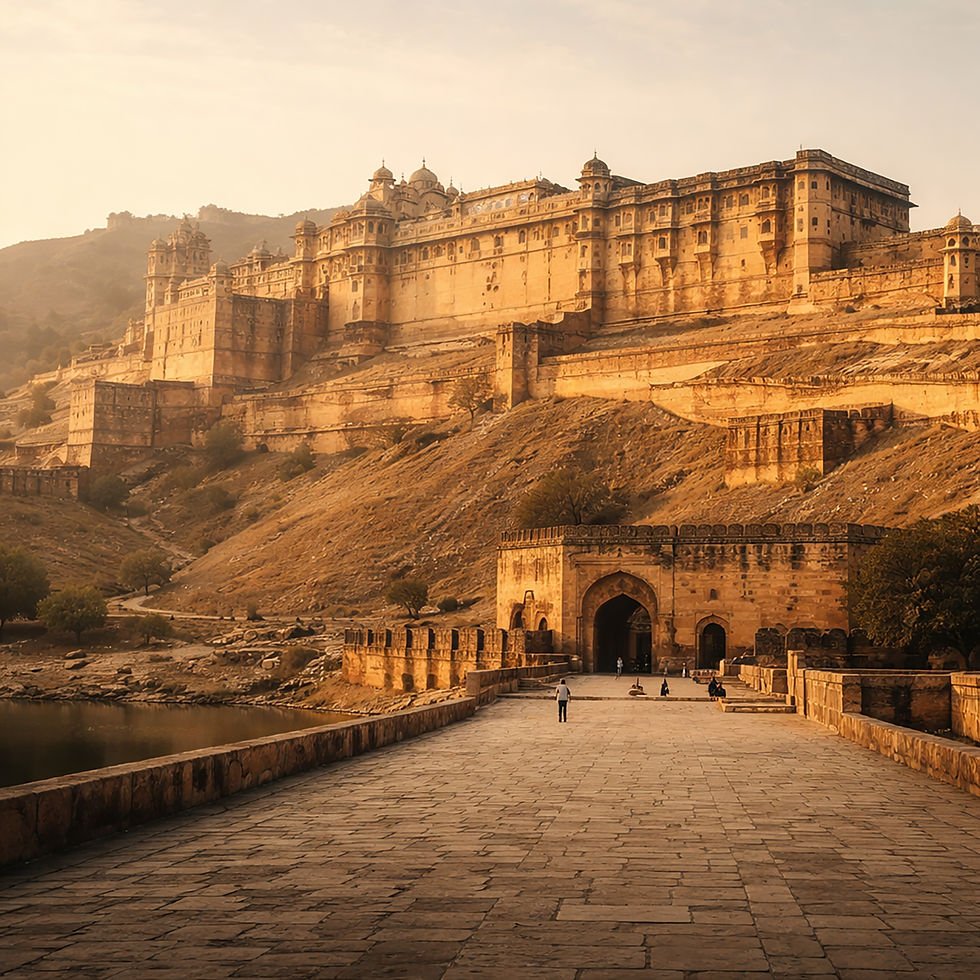
The first thing you notice about Amber Fort is not its size, or even its beauty.
It’s the way it rises.
High above the dusty plains outside Jaipur, the fort appears to grow directly out of the hillside.
Honey-colored stone stacked with purpose, confidence, and the quiet authority of centuries.
From a distance, it feels less like a monument than a presence. Something that has always been there. Something that remembers.
The road up to Amber winds slowly, climbing past elephant rides, vendors selling bangles and scarves, and tourists pausing to photograph the façade from every conceivable angle.
But once you pass through the gates, the noise thins. The air changes. And suddenly you are inside history.
A Fortress Built for Power
Amber Fort, also known as Amer Fort, was begun in 1592 by Raja Man Singh I, one of the most trusted generals of the Mughal emperor, Akbar.
Long before Jaipur became the capital of Rajasthan, Amber was the seat of the Kachwaha Rajputs, a warrior clan that learned how to survive by balancing loyalty, diplomacy, and force.
The fort is not a single structure but a complex: courtyards within courtyards, gates leading to gates, corridors that seem designed to confuse outsiders and protect those within.
This was not merely a palace. It was a strategic stronghold, a place where military precision and royal life overlapped seamlessly.

What is immediately evident is the blending of Hindu and Mughal architecture.
Red sandstone and pale marble. Carved lotus motifs beside Islamic arches.
The result is neither austere nor flamboyant, but assured. Confident. A physical expression of power that did not need to shout.
The Light in the Mirror Palace
Inside the fort lies the Sheesh Mahal - the Mirror Palace - and it stops you in your tracks.
The walls and ceilings are inlaid with thousands of tiny mirror fragments, each angled to catch even the faintest light.
Legend has it that a single candle could illuminate the entire chamber.
Standing there, even in daylight, you understand the intention: not excess, but enchantment.
This was a place designed to impress, to soothe, to remind visitors of the ruler’s wealth and sophistication. And yet there’s something intimate about it too. You can imagine evenings here. Lamplight flickering, voices low, the quiet politics of court life unfolding behind silken curtains.
It’s easy to forget that behind this beauty was a rigid hierarchy. Power lived here. Decisions were made here that shaped lives far beyond the fort’s walls.
Water, Women, and the Architecture of Survival
One of the most striking features of Amber Fort is its relationship with water. Stepwells, channels, reservoirs—everything was engineered to collect and conserve it. In a desert landscape, water was power.

The Zenana, or women’s quarters, reveals another layer of life within the fort. The rooms are arranged so that each queen or consort had identical quarters, connected by hidden corridors. The king could move between them unseen. Equality of space, perhaps, but not of agency.
It’s impossible to walk these halls without thinking about the lives lived quietly here. The routines. The rivalries. The silences. History often celebrates kings and generals, but the fort whispers about the women who endured its beauty.
Tourists, Cameras, and Contradictions
Today, Amber Fort is alive in a different way.
Tour groups funnel through the courtyards. Guides raise their voices above the hum.

Couples pose for photographs. Some joyful, some hesitant, some clearly arranged rather than chosen. It’s hard not to notice the contrast: a place built to display certainty now serving as a backdrop for uncertainty.

You see young couples in elaborate pre-wedding photo shoots. Some are radiant with anticipation. Others look solemn, almost apprehensive. You wonder what stories will unfold from these images years from now. Whether love will grow into the frame, or strain against it.
And yet, the fort holds them all without judgment.

A Place That Outlasts Us
What Amber Fort does best is remind you of scale.
Not just physical, but temporal.
Empires rose and fell here. Dynasties flourished and faded. The British came and went. Jaipur expanded, modernized, electrified. And still the fort stands, unchanged in its essentials.
Walking back down the hill as evening approaches, the stone warms in the late light. The lake below reflects the walls in a softened mirror of gold and dust. For a moment, the noise recedes again.
Amber Fort does not try to impress you.
It simply endures.
And perhaps that is its quiet lesson: that power fades, beauty survives, and history still speaks from the walls.


Comments