Between Stone and Promise: Reflections on arranged marriage in India (#512)
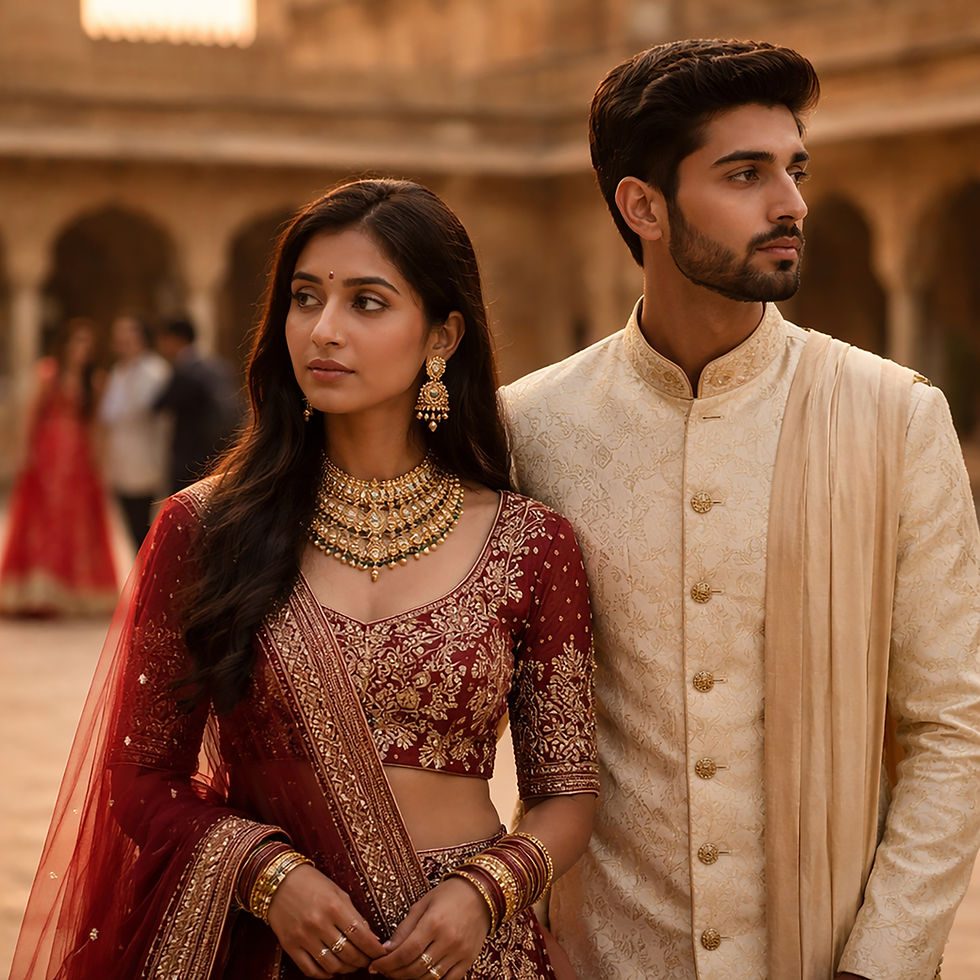
The first thing you notice at the Amber Fort, just outside Jaipur in India, is the light.
It slides across the honey-colored stone in the late afternoon, catching on carved arches and mirrored halls, softening the heat of Jaipur into something almost theatrical.
The second thing you notice is the couples.
They appear gradually, as if summoned by the light itself.
Young men in tailored sherwanis.
Young women in embroidered lehengas so intricately worked they seem less like clothing and more like inheritance.
Gold everywhere. Necklaces, bangles, earrings that sway as they walk.
And always, hovering just out of frame, a photographer or two, sometimes three, choreographing each step, each smile, each twirl, each turn of the head.
This is pre-wedding season at the Amber Fort.
Some couples look radiant. Effortlessly so. They lean toward one another without prompting, laughter rising easily, hands brushing with familiarity. You sense affection, perhaps even love. The camera barely needs to work.

Others look … composed. Careful. Their smiles are technically perfect, but their eyes flick away when the photographer isn’t watching. They stand close because they are told to, not because they would choose to.
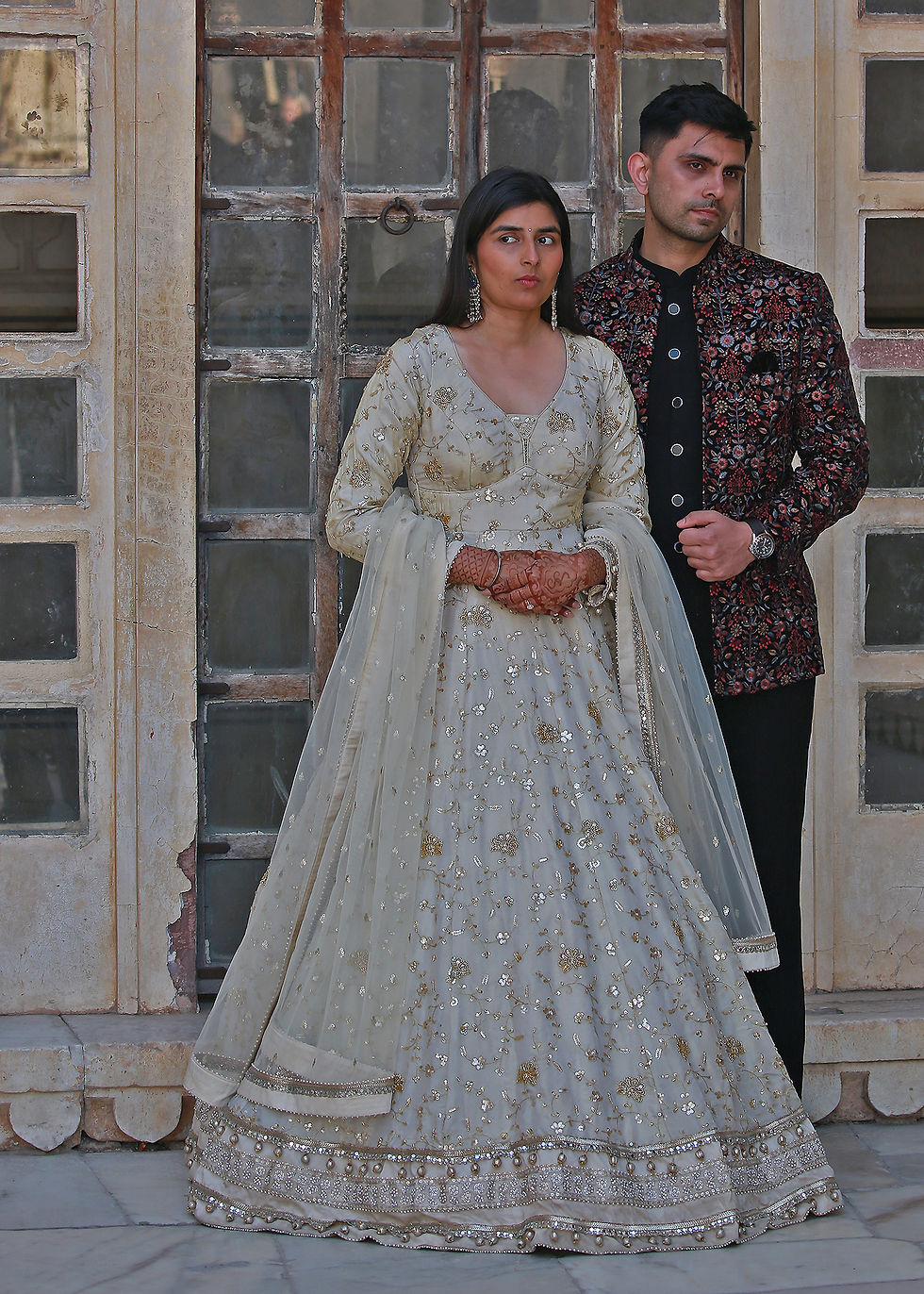
And then there are the ones who seem almost frightened. Young women especially. Faces taut beneath layers of makeup, eyes scanning the courtyard as if searching for something unnamed.

And then there are the ones who look like they might love someone else.

Not in a scandalous way. More in the quiet, internal way of memory.
A glance that lingers too long on nothing. A smile that doesn’t quite reach the eyes. The subtle posture of someone playing a role they did not write.
Watching them, it is impossible not to think about the institution that brought them here.
Arranged marriage in India is often misunderstood in the West. Flattened into caricature, either oppressive or quaint, archaic or transactional.
The truth, like most truths in India, is layered.
For many families, arranged marriage is not about coercion but continuity. It is a merging of families, values, caste histories, education levels, financial stability, and social expectations. It is logistics, but also lineage, reputation, and duty. Love, when it comes, is expected to grow later, like a vine trained carefully along a wall.
And sometimes, it does.
I’ve heard about couples who met once or twice before their wedding and now, decades later, move through life with a quiet intimacy that feels earned rather than assumed. Their affection is not loud, but it is deep. They speak of partnership, of shared endurance, of choosing each other again and again after the ceremony rather than before it.

But standing in Amber Fort, watching young couples pose beneath Mughal arches built for emperors and conquest, you also feel the weight of expectation pressing in from all sides.
The jewelry alone tells a story. Heavy gold necklaces resting on collarbones like ancestral obligations. Bangles stacked thickly on wrists, each one a symbol of prosperity, fertility, and continuity.
The gowns and sherwanis are exquisite, but they are also armor. Cultural, familial, and generational.
What struck me most was not whether the marriages would succeed or fail, but how little space there seemed to be for uncertainty.
In the West, we romanticize choice. We speak endlessly of love as destiny, of chemistry as proof. And yet, we divorce at staggering rates, drift apart quietly, or discover too late that affection alone does not sustain a life.
In India, the wager is different. Stability first. Love, perhaps, later. Or love defined not as passion, but as commitment, patience, and shared responsibility.
Neither system is clean.
Neither is guaranteed.
And standing there, watching a young couple repeat a pose for the third time while the photographer adjusted the angle of the light, I found myself wondering if what we were witnessing was not romance or resignation, but something more human. Hope.
Hope that this person beside you might become your person.
Hope that duty might soften into affection.
Hope that the life you are stepping into will be kind.
The Amber Fort, after all, has seen centuries of alliances formed for political reasons, for survival, for power. Some failed. Some endured. Some likely grew into something tender despite their beginnings.
As the sun lowered and the courtyard began to empty, one couple lingered behind. The photographer had packed up. The crowd had thinned. And for a moment, unobserved, they laughed freely at something only they knew. No choreography. No instruction. No performance.
Just two people, standing at the edge of a future neither could fully see.
And I thought: perhaps that is where all marriages begin, arranged or otherwise, not in certainty, but in the fragile, hopeful space between fear and possibility.


Comments