Fontfroide Abbey Part 2: The art of giving an abbey new life (#774)

Of all the things I encountered during our visit to Fontfroide Abbey, its stained-glass windows made perhaps the greatest impression.
Their brilliant colors fill a church built by Cistercian monks who favored simplicity and restraint.
Several depict St. Francis of Assisi, an unexpected presence in a monastery belonging to a different religious order.
The explanation lies largely with Gustave Fayet, the painter and collector who purchased Fontfroide in 1908.
Fayet helped save the deteriorating buildings, but his ambition extended beyond restoration.
Working with artists and craftsmen, he transformed the abbey into a place where medieval architecture and later artistic imagination could coexist.
From plain glass to brilliant color
The original Cistercian windows were relatively plain, admitting light without elaborate religious imagery.
When Fayet acquired the abbey, many church windows had lost their glazing.
He commissioned his friend Richard Burgsthal, an artist and musician, to create replacements.
Together they established the Verrerie des Sablons glassworks at Bièvres, near Paris.
Burgsthal experimented with historical glassmaking techniques to achieve the rich colors they wanted.
Most of the church’s new windows were designed and installed between 1914 and 1925.
Five windows in the northern aisle depict episodes associated with St. Francis, including his celebrated preaching to birds and the reception of the stigmata.

Their variations of green are particularly appealing.
For someone interested in wildlife and conservation, the association between Francis and the natural world adds another dimension to their beauty.
Why Francis rather than a figure more closely associated with the Cistercians?
The abbey’s guide acknowledges the unusual choice without offering a definitive explanation.
His affinity with nature may have appealed to Fayet and Burgsthal, but their motives remain uncertain.
The western rose window offers a different spectacle: the creation of the world, with God the Father surrounded by angels and signs of the zodiac.

Such imagery could express the seasons, the passage of time and the ordering of the universe.
Its exuberance seems far removed from the restraint of the abbey’s founders.
An abbey reimagined
Fayet’s creative approach extended throughout Fontfroide.
In the cloister, structural restoration was accompanied by historical sculptures and newly commissioned gargoyles inspired by those at Narbonne Cathedral.
He arranged objects from different periods according to his own artistic vision.

The enormous Renaissance fireplace in the former lay brothers’ refectory illustrates that approach.
Acquired in 1908, it came from the Château de la Grange des Prés in Pézenas.
A room originally intended for communal dining gained a magnificent feature from another place and century.

The Starfish Door is a more intimate example.
Situated at the foot of the staircase leading to the former lay brothers’ dormitory, it combines wrought iron with colored glass in sixteen panels bearing star-shaped motifs.

Fayet worked with ironworker Jean Trouilhet and Burgsthal to bring together structure, color and light.
It expresses, on a smaller scale, the same imagination evident in the church windows.
A continuing conversation
The Chapel of the Dead brings these layers of history together.
Built in the thirteenth century, it overlooks the former monastery cemetery, now the rose garden.
Fayet furnished it with historical sculptures, including a monumental sixteenth-century limestone cross acquired in 1909 from an antiques dealer in Béziers.
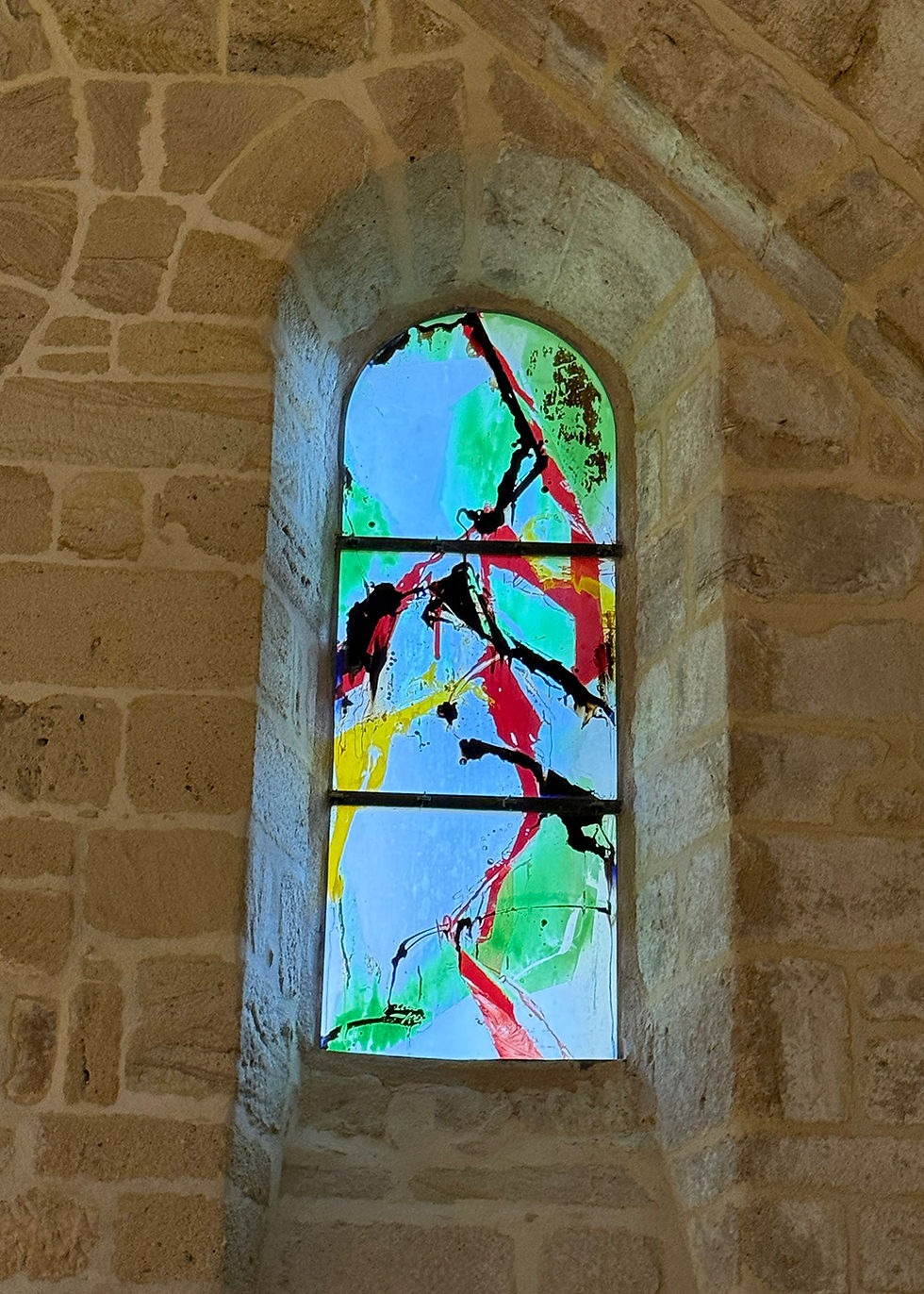
In 2009, the chapel received abstract stained-glass windows by Kim En Joong, a Korean-born artist and Dominican priest.

Unlike Burgsthal’s recognizable figures and religious narratives, these windows work through color, movement and light.
They invite contemplation without requiring visitors to identify a particular story.
Walking through Fontfroide made me reconsider what preservation means.
An old building rarely has a single identity to which it can simply be returned.
It carries the choices of successive generations, each leaving something of its own time.
Fayet preserved the abbey while allowing it to acquire a new artistic life.
Later artists have continued that process.


The stone still speaks of the medieval monastery; the glass and craftsmanship reveal what others have found possible within it.
The monks built a place for contemplation.
Centuries later, light still encourages visitors to pause - now colored by the imagination of those who followed.


Comments