Oubaitori: The Wisdom of Not Comparing Ourselves to Others (#618)
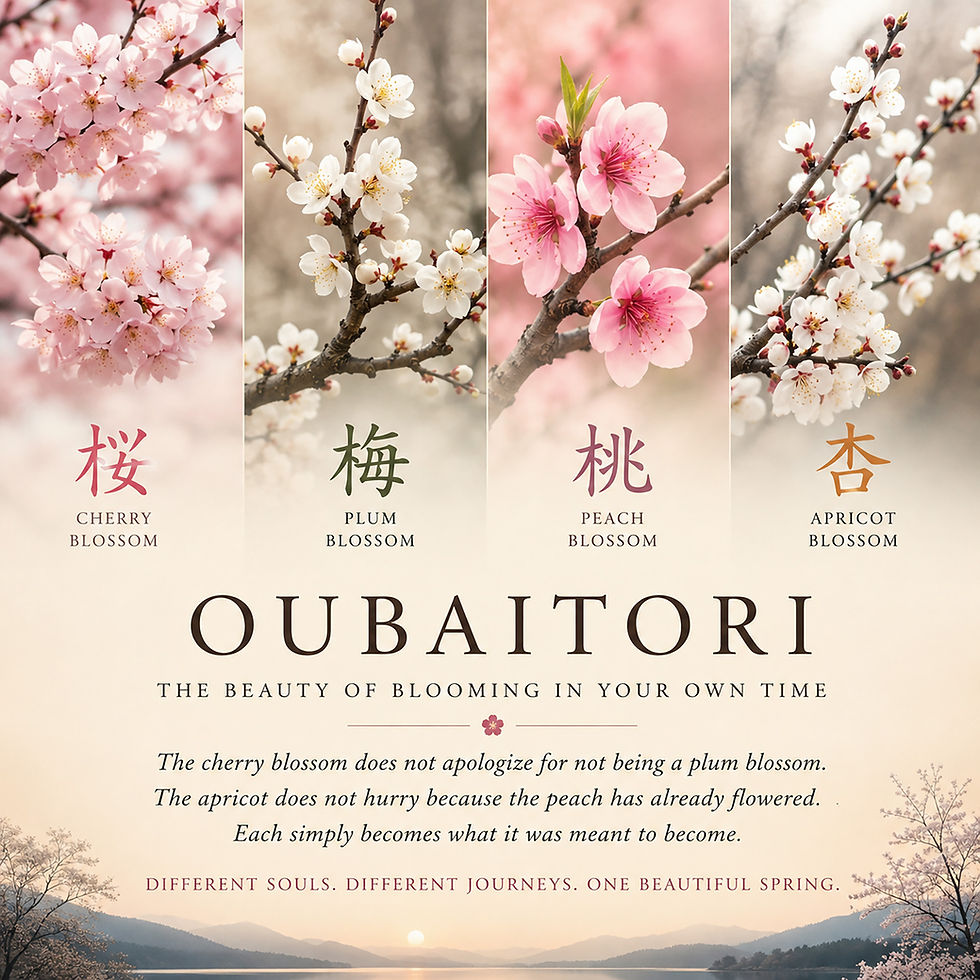
There is a Japanese concept known as Oubaitori, written with four kanji characters representing four different flowering trees:
Cherry blossom,
Plum blossom,
Peach blossom, and
Apricot blossom.
Kanji are the adopted Chinese characters used in the Japanese writing system. Each character carries both sound and meaning, often conveying an idea or image rather than simply a phonetic sound.
In Oubaitori, the four kanji symbolize distinct blossoms, each with its own unique beauty and season of flowering.
None competes with the others.
The cherry blossom does not apologize for not being a plum blossom.
The apricot does not hurry because the peach has already flowered.
Each simply becomes what it was meant to become.
In a world increasingly obsessed with comparison, metrics, rankings, and visibility, Oubaitori offers a quiet but profound lesson.
We are not meant to bloom simultaneously.
We are not meant to have identical journeys.
And perhaps most importantly, another person’s success is not evidence of our failure.
For much of life, we are conditioned to compare ourselves to others.
As children, grades and awards become measures of worth.
Later come promotions, titles, publications, income, social status, followers, citations, rankings, and public recognition.
Even universities and professions now live in ecosystems dominated by league tables and numerical comparisons.
Comparison has become a cultural reflex.
Yet comparison is often deeply misleading because it ignores context, temperament, timing, opportunity, hardship, and individuality.
Comparison reduces complex human lives into simplistic scorecards.
Some people bloom early.
Others bloom late.
Some flourish publicly, while others quietly enrich the lives immediately around them without fanfare or applause.
A veterinarian comforting an elderly client in a consultation room may contribute more goodness to the world than someone delivering a keynote lecture to thousands.
A teacher who inspires one struggling student may alter a family’s future for generations.
A parent sitting beside a sick child at 2 a.m. may be displaying a form of greatness that never appears on a résumé.
The world often notices achievement.
It less frequently notices meaning.
Oubaitori reminds us that the pace and shape of another person’s journey should not dictate our own sense of worth.
This is particularly important in academia and professional life, where comparison can become corrosive.
Careers are too often viewed as races rather than individual paths of contribution and growth.
People begin measuring themselves against colleagues’ grants, titles, salaries, awards, board positions, or institutional prestige.
Quietly, joy disappears and is replaced by anxiety, resentment, or inadequacy.
The tragedy is that comparison rarely produces peace.
Even the successful frequently feel behind someone else.
There is always another ranking.
Another accolade.
Another institution.
Another person apparently doing better.
Comparison creates a horizon that continually recedes.
But fulfillment often emerges when people stop asking, “How do I measure against others?” and instead ask, “Am I becoming more fully myself?”
That is a very different question.
The Japanese flowering trees do not bloom identically because their purpose is not sameness.
Diversity of timing and form is part of the beauty of the garden itself.
Human beings are much the same.
Some people are builders.
Some are healers.
Some are artists.
Some are listeners.
Some are explorers.
Some are caretakers.
Some are innovators.
Some are quiet stabilizing presences in the lives of others.
Not every meaningful life is publicly celebrated.
Not every valuable contribution is visible.
And not every season is a blooming season.
There are periods in life devoted to survival, grief, care giving, rebuilding, reflection, learning, or healing.
Modern culture often treats these quieter seasons as unproductive interruptions. Oubaitori suggests otherwise.
Winter is not failure. It is part of the cycle.
Many older people eventually discover this truth.
With age often comes the realization that life is not a competition to defeat others, but an opportunity to become more authentic, compassionate, and at peace with oneself.
The irony is that people who stop obsessively comparing themselves to others often become more creative, generous, and fulfilled.
Freed from the exhausting burden of external validation, they begin producing work and relationships rooted in sincerity rather than performance.
There is also humility in Oubaitori.
If each flower blooms differently, then perhaps we should be gentler with one another.
We know little of another person’s hidden struggles, sacrifices, disappointments, or private courage.
The colleague who appears successful may be lonely.
The student who seems lost may one day flourish magnificently.
The person moving slowly may simply be enduring a difficult season invisible to others.
Judgment becomes harder when we appreciate that human lives unfold unevenly.
Nature understands this instinctively.
A garden composed entirely of identical flowers would be monotonous.
Beauty often emerges precisely because of variation - different colors, heights, fragrances, and blooming times.
Human communities are no different.
Perhaps the goal of life is not to outshine everyone else, but simply to bloom fully in our own way, and to allow others the dignity to do the same.
The cherry blossom blooms.
The plum blossom blooms.
The peach blossom blooms.
The apricot blossom blooms.
None diminishes the others.
Together, they create spring.



Comments