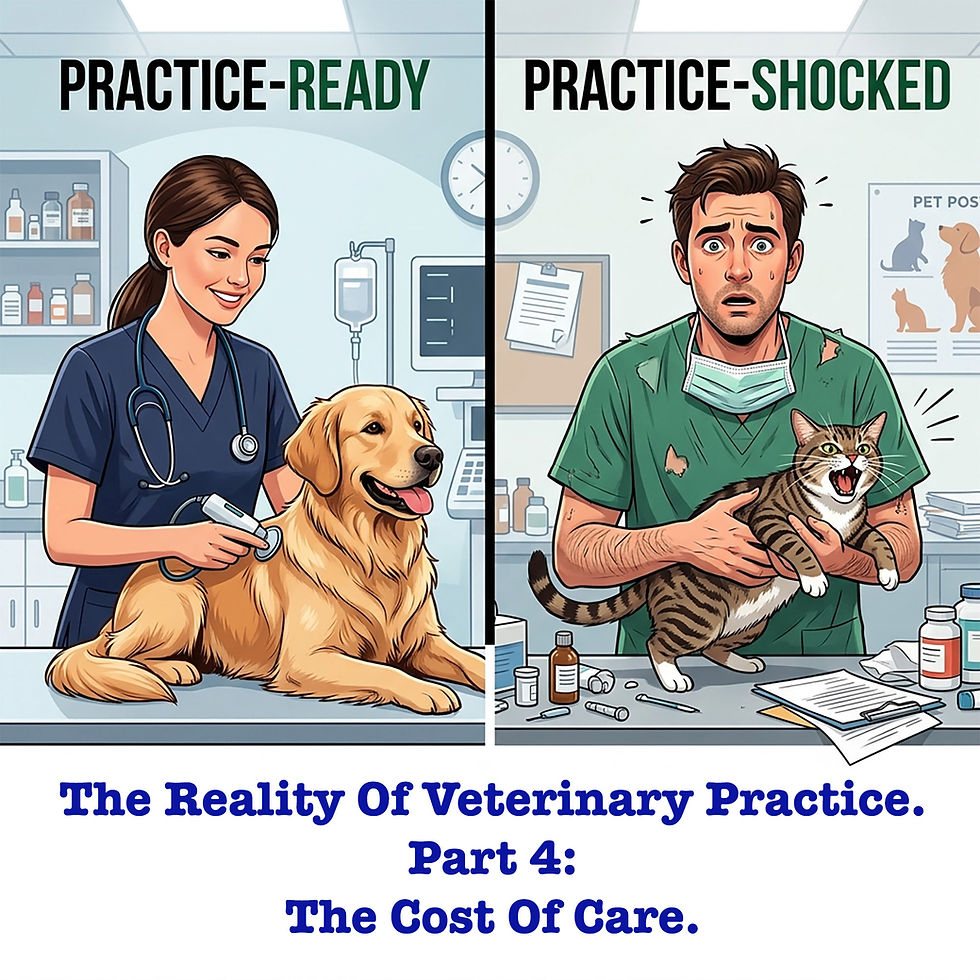
Practice-Ready or Practice-Shocked? The Reality of Veterinary Practice. Part 4: The Cost of Care (#603)
- Rick LeCouteur
- Apr 23
- 4 min read
Economics, Ethics, and Reality
There is a moment - quiet, but unmistakable - when the conversation changes.
The diagnosis has been discussed. The options have been outlined. The path forward, at least medically, is clear.
And then the client asks:
“How much is this going to cost?”
It is a simple question.
It is also the moment when medicine meets reality.
The World of Possibility
In veterinary school, the emphasis is, rightly, on what can be done.
Students are taught:
The best diagnostic pathways.
The most effective treatments.
The standards of care that represent the pinnacle of the profession.
This is essential. Without a clear understanding of what is possible, there can be no meaningful clinical decision-making.
But this world of possibility is, in many ways, an idealized one.
It assumes:
Access.
Resources.
Agreement.
Conditions that do not always exist in practice.
The World of Constraint
In the real world, every case exists within constraints.
Some are visible:
Financial limitations.
Time pressures.
Geographic access to care.
Others are less so:
A client’s personal priorities.
Cultural beliefs about animals.
Past experiences with veterinary medicine.
The quiet, unspoken calculation of what is “worth it.”
These constraints do not sit outside the consultation. They are part of it. And they shape every decision that follows.
The First Time It Happens
For many young veterinarians, the first encounter with financial limitation is unsettling.
A clear diagnosis seems within reach. A treatment plan offers hope.
But the client hesitates. Or declines. Or asks for an alternative.
The instinct, trained over years, is to return to the medical argument:
To explain more.
To justify the recommendation.
To advocate for what is “best.”
But here, something important must be understood.
The client is not rejecting medicine. They are navigating reality.
The Myth of the Right Answer
In the absence of constraint, the right answer often appears straightforward.
But once constraint enters, the landscape changes.
There may be:
A gold standard approach.
A middle-ground option.
A palliative path.
Or, at times, no intervention at all.
Each carries its own implications:
For the animal’s welfare.
For the client’s experience.
For the veterinarian’s sense of responsibility.
To insist that only one path is acceptable is to ignore the complexity of the situation.
To accept any path without reflection is to risk losing professional integrity.
The work lies in navigating between these positions.
The Emotional Weight of Compromise
Compromise is an uncomfortable word.
It can feel like:
Settling.
Falling short.
Accepting less than ideal.
For the new graduate, this can be particularly difficult.
They have been trained to pursue the best possible outcomes. To diagnose definitively. To treat effectively.
And now, they are asked to consider:
What is feasible.
What is affordable.
What is acceptable to the client.
This can feel like a departure from the principles of medicine.
But it is not.
It is an expansion of them.
Because good veterinary care is not defined solely by technical excellence. It is defined by appropriateness within context.
Advocacy and Respect
The veterinarian occupies a unique position.
They are:
An advocate for the animal.
An advisor to the client.
A professional bound by ethical responsibility.
These roles can, at times, pull in different directions.
Advocacy for the animal may suggest one course.
Respect for the client’s circumstances may suggest another.
It is to:
Present options clearly.
Explain consequences honestly.
Support the client in making an informed decision.
Without judgment. Without coercion. Without retreating from professional responsibility.
The Language of Cost
How we speak about cost matters.
If it is introduced abruptly, it can feel transactional.
If it is avoided, it can lead to misunderstanding and mistrust.
Over time, experienced clinicians learn to integrate cost into the conversation naturally:
Not as an afterthought.
Not as an obstacle.
But as one of several factors to be considered.
This requires comfort - not only with numbers, but with the reality they represent.
Moral Stress and Its Consequences
There are moments when the tension between what is possible and what is achievable becomes acute.
When:
An animal could be helped, but treatment is declined.
A condition progresses that might have been addressed earlier.
A decision is made that feels, to the veterinarian, incomplete.
These moments carry weight.
They can lead to what is often termed moral stress - the discomfort of knowing what could be done, but being unable to pursue it.
Left unacknowledged, this can accumulate:
Quietly.
Gradually.
Significantly.
It is one of the less visible challenges of practice. And one that deserves recognition.
A Broader Perspective
With time, many veterinarians come to see these situations differently.
They begin to understand that:
Care exists on a spectrum.
Good outcomes are not always perfect outcomes.
Support, honesty, and compassion are as important as intervention.
They learn that a thoughtfully chosen, limited approach can still be:
Ethical.
Effective.
Compassionate.
And that sometimes, the role of the veterinarian is not to fix, but to guide.
Closing Reflection
The question of cost is not separate from veterinary medicine.
It is embedded within it.
It shapes decisions, influences outcomes, and tests the balance between ideals and reality.
Veterinary school teaches us what is possible.
The real world asks what is possible here, for this animal and for this client?
And in answering those questions, the veterinarian learns something essential.
Not how to lower standards.
But how to apply them, thoughtfully, flexibly, and humanely, in a world that is rarely ideal.
Coming Next
Practice-Ready or Practice-Shocked? The Reality of Veterinary Practice.
Part 5: The Emotional Toll: Compassion, Fatigue, and Resilience.
In Part 5, we turn to the emotional landscape of veterinary practice.
The quiet accumulation of responsibility, compassion, and fatigue that shapes both the profession and those within it.


Comments