Shared Governance at UC Davis: Does the Renaming of the Vet School Meet the University's Own Principles? (#749)
Updated: 7 days ago
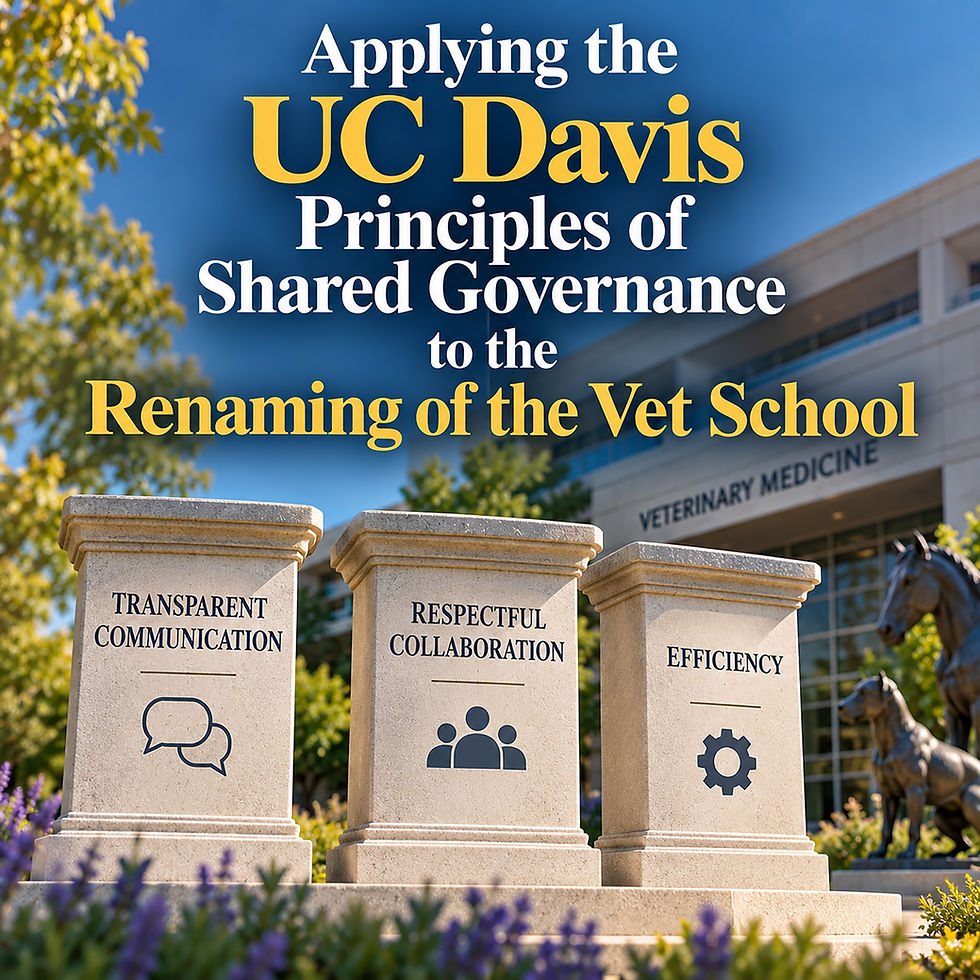
The University of California, Davis, proudly identifies shared governance as one of the foundations of its academic excellence.
On its official website, the Davis Division of the Academic Senate explains that faculty, administrators and the Regents work together to fulfill the university's missions of teaching, research and public service.
It identifies three principles intended to sustain that relationship:
Transparent communication,
Respectful collaboration, and
Efficiency.
These are not principles imposed upon UC Davis by an external organization. They are the university's own publicly stated commitments.
They therefore provide an appropriate framework for examining the decision to rename the UC Davis School of Veterinary Medicine in recognition of the $120 million philanthropic commitment from Joan and Sanford Weill.
Documents I obtained from the UC Davis Office of Public Records indicate that substantial elements of the gift agreement and naming arrangements had already been negotiated before the School's Faculty Executive Committee (FEC) was asked to consider the proposal.
The FEC was called to a special meeting on November 6, 2025. It met four days later, on November 10, and unanimously endorsed the proposed name change following a question-and-answer session with the dean and assistant dean and approximately ten minutes of private deliberation.
The discussions were subject to instructions that the information remain strictly confidential.
The question is whether this process was consistent with UC Davis's own principles of shared governance.

1. Transparent Communication
Transparency does not mean that every university discussion must take place in public.
There are legitimate reasons for protecting confidential information, particularly during philanthropic negotiations.
However, transparency requires more than simply providing information to a small group of representatives who are prohibited from sharing it.
It involves ensuring that relevant stakeholders understand the issues under consideration and have an appropriate opportunity to contribute before consequential decisions are made.
In the Weill renaming, the dean provided information to the FEC. That was an important element of communication between the administration and the committee.
But the wider faculty, staff, students and alumni were not shown to have had an opportunity to consider the proposal before the committee endorsed it.
The confidentiality instructions also raise questions about whether FEC members could consult their colleagues or obtain views beyond those expressed within the committee.
This is particularly significant because the proposal concerned the identity of the entire School, rather than a routine administrative or financial matter.
It would have been possible, at least in principle, to distinguish between confidential financial negotiations and consultation about the proposed institutional recognition.
For example, the administration could have discussed the possibility of renaming the UC Davis School of Veterinary Medicine (the School) without disclosing the donors' identities or the precise financial terms of an unfinished agreement.
Alternatively, the FEC could have been involved earlier and authorized to undertake limited consultation under appropriate confidentiality arrangements.
The available documentation does not establish whether such alternatives were considered or rejected.
The central question is whether the confidentiality restrictions were proportionate to the legitimate need for discretion or whether they unnecessarily prevented meaningful consultation.
UC Davis's commitment to transparent communication provides a reason to seek an explanation.
2. Respectful Collaboration
Respectful collaboration requires more than courtesy between administrators and faculty representatives. It requires recognizing the distinct responsibilities and legitimate authority of both groups.
UC Davis has addressed this issue explicitly in its own governance history.
In 2002, the UC Davis Division's Committee on Elections, Rules and Jurisdiction (CERJ) considered concerns about the role of the administration in the School of Veterinary Medicine's faculty committees.
The committee distinguished between arrangements that were formally permissible and those that respected the spirit of shared governance.
It warned that excessive administrative involvement could compromise faculty independence, particularly because administrators control financial resources and influence personnel decisions.
CERJ concluded that the degree of administrative involvement in certain School committees strained the spirit of shared governance, although it remained within the applicable rules.
That earlier ruling concerned curricular governance, not philanthropy or institutional naming.
Nevertheless, it establishes an important principle:
Formal compliance with university rules does not necessarily demonstrate that faculty independence has been adequately protected.
The Weill renaming raises a related question.
The dean and assistant dean attended the November 10, 2025, meeting, answered questions and then withdrew while the FEC deliberated. This arrangement allowed the committee to make its decision without the administrators being present.
However, the administration had already played the central role in negotiating the proposed agreement and determining the terms of the proposal presented to the committee.
If the essential arrangements were substantially settled before the FEC became involved, the committee's ability to influence the outcome may have been limited.
The confidential nature of the discussions also restricted opportunities for the committee to seek input from its constituency.
Respectful collaboration should recognize that faculty representatives have responsibilities beyond responding to administrative proposals. They have an independent role in shaping institutional decisions.
The relevant questions are whether the FEC had sufficient independence, information and opportunity to exercise that role, and whether it could have proposed substantive changes to the naming arrangements.
The available record establishes that the committee endorsed the proposal. It does not fully establish how much influence the committee could have exercised over its development.
3. Efficiency
Efficiency is the third principle identified by the UC Davis Academic Senate.
It is particularly relevant to the Weill renaming because the process was conducted under a compressed timetable.
The FEC received notice of the special meeting on November 6, 2025, and met on November 10, 2025. Following approximately 50 minutes of discussion with the dean and assistant dean, the committee deliberated privately for approximately ten minutes before unanimously endorsing the proposal.
The committee communicated its endorsement on November 12, 2025.
There may have been legitimate reasons for accelerating the process, including the financial and timing considerations associated with the gift.
However, efficiency should not be confused with speed alone.
UC Davis's own consultation procedures illustrate this distinction.
The Davis Division's Request for Consultation Process generally provides an eight-week consultation period.
Committees ordinarily have six weeks to consider a proposal, followed by two weeks for the Division to prepare its formal response.
The procedures permit shorter periods when appropriate, particularly when only a limited number of committees need to be consulted. They also recognize that committees require adequate time to meet and consider the issues before them.
The general eight-week period does not establish that the FEC was entitled to eight weeks in this particular case. The naming proposal followed its own approval pathway.
Nevertheless, the contrast is informative.
The ordinary consultation process recognizes that informed deliberation takes time.
The Weill proposal involved a substantial philanthropic agreement and a permanent change to the School's public identity. It was considered by the FEC within four days of the special meeting being called.
The question is whether the accelerated timetable was necessary and whether it permitted the committee to examine the agreement, consider alternatives and discharge its representative responsibilities.
An efficient process should use time and resources responsibly while preserving the quality of the decision.
A process that is rapid but leaves important questions about consultation unresolved may ultimately create additional work, disagreement and demands for accountability.
The relevant measure of efficiency is therefore not simply how quickly approval was obtained, but whether the process achieved its objectives while respecting the responsibilities of everyone involved.
4. UC Davis's Own Consultation Procedures
There is another important consideration beyond the three stated principles.
The Davis Division maintains a formal Request for Consultation (RFC) process intended to ensure that the Division is appropriately engaged in university governance.
The process distinguishes routine business, which can be handled by committees under their established authority, from non-routine matters that require broader consideration.
Its stated purpose includes ensuring appropriate consultation across the Division and maintaining a transparent public record of inquiries and responses.
The renaming of an entire professional school raises questions about where the boundary between routine and non-routine business should be drawn.
The proposal was treated as a simple name change that did not involve curricular or programmatic modifications. That classification helped determine its administrative review pathway.
But an institutional name is more than an administrative designation.
An institutional name represents the history, reputation and public identity of the institution.
Changing it affects how the School is identified by its faculty, students, alumni, professional colleagues and the wider community.
The question is whether the significance of the proposed change warranted broader consultation, even if the applicable rules did not explicitly require it.
The formal RFC process demonstrates that UC Davis recognizes the importance of consultation beyond the deliberations of a single committee.
Whether that broader approach should have been applied to the Weill renaming is a question deserving an explicit explanation.
5. The Lessons of Mending the Wall
The concerns raised by the Weill renaming are not entirely new to UC Davis.
In 2004, a special Academic Senate committee prepared a report entitled Mending the Wall:
The report examined the relationship between the administration and the Academic Senate and recommended improvements to shared governance.
The report emphasized that neither the administration nor the Senate can effectively govern the university in isolation. Both have distinct responsibilities, and the successful exercise of those responsibilities requires cooperation.
The report also warned that disregarding the Senate's views can create distrust and undermine the cooperative relationship upon which shared governance depends.
The report's central message remains relevant.
Shared governance is not simply a sequence of administrative approvals.
Shared governance is a continuing relationship between institutions that possess different forms of authority and responsibility.
The Weill renaming provides an opportunity to examine how that relationship functions when substantial financial considerations and institutional identity intersect.
Did the FEC participate as an independent partner in developing the proposal, or was its principal role to endorse an agreement that had already been negotiated?
Did the administration provide sufficient time and information for the committee to exercise its responsibilities?
And did the confidentiality restrictions protect legitimate negotiating interests while still allowing appropriate consultation?
These are questions about the functioning of shared governance, not simply about the outcome of the naming decision.
A Summary: The Three Principles Applied
UC Davis principle | Documented circumstances | Questions requiring clarification |
Transparent communication | The FEC received information, but discussions were subject to strict confidentiality. | Could the wider faculty have been consulted without compromising sensitive negotiations? |
Respectful collaboration | The FEC questioned the administration and deliberated privately after the administrators withdrew. | Could the committee influence the essential terms, or was its role confined to endorsing or rejecting the proposal? |
Efficiency | The FEC met four days after the special meeting was called and endorsed the proposal after approximately ten minutes of private deliberation. | Was the timetable necessary, and did it provide sufficient opportunity for informed consideration? |
The documented process establishes that formal consultation occurred.
The documented process leaves unresolved questions about the timing, scope and practical influence of that consultation.
The Difference Between the Letter and the Spirit of Shared Governance
The distinction between formal compliance and meaningful participation is not one I have invented for the purpose of questioning the Weill renaming.
It is a distinction that UC Davis's own Academic Senate has previously recognized.
In its 2002 ruling concerning the School of Veterinary Medicine, CERJ explicitly distinguished between what university rules permitted and what was consistent with the spirit of shared governance.
The committee also identified the faculty themselves as the principal guardians of their institutional independence.
That observation is particularly relevant to the responsibilities of the FEC.
An elected faculty committee is not merely an administrative mechanism through which proposals receive formal endorsement.
An elected faculty committee is an institution through which faculty exercise their collective responsibility for the university.
Its members must be able to exercise independent judgment, question administrative proposals and, where appropriate, obtain the views of the people they represent.
The administration has a corresponding responsibility to ensure that the committee is given the information, time, and opportunity necessary to fulfill that role.
The Weill gift was a substantial philanthropic contribution, and its potential benefits to the School are clear.
But the significance of the gift does not eliminate the importance of the process through which the naming decision was reached.
Indeed, the greater the institutional significance of a decision, the more important it becomes to demonstrate that the process was transparent, collaborative and appropriately considered.
The documentation currently available establishes that the FEC endorsed the proposal through the formal approval process.
The documentation currently available does not conclusively establish whether the committee had a meaningful opportunity to shape the proposal before its essential terms were settled.
Nor does the documentation fully explain why strict confidentiality and an accelerated timetable were necessary, or whether alternatives that permitted broader consultation were considered.
These are matters on which the administration and the FEC could provide further clarification.
Shared Governance Must Be Practiced, Not Merely Proclaimed
UC Davis has publicly committed itself to transparent communication, respectful collaboration and efficiency.
These principles are intended to sustain the relationship between the administration and the faculty and to ensure that the university's academic mission is supported by responsible institutional governance.
The renaming of the School of Veterinary Medicine provides an opportunity to examine how those principles were applied in practice.
The administration negotiated a substantial philanthropic agreement. The FEC received information, questioned the administration and unanimously endorsed the proposed name change. The proposal subsequently proceeded through the university's approval process.
Those actions are documented.
What remains less clear is whether the FEC was involved early enough to influence the proposal, whether its members could meaningfully consult their constituency, and whether the timetable allowed sufficient consideration of the institutional consequences.
The distinction matters because shared governance is not simply about who has the authority to make a final decision.
Shared governance is also about how decisions are developed, whose perspectives are considered, and whether the participants have a genuine opportunity to influence the outcome.
UC Davis's own history demonstrates that these concerns are not new. Its Academic Senate has previously warned that arrangements may comply with formal rules while placing the spirit of shared governance under strain.
The Weill renaming invites the university to explain how its current practices reflect the principles it has publicly adopted.
The fundamental question is not whether the administration obtained the FEC's approval.
The fundamental question is whether the administration and the FEC worked together in a manner that gave the faculty a meaningful voice before the decision was substantially settled.
That is the difference between shared governance as a procedural requirement and shared governance as a genuine institutional commitment.
Principal Sources
The three stated principles of shared governance.
About the Davis Division of the Academic Senate.
The Division's consultation procedures and ordinary timelines.
Requests for Consultation.
The Senate's report on improving shared governance.
Mending the Wall: Reports of the special committee on shared governance and senate operations.
Professor Robert Powell's assessment of shared governance.
State of Shared Governance at UC Davis.
The earlier ruling concerning the School of Veterinary Medicine.
Advice to a member of the Faculty of the School of Veterinary Medicine 11/5/2002. https://academicsenate.ucdavis.edu/role-administration-operation-senate
The formal review and endorsement of the proposed name change.
UC Academic Senate: Weill Renaming Documentation.
https://senate.universityofcalifornia.edu/_files/reports/council-chair-to-provost-name-chage-ucd-vet-medicine.pdf


Comments