The Corporate Group Photo: Everyone Present. Not Everyone There (#722)
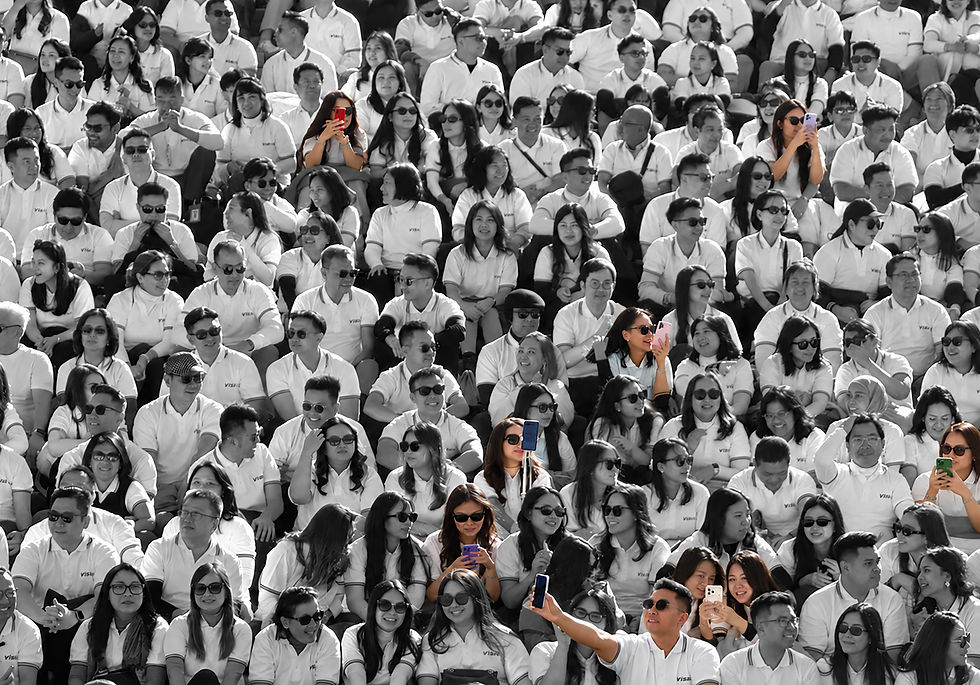
There is a certain irony in gathering hundreds of people together for the quintessential corporate ritual.
The corporate group photograph.
Only to discover that some are experiencing the moment through a screen.
While the official camera records the group, dozens of smaller cameras compete to record the recording.
Perhaps this is the modern group portrait.
Everyone together.
Everyone connected.
And some looking somewhere else.
I happened to walk past a corporate rally on the Sydney Opera House steps.
An insurance company group photo.
There were hundreds of people arranged in neat rows, almost everyone wearing the same white corporate shirt.
From a distance, individuality disappeared.
The people became a pattern:
White shirts, dark trousers, faces turned toward the official photographer.
A corporation made visible.
But then I noticed the cell phones.
Scattered throughout the crowd were people photographing the photograph.
Some held phones at arm’s length. Some took selfies. Some seemed more interested in capturing their own version of the occasion than in looking toward the camera that had assembled them there in the first place.
I found the contradiction fascinating.
The official photograph was saying:
This is us.
The cell phones were saying:
But this is me.
And inevitably, I thought about veterinary medicine.
From Profession to Corporation
Veterinary medicine was once overwhelmingly a profession of relatively small enterprises. A veterinarian might own the hospital, employ the nurses and receptionists, know the clients, treat their animals, and live in the community the practice served.
That model was hardly perfect. But authority, responsibility, professional judgment, and ownership often occupied roughly the same physical space.
Corporate consolidation has changed that.
Today, many veterinary hospitals belong to organizations whose ultimate ownership may be several layers removed from the examination room.
Decisions about staffing, pricing, purchasing, scheduling, productivity, inventory, marketing, and performance can increasingly be influenced by people who will never meet the veterinarian, the client, or the animal affected by those decisions.
The individual veterinarian remains the person in the examination room.
But increasingly, the veterinarian stands inside a much larger photograph.
Everyone in the Same Shirt
That was what struck me about the Opera House scene.
Corporations depend upon standardization.
There are good reasons for this. Standardized systems can improve efficiency, purchasing, training, safety, record keeping, quality control, and access to sophisticated administrative and practical resources.
Veterinary medicine benefits from many of those things.
But standardization has another side.
What happens when protocols begin to displace judgment? When performance indicators become proxies for professional accomplishment? When the time allocated to an appointment matters as much as what happens during it?
When revenue, average transaction value, diagnostic compliance, or other measurable outputs become easier to see from headquarters than compassion, restraint, clinical wisdom, mentorship, or the decision not to perform a test?
The danger is not necessarily that corporations employ veterinarians.
It is that veterinary medicine begins to adopt the values of the corporation rather than the corporation accommodating the values of veterinary medicine.
There is an important difference.
The Cell Phone in the Crowd
And that brings me back to those little splashes of color in the corporate photograph.
I deliberately left most of the crowd in black and white and colorized the people holding cell phones.
Suddenly, individuals emerged from the corporate pattern.
They were still part of the group. They still wore the shirt. They had not climbed down from the steps.
But they were looking through their own lenses.
Perhaps that is a useful metaphor for the veterinarian working within corporate medicine.
Corporate employment does not extinguish professional identity.
A veterinarian does not surrender decades of education, ethical obligations, clinical experience, curiosity, compassion, or professional judgment simply by becoming an employee.
The veterinarian still has a lens.
And preserving that lens may be one of the most important challenges facing the profession.
Who Owns the View?
The fundamental question may therefore be larger than:
Who owns the veterinary hospital?
It is:
Who owns professional judgment inside it?
When a veterinarian closes the examination-room door and sits opposite a worried owner with a sick animal between them, whose values govern what happens next?
The corporation's? The veterinarian's? The client's? The animal's?
Ideally, these interests need not conflict.
A financially healthy veterinary business is essential. Veterinarians and veterinary nurses deserve good salaries. Hospitals need investment. Equipment costs money. Buildings cost money. Veterinary medicine cannot survive by pretending economics does not matter.
But neither can veterinary medicine be understood entirely through a spreadsheet.
Some of its most important qualities are stubbornly difficult to measure:
Judgment. Trust. Restraint. Empathy. Curiosity. Time.
The willingness to say: We could do more, but I don't think we should.
Those things rarely make impressive quarterly metrics.
They are nevertheless at the heart of a profession.
This Is Us. This Is Me.
Perhaps that is why the photograph stays with me.
Hundreds of people had gathered beneath one corporate identity.
From a distance, they looked remarkably similar.
Look more closely, however, and the individuals reappeared.
Someone laughed. Someone turned away. Someone talked to a neighbor. Someone raised a cell phone and chose a different frame.
Corporate veterinary medicine faces much the same tension.
There is nothing inherently wrong with being part of something larger. Scale can bring resources, opportunities, technology, expertise, and stability that an individual practice may struggle to provide.
The question is what happens to individuality once everyone puts on the same shirt.
Veterinary medicine needs systems. It needs organizations. It needs capital.
But it also needs veterinarians who continue to look through their own professional lenses, and organizations willing to encourage them to do so.
Because the moment everyone is required to see exactly the same picture, something important has been lost.
The corporate photograph says:
This is us.
Professional judgment must always retain the freedom to answer:
Yes. But this is what I see.


Comments