The Future of Veterinary Education: Part 11 - What We Cannot Measure (#675)
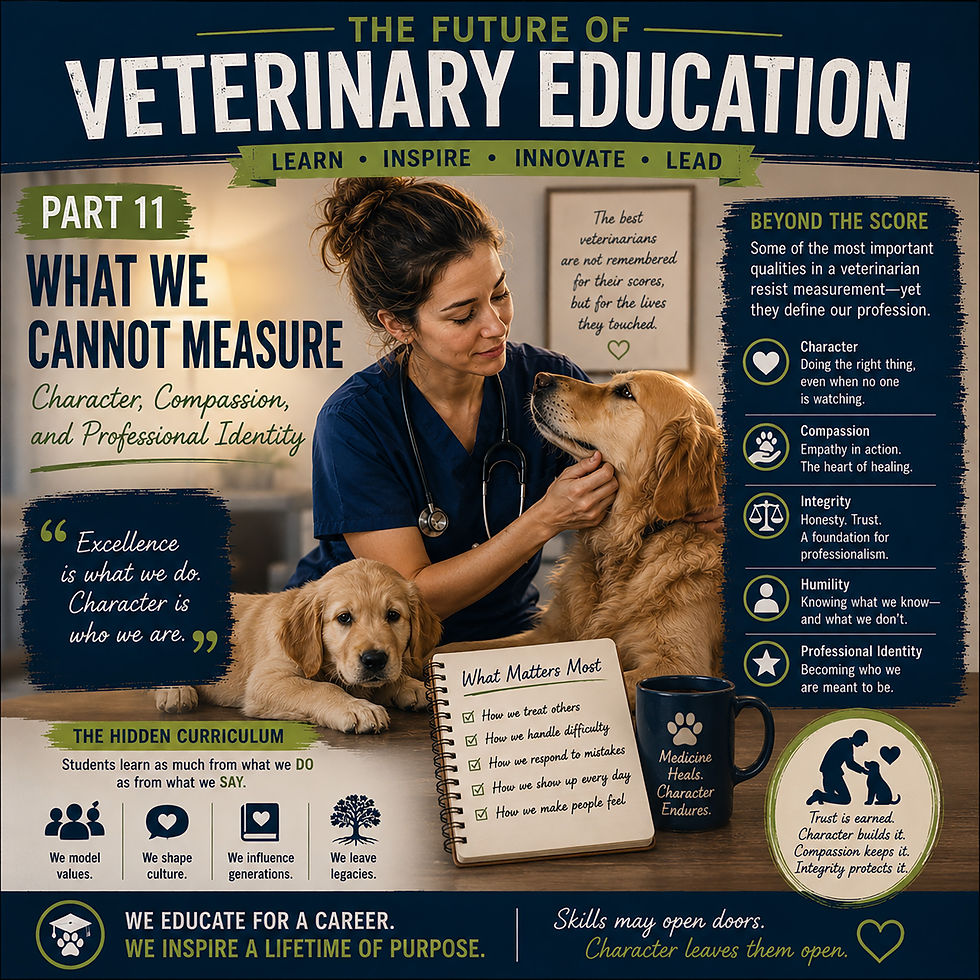
Character, Compassion, and Professional Identity
Part 11 brings the series of The Future of Education full circle.
Part 1 began by asking whether examinations measure what truly matters.
Ten essays later, we arrive at perhaps the most important question of all:
What if the most important qualities in a veterinarian are the very qualities that resist measurement?
Veterinary education has become remarkably sophisticated.
We can measure knowledge. We can assess competencies. We can evaluate technical skills. We can track milestones. We can analyze outcomes. We can generate data on almost everything.
And yet, some of the most important qualities in a veterinarian remain stubbornly resistant to measurement.
Character. Compassion. Integrity. Humility. Professional identity.
These qualities rarely appear on transcripts.
Yet they often define careers.
The Veterinarian We Remember
Think about the veterinarians who influenced your life.
The professor who inspired you. The clinician you admired. The mentor who changed your career. The colleague everyone trusted.
What made them exceptional?
It was rarely their examination scores.
Few of us remember whether a mentor earned 85% or 95% on a pathology examination. Few of us know their class ranking. Few of us know their GPA.
What we remember is something else.
How they treated people. How they treated animals. How they behaved under pressure. How they carried themselves. How they made others feel.
The Limits of Measurement
Modern institutions naturally gravitate toward measurable outcomes.
Measurement creates accountability, consistency, transparency, and comparability.
Those are worthy goals.
But measurement also has limitations.
Not because measurement is bad.
Because not everything important can be reduced to a number.
How do we measure integrity?
How do we quantify kindness?
How do we score humility?
How do we calculate compassion?
Educational systems often struggle with these questions.
The result is predictable.
We measure what we can.
And sometimes neglect what we cannot.
The Character Question
Character is revealed most clearly when no one is watching.
When the case is difficult. When the outcome is uncertain. When a mistake has been made. When doing the right thing carries a cost.
Veterinary schools can teach ethics, discuss professionalism, and establish codes of conduct.
But character itself develops over time.
Through choices, habits, experiences, and relationships.
Character is less a lesson than a journey.
Compassion Fatigue and Compassion Strength
Compassion is often discussed as a vulnerability.
And certainly it can become exhausting.
But compassion is also a professional strength.
Clients remember compassionate veterinarians. Teams trust compassionate leaders. Students admire compassionate mentors. Animals benefit from compassionate caregivers.
Compassion is not merely an emotional trait.
It is a clinical asset.
The challenge for veterinary education is not simply teaching compassion.
It is preserving it.
Many students arrive at veterinary school with abundant compassion.
The question is whether they leave with it intact.
The Importance of Humility
The longer many veterinarians practice, the more they appreciate uncertainty.
Medicine has a way of humbling people.
Every clinician encounters unexpected outcomes, missed diagnoses, complications, and surprises.
Humility does not mean lack of confidence.
Humility means recognizing the limits of certainty.
Ironically, humility often becomes more valuable as knowledge increases.
The best clinicians are frequently those most comfortable saying:
I don't know.
And then working diligently to find out.
Professional Identity
At some point during training, students stop thinking of themselves as students.
They begin thinking of themselves as veterinarians.
This transition is profound.
Professional identity shapes behavior, decision-making, responsibility, ethics, relationships, and pride.
The formation of professional identity may be one of the most important outcomes of veterinary education.
Yet it rarely appears in accreditation documents.
It is difficult to assess.
Difficult to quantify.
And impossible to automate.
The Hidden Curriculum, Once Again
Throughout this series, a recurring theme has appeared.
The hidden curriculum.
Students learn from what faculty do.
Not merely what faculty say.
They observe interactions, behavior, values, and priorities.
Students quickly identify inconsistencies.
If professionalism is taught in lectures but ignored in practice, students notice.
If compassion is praised but not modeled, students notice.
If integrity is discussed but not demonstrated, students notice.
The hidden curriculum may be the most powerful educational force in any veterinary school.
The Legacy Question
Imagine two veterinarians at retirement.
One was technically brilliant.
The other was technically excellent as well.
But the second was also known for integrity, generosity, compassion, mentorship, and kindness.
Which leaves the greater legacy?
The answer seems obvious.
Professional achievement matters.
But professional character endures, long after publications are forgotten, awards gather dust, and careers conclude.
People remember character.
What Society Expects
Society grants veterinarians extraordinary trust.
Clients allow us to make life-and-death decisions.
Clients share personal stories, financial concerns, family struggles, and emotional vulnerabilities.
Clients trust us.
That trust depends upon more than competence.
It depends upon character.
A technically skilled veterinarian without integrity ultimately fails the profession.
Character is not an optional extra.
It is foundational.
Looking Ahead
As veterinary education becomes increasingly sophisticated, we must be careful not to confuse measurement with importance.
The qualities that define exceptional veterinarians often resist quantification.
Character. Compassion. Integrity. Humility. Professional identity.
These attributes cannot be downloaded, automated, or fully assessed through examinations or competencies.
Yet they may be among the most important outcomes veterinary education produces.
The future of veterinary education will undoubtedly involve new technologies, new assessment methods, and new educational models.
But the profession's future will depend just as much on preserving timeless human qualities.
Because clients may admire expertise.
Colleagues may respect competence.
But trust is earned through character.
And ultimately, trust is the foundation upon which every profession rests.
Coming Next
Part 12. The Veterinarian of 2050: Imagining the Future
Part 11 is the philosophical heart of the series on The Future of Veterinary Education.
Part 10 focused on the well-being of veterinarians.
Part 11 focuses on who veterinarians become.
Part 11 also prepares the reader perfectly for Part 12, which can step back and ask:
If we were designing veterinary education from scratch for the year 2050,
what would we keep,
what would we change, and
what must never be lost?


Comments