The Living Vault: The Trees of the Canal du Midi (#711)

There are moments on the Canal du Midi when the trees seem almost more important than the canal itself.
Traveling slowly along the water, one enters long green corridors where branches reach toward one another from opposite banks. Sunlight filters through the leaves. Reflections of trunks stretch into the water. The towpath disappears beneath shade. In places the trees meet overhead so completely that the boat seems to pass through a living cathedral.
And then, quite suddenly, the cathedral disappears.
There are open stretches where young trees stand in disciplined rows, each supported by stakes, the Mediterranean sun beating down on water that was once shaded by enormous plane trees.
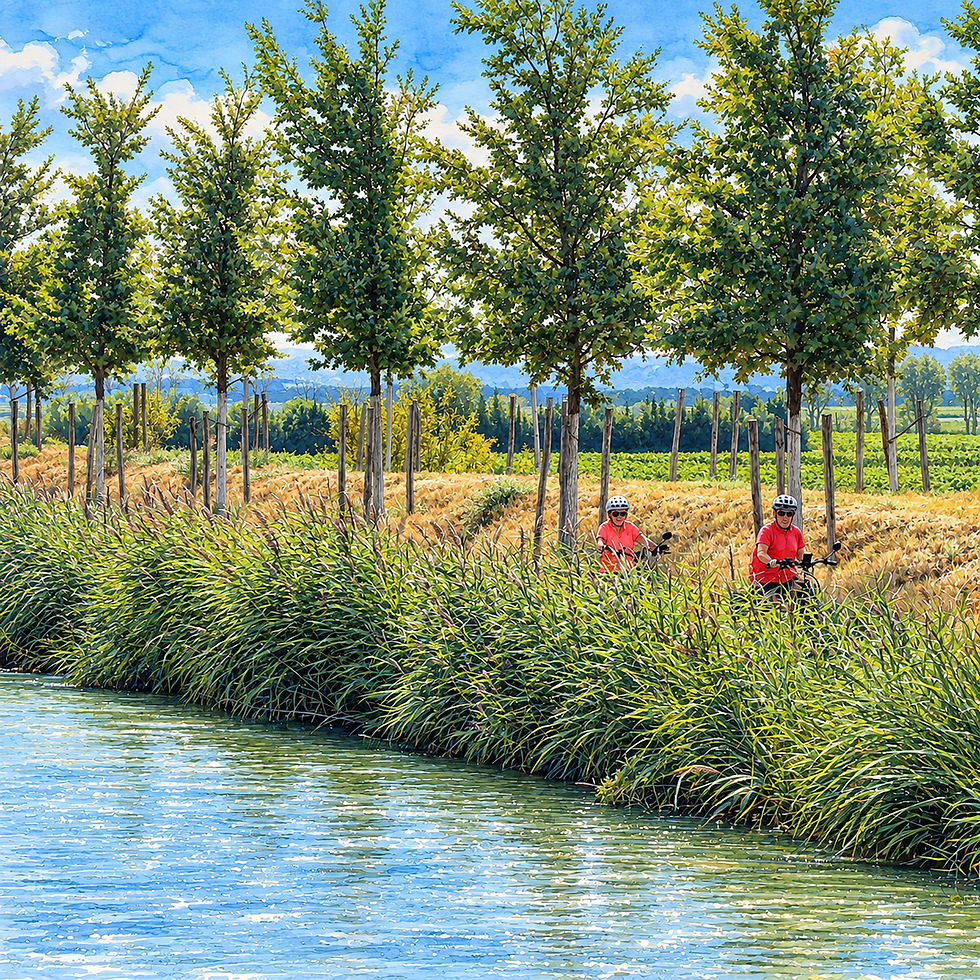
Elsewhere there are gaps, stumps, recently disturbed banks, or surviving old trees standing like remnants of another age.
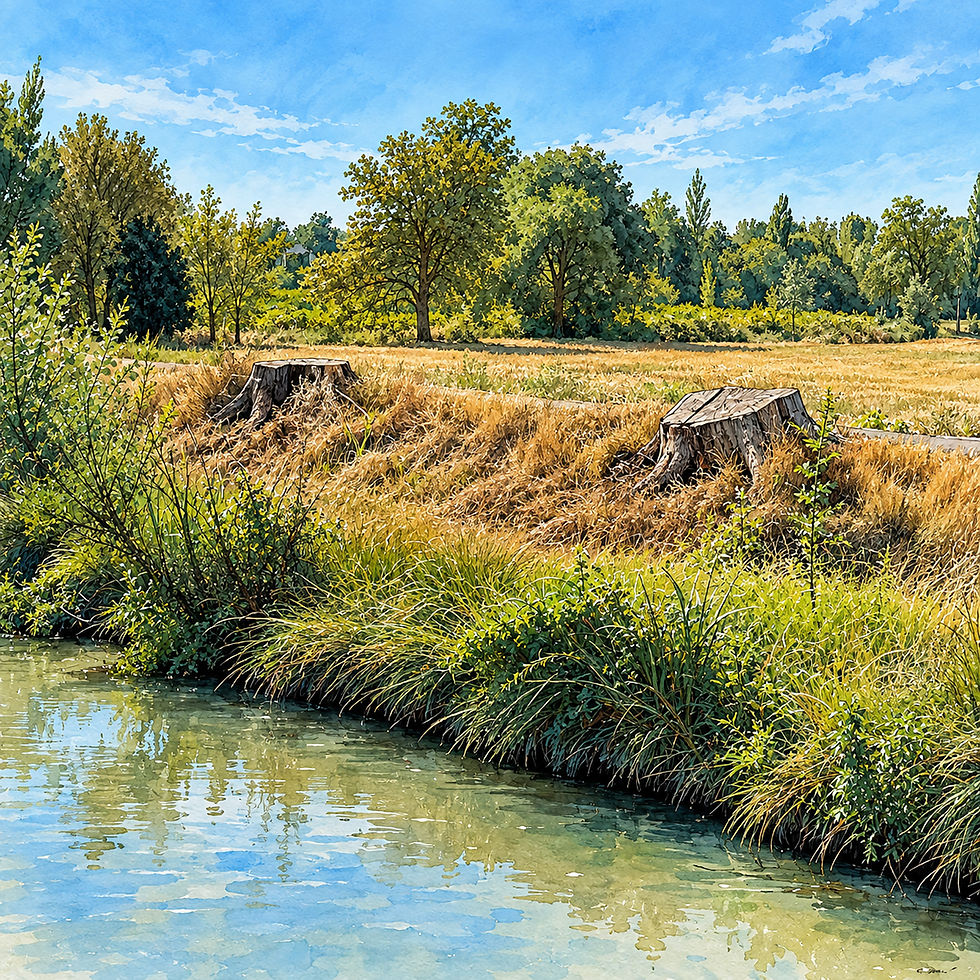
I wondered what had happened.
The answer is a remarkable story of engineering, landscape architecture, commerce, biological invasion - and one of the largest battles against a tree disease in modern France.
The Trees Were Not Always Plane Trees
The Canal du Midi itself was the extraordinary vision of Pierre-Paul Riquet. Built during the reign of Louis XIV and opened to navigation in 1681, it created a navigable route across southern France between the Mediterranean and the Garonne River system leading toward the Atlantic.
Today the canal and its associated waterways extend for roughly 360 kilometers, while the historic Canal du Midi proper is about 240 kilometers long. UNESCO inscribed it on the World Heritage List in 1996, describing it as one of the great achievements of modern civil engineering.
But the famous green tunnel through which we travel today was not part of Riquet's original romantic vision.
Trees were planted for practical reasons.

The excavation of the canal created banks vulnerable to erosion. Vegetation helped stabilize the soil. Trees also provided timber and, increasingly importantly, shade.
Before engines, barges were commonly pulled from the towpaths by horses, mules and sometimes men. In the fierce summer heat of Languedoc, shade was not simply picturesque. It made work along the canal more tolerable.
The early plantings were diverse. Willows, poplars, ash, mulberries, fruit trees and other species appeared along different sections. The landscape evolved repeatedly as the canal's economic uses changed.
The idea that Riquet planted the Canal du Midi with the great avenues of plane trees we see in old photographs is therefore misleading.
Those came much later.
The Rise of the Plane Tree
During the nineteenth century, plane trees increasingly came to dominate the canal landscape.
The species commonly planted was the hybrid plane, Platanus × acerifolia - also called the London plane. It proved exceptionally well suited to life beside roads and waterways. It grew quickly, tolerated pruning and pollution, developed a substantial root system and produced a magnificent spreading crown.
Along the Canal du Midi something extraordinary happened.
Trees planted opposite one another grew upward and outward until their branches almost touched above the water.
A roof appeared.
The practical landscape became an aesthetic one.
The roots helped stabilize the banks. The trees shaded the towpaths and water. Their timber had economic value. And their enormous crowns reduced the punishing effects of the southern French sun.
Generation after generation grew accustomed to the Canal du Midi looking this way.
Eventually some 42,000 plane trees lined the canal.
They became inseparable from its identity.
What began as vegetation associated with a transportation system had become a cultural landscape.
And therein lay the danger.
The Canal du Midi had effectively become a vast linear monoculture.
An Invisible Passenger Arrives from America
The destruction of this landscape began thousands of kilometers away.
The culprit is canker stain of plane - chancre coloré du platane - caused by the microscopic fungus Ceratocystis platani.
The fungus is native to North America, but the best-supported historical account specifically links its introduction into Europe to infected plane-tree wood from the United States.
British Forest Research summarizes the evidence as an accidental wartime introduction from the eastern United States, carried in wooden crates and boxes containing military supplies.
France's Ministry of Agriculture similarly says the organism probably reached France around Marseille during World War II in infested wooden ammunition crates.
A detailed Canal du Midi heritage study dates the likely introduction to 1943-44 and refers specifically to American ammunition crates unloaded at Naples and Marseille.
It is one of those extraordinary unintended consequences of war.
Soldiers, ammunition, vehicles and supplies crossed the Atlantic to liberate Europe.
Somewhere among those supplies were wooden crates fashioned from infected American plane or sycamore wood.
Inside the timber traveled something nobody could see.
A fungus.
From Marseille to the Canal du Midi
The fungus did not immediately devastate the Canal du Midi. It had been present in southern France for decades before the disaster there became obvious.
The first outbreak along the canal was identified in the Aude in 2006, although a Voies Navigables de France (VNF) technical report records diseased trees detected near Villedubert in 2005. From there the disease spread through the Aude and Hérault and eventually farther west into Haute-Garonne.
The biology of the organism makes the Canal du Midi almost an ideal environment for an epidemic.
Ceratocystis platani is a vascular pathogen. It usually enters through wounds in the tree.
Once inside, the fungus colonizes the water-conducting tissues, disrupting the movement of water through the tree.
Characteristic dark blue, violet or blackish lesions - sometimes described as flammes bleues, or blue flames - may develop beneath or through the bark. Foliage yellows. Branches die. Eventually the entire crown collapses.
And there is no curative treatment.
Once a plane tree is infected, death is effectively inevitable.
A tree that has taken a century or more to become part of the landscape can be killed within months to a few years.
The Canal Became Part of the Disease
There was another cruel twist.
The very architecture that made the avenue of plane trees so magnificent helped the disease spread.
The roots of adjacent trees intertwine and can transmit infection from tree to tree. Spores and contaminated material can move in water. Maintenance equipment can carry the fungus from one site to another. Pruning, excavation and other activities can create wounds through which infection enters.
Even boats can contribute.
VNF warns boaters not to damage trees or moor directly to them. Hulls striking exposed roots can create precisely the wounds through which the pathogen gains access. Water can also transport fungal material along the canal.
Thus the Canal du Midi became more than the setting for the epidemic.
Its water, boats, banks, intertwined roots and human activity all helped create an efficient pathway for transmission.
The living vault had become biologically connected - and biological connectedness can transmit disease as efficiently as it sustains life.
The Only Treatment Is Destruction
There is something deeply counterintuitive about saving a historic landscape by cutting down its historic trees.
But with canker stain, that is essentially the only option.
Infected trees must be felled under stringent phytosanitary conditions. Contaminated wood is destroyed, equipment disinfected and nearby trees may also have to be removed because apparently healthy neighbors can already be infected through their roots.
The scale is difficult to comprehend.
By January 2026, VNF reported that 33,350 of the approximately 42,000 plane trees present before the epidemic had been felled.
That is roughly four out of every five trees.
That is what has happened to the Canal du Midi's living architecture.
What Do You Replace 42,000 Plane Trees With?
The obvious answer might seem to be: more plane trees.
But that would risk repeating the mistake.
The extraordinary visual uniformity of the old canal was also its biological weakness.
Tens of thousands of closely planted trees belonging largely to the same species of tree created ideal conditions for a specialist pathogen.
So the new Canal du Midi is deliberately becoming more diverse.
VNF's restoration program combines replanting with bank stabilization, biodiversity conservation and adaptation to climate change.
Among the species being used are oak, maple, chestnut, poplar, European hackberry (micocoulier), lime and pine.

By 2026, more than 20,000 replacement trees had already been planted; VNF's current restoration page reports more than 22,000 replanted against roughly 33,000 removed.
The project has involved investment approaching €110 million, with contributions from government, regional authorities and millions of euros in private donations.
This is therefore not simply a tree-planting exercise.
It is ecological reconstruction on a landscape scale.
Can the Living Vault Ever Return?
Yes.
But not quickly.
That is perhaps the hardest part of the story to appreciate.
We can excavate a canal with machinery. We can repair a lock. We can rebuild a stone wall. We can replace a bridge.
We cannot manufacture a hundred-year-old tree.
The young trees I saw along the Canal du Midi looked almost insignificant beside the immense trunks that remain. Some barely cast enough shade for a person, let alone enough to span a canal.

But those saplings are being planted for people who have not yet been born.
If the project succeeds, their crowns will broaden. Their roots will strengthen the banks. Birds, bats and insects will colonize them. Shade will return to the towpaths. Reflections will once again darken the water.
The new vault will not look exactly like the old one.
And perhaps it shouldn't.
The Lesson of the Canal du Midi
There is something larger in this story than the loss of beautiful trees.
The first trees were planted because humans needed to control erosion and make a new engineering project work. Later generations replaced that diversity with plane trees because plane trees performed exceptionally well. The result was so successful that the trees became part of the cultural identity of southern France.
Then a microscopic organism crossed an ocean as an accidental passenger of human activity.
Decades later, it encountered an almost perfect monoculture.
The consequences are still unfolding.
There is an uncomfortable lesson here about our desire for uniformity. We like avenues in which every tree is identical. Agriculture has often pursued the same goal. So has forestry. Uniformity is visually satisfying and administratively convenient.
Nature tends to favor something messier.
Diversity.
And diversity brings resilience.
Perhaps that is what makes the Canal du Midi particularly fascinating today. We are watching a famous landscape change its philosophy before our eyes - from uniformity to diversity, from preservation of an image to preservation of an ecosystem.
The great nineteenth-century plane-tree cathedral is disappearing.
But the Canal du Midi is not becoming treeless.
It is becoming something new.
Traveling beneath the surviving giants and then emerging into sunlight beside rows of young trees, it is tempting to see only what has been lost. Yet those saplings suggest another way of looking at it.
They are not replacements for the past.
They are an investment in a landscape that none of us will live long enough to see fully mature.
And perhaps that is the most beautiful thing about planting a tree.
You create shade for someone you will never meet.
A Word about the VNF
Voies navigables de France (VNF) is the public French navigation authority responsible for managing, operating, and developing the majority of the country's inland waterways network.
Established in 1991, VNF operates under the French Ministry of Ecological Transition. It manages roughly 6,700 kilometers of canals, rivers, and canalized waterways. The organization oversees more than 4,000 civil engineering structures, including locks, dams, and canal bridges.
The VNF promotes and develops sustainable freight transport by water, to lower carbon emissions. This supports economic growth, local jobs, and tourism such as pleasure boating and river cruises.
The VNF also ensures comprehensive hydraulic management and water resource availability across its networks


Comments