Who Owns Your Vet (1)? Transparency in the age of private equity (#424)
- Rick LeCouteur
- Oct 25, 2025
- 4 min read
Updated: Oct 26, 2025
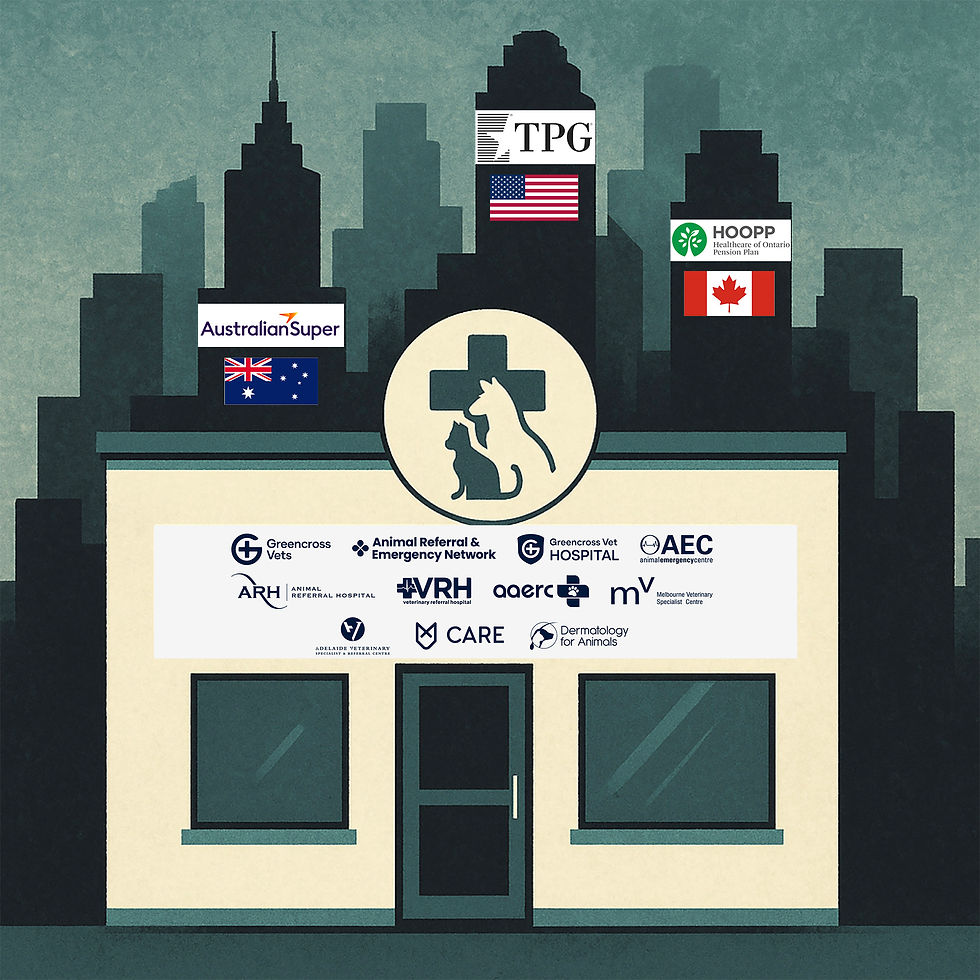
When a pet owner walks into a veterinary hospital, they see the same reassuring faces, the same compassionate care, and the same polished reception desk.
What they rarely see, indeed, what is seldom mentioned, is who actually owns the practice.
In Australia today, a significant number of veterinary clinics, specialty hospitals, and emergency centers, belong to large corporate networks backed by private-equity capital.
The biggest of them all is Greencross Group, which operates more than 165 general practices and around 30 specialist and emergency hospitals across the country.
On paper, Greencross is owned and controlled by TPG Inc., a U.S. private-equity giant, with minority stakes held by AustralianSuper and HOOPP (a Canadian pension fund).
Yet walk into any of its hospitals and you’ll be hard-pressed to find any mention of private equity.
Silence by Design
In a recent audit I conducted of 30 Greencross-owned hospital websites, not one disclosed its ownership structure.
Each proudly displayed its sub-brand - Animal Emergency Centre (AEC), Animal Referral Hospital (ARH), or Vet Referral Hospital (VRH).
But nowhere did it state: This hospital is part of Greencross Group, owned by TPG Inc.
The absence is not accidental. It’s deliberate.
Private-equity ownership, while public record through ASIC filings and media coverage, is not part of the patient-facing story.The client is invited to believe that the practice remains a locally owned, community-oriented institution, independent in spirit if not in fact.
Why It’s Hidden
There are several reasons for this discretion.
Marketing Psychology
Most pet owners want their vet to be local, not leveraged. The words private equity conjure images of distant boardrooms, quarterly returns, and profit margins, not the empathy and continuity that define good veterinary care.
Greencross’s messaging revolves around trust, compassion, and your neighborhood vet. Declaring TPG ownership at the front door risks puncturing that illusion.
Regulation, or the lack thereof
Unlike human healthcare or financial services, veterinary practices are not required by law to identify their beneficial owners.
As long as the corporate parent complies with disclosure obligations to regulators and investors, there’s no mandate for clinic-level transparency.
The result is a quiet opacity. Everything is legal, but little is visible.
The private-equity playbook
Most investors prefer the brand, not the balance sheet, to face the public.
Their objective is to grow the network, improve efficiency, and eventually exit, via IPO or sale, without stirring debate about capital motives.
To that end, brand segmentation serves a purpose: Greencross Vets for general practice, ARH for referral, AEC for emergency, each presented as distinct and local.
The parent company, and its financiers, remain comfortably backstage.
The Ethical Dimension
Does it matter?
That depends on how one defines trust.
For the average pet owner, the quality of clinical care is paramount.
But for the profession, and for society’s confidence in healthcare more broadly, the question of ownership speaks to accountability and autonomy.
If pricing decisions, diagnostic protocols, or resource allocations are influenced by corporate targets rather than clinical judgment, should that influence be disclosed?
Many independent practitioners believe so. They argue that pet owners deserve to know who ultimately benefits from the bill they pay.
Transparency, in their view, isn’t a marketing burden, it’s an ethical obligation.
A Broader Pattern
This lack of disclosure is not unique to Greencross.
Across the world, private-equity ownership has quietly permeated veterinary medicine, dentistry, physiotherapy, dermatology, radiology, and even primary medical care.
In each case, the brand names remain local, personal, and human, while the profits and decisions flow to global investment firms.
The same dynamic drives consolidation in the United States and the United Kingdom.
Names like Mars Veterinary Health (which owns VCA, Banfield, and AniCura), IVC Evidensia (backed by EQT), and National Veterinary Associates (NVA) (backed by Ares Management) now dominate those markets.
However, few clients would know it.
The Cost of Quiet
Greencross is not doing anything illegal or unusual. It’s playing by the same rules as everyone else.
But the absence of disclosure carries a subtle cost.
It erodes the transparency that sustains trust.
Veterinary medicine depends on relationships, between clinician and client, and between animal and advocate. Those relationships are built on honesty.
When ownership is obscured, even unintentionally, the profession risks appearing less personal, less accountable, and more transactional.
In the long run, silence breeds suspicion.
As one might say of medicine in general: if you’re proud of your investors, you shouldn’t have to hide them.
A Call for Candor
It’s time to ask whether veterinary practices, especially those in corporate networks, should be required to disclose their ownership structures clearly to the public.
A small note on a website footer, a sign in the waiting room, or a statement of corporate affiliation would suffice.
It would cost nothing, and it would acknowledge the reality that modern veterinary care is delivered within large, complex financial systems.
Clients don’t expect perfection.
They do, however, expect honesty.
Rick’s Commentary
When Greencross was founded in the 1990s, it was built on the promise of professionalism and scale.
Its founder, Dr Glen Richards, saw corporate consolidation as a way to ensure the survival of small practices in a changing world.
Perhaps, then, the best way to honor that vision is through transparency. To let clients, clinicians, and investors all know who owns the practice, and why that ownership matters.



Comments