Who Owns Your Vet (4)? Follow the money (#427)
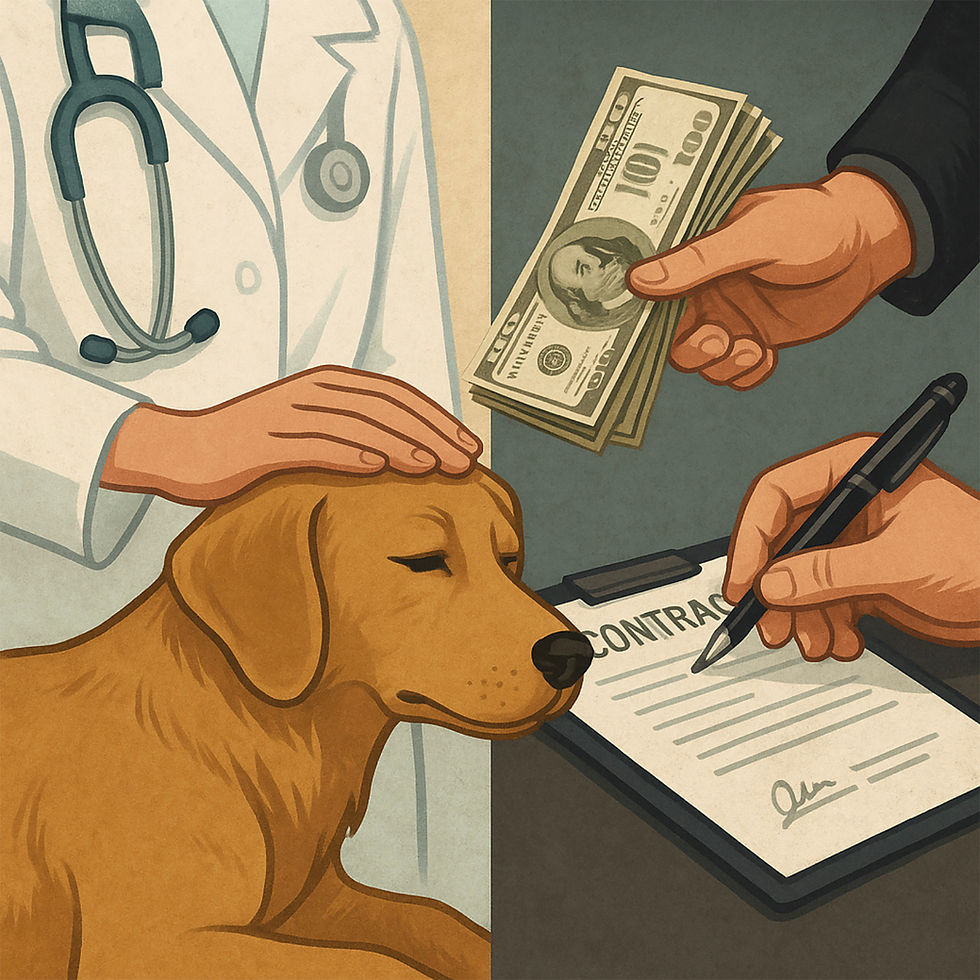
Walk into a veterinary clinic today and you’ll see the familiar signs of care.
Stethoscopes, wagging tails, and anxious owners.
But behind the comforting rituals of everyday medicine, something far less visible is at work.
A complex web of financial transactions that has turned veterinary care into one of private equity’s newest and most profitable playgrounds.
The story is not just about who owns the clinic.
It’s about why they own it and for how long.
The Financialization of Compassion
Veterinary medicine, once the domain of dedicated professionals, has become an asset class.
Private equity firms - investment houses that buy businesses using borrowed money, streamline operations, and sell them for profit within a few years - have discovered that people rarely economize when their pets are sick.
Companion animals, with their emotional gravity, guarantee a steady cash flow.
In business terms, that makes the veterinary profession sticky.
In human terms, it makes it vulnerable.
How the Game Works
The private equity model is elegantly simple and brutally efficient:
Acquire
Buy a profitable independent clinic - often family-owned - at a premium price, convincing the owners it’s time to take some chips off the table.
Leverage
Finance the purchase with heavy debt.
The acquired clinic’s revenues are used to service that debt.
Consolidate
Merge multiple practices into a single brand to reduce costs and increase bargaining power.
Exit
Sell the conglomerate to another investor or multinational within 3–7 years at a significant markup.
This process, known as a roll-up, can turn hundreds of small, community-based practices into a corporatized chain with unified branding, centralized decision-making, and identical price structures.
From Family Clinics to Financial Portfolios
In Australia, companies like Greencross and NVAs VetPartners exemplify this shift.
Greencross began as a cooperative network of clinics before being floated on the ASX, delisted under private equity ownership, and later reacquired by new investors.
VetPartners, founded in 2016, quickly expanded across Australia and New Zealand, eventually falling under the ownership of EQT Inc., a global private equity giant based in Sweden.
Each transaction promises efficiency, scale, and improved standards. Yet each also extracts value from the profession itself.
Clinics are sold not because their founders no longer love animals, but because they can no longer compete with the financial muscle of corporations buying up the neighborhood one suburb at a time.
The Short Game vs. the Long Game
Veterinary medicine requires a long view of patient health, staff development, and community trust.
Private equity, by its nature, plays a short game.
Investment funds typically seek returns within a few years, not decades.
When returns lag, expenses are cut, consultation times shortened, and wages squeezed.
This is not villainy; it’s simply the logic of finance.
But the logic of finance is not the logic of care.
A profession that once measured success by the health of animals and the satisfaction of clients now finds itself measured by EBITDA margins and exit valuations. Compassion is no longer the primary product. It’s the marketing.
The Debt That Never Sleeps
One of the least understood aspects of private equity ownership is debt.
When a fund buys a veterinary group, it rarely uses its own cash. Instead, it borrows heavily, and the debt sits on the balance sheet of the company itself.
That means the clinics, their staff, and their clients are effectively paying interest on their own acquisition.
In financial circles, this is efficient capital deployment.
In ethical terms, it’s extracting profit from purpose.
Why It Matters for the Profession
This isn’t just a business story; it’s a cultural one.
Private equity doesn’t just change who owns veterinary clinics. It changes what ownership means. Independent practitioners once saw their clinics as legacies, extensions of their professional identity. Under corporate structures, ownership becomes transient, transactional, anonymous.
When the ultimate goal is resale, not stewardship, the profession’s soul begins to fray.
Mentorship diminishes, continuity erodes, and the young veterinarian’s dreams of one day owning a practice fade into nostalgia.
A Future at a Crossroads
Awareness and resistance are growing.
Some veterinarians are banding together to form cooperative ownership models, employee-owned practices, or ethical investor groups that emphasize sustainability over speculation.
Universities are beginning to discuss the impact of corporate ownership on clinical training and career paths.
The profession stands at a crossroads between treating animals as patients or as profit centers, and between being a calling or a commodity.
Rick’s Commentary
Private equity didn’t invent ambition or efficiency. But it has reframed them.
When the care of animals becomes a line item in an investor’s portfolio, the stakes extend far beyond finance.
The question isn’t whether private equity belongs in veterinary medicine.
It’s whether veterinary medicine can remain itself once private equity has moved in.


Comments