Anonymous Street Photography: France, Faces, and the Right to Be Seen (#704)

France is one of the great homes of street photography.
And, in 2026, it is also one of the more complicated places in which to practice it.
Walk through Paris, Aix-en-Provence, Narbonne, or Saintes-Maries-de-la-Mer with a camera and the temptation is everywhere.
A woman reading alone at a café. An elderly couple walking arm in arm. Children chasing pigeons across a square. A waiter smoking during his break. A man asleep on a bench. Two strangers arguing. Two others kissing.
These are not celebrities. They are not models. They are simply people being people.

That is precisely what makes street photography interesting.
France Invented Much of the Tradition
There is a certain historical irony here.
French streets helped give birth to photography itself. Louis Daguerre's famous 1838 image of the Boulevard du Temple is generally regarded as one of the earliest photographs to contain a human figure. The long exposure erased most of the moving population, but one man - apparently having his shoes shined - stood still long enough to survive.
He was anonymous.

And yet he became immortal.
A century later, photographers such as Eugène Atget, Robert Doisneau, Willy Ronis and Henri Cartier-Bresson transformed ordinary French life into visual history.
Cartier-Bresson called it the decisive moment:
That fraction of a second when people, geometry, light and circumstance unexpectedly come together.
The essential ingredient was spontaneity.

The people in those photographs were rarely posing. Frequently they did not even know they were being photographed.
Today those images hang in museums.
France in 2026
The law has evolved considerably since those photographs were made.
French law gives substantial protection to both privacy and what is commonly called the droit à l'image - the right to control the public use of one's image.
Article 9 of the French Civil Code begins with the deceptively simple principle:
Everyone has the right to respect for their private life.

There is, however, an important distinction between taking a photograph and publishing it.
Photography in a public place is not simply prohibited. The City of Paris itself describes the underlying principle as freedom to photograph, although that freedom must be balanced against image rights, privacy, copyright and public security.

Publication is where things become more complicated.
French government guidance says that when an adult is isolated and recognizable in an image taken in a public place, permission is normally required for publication.
But there are important exceptions involving freedom of expression, information, and artistic and cultural freedom. A general street scene in which nobody is individually singled out may therefore be published without obtaining permission from everyone who happens to appear in the frame.
Context matters.
So do dignity, purpose and the way the photograph is used.
A photograph documenting life on a Paris street is very different from using the recognizable stranger in that photograph to advertise a hotel, restaurant or product.
And private places are another matter altogether.

French criminal law specifically protects a person against non-consensual image capture while that person is in a private place.
Children deserve particular caution. French official guidance requires parental authorization for publication of a recognizable minor's image by a third party.

The Anonymous Solution
All of this has changed the way I think about street photography.
Perhaps the answer is not to stop photographing people.
Perhaps it is to photograph humanity without necessarily photographing identity.
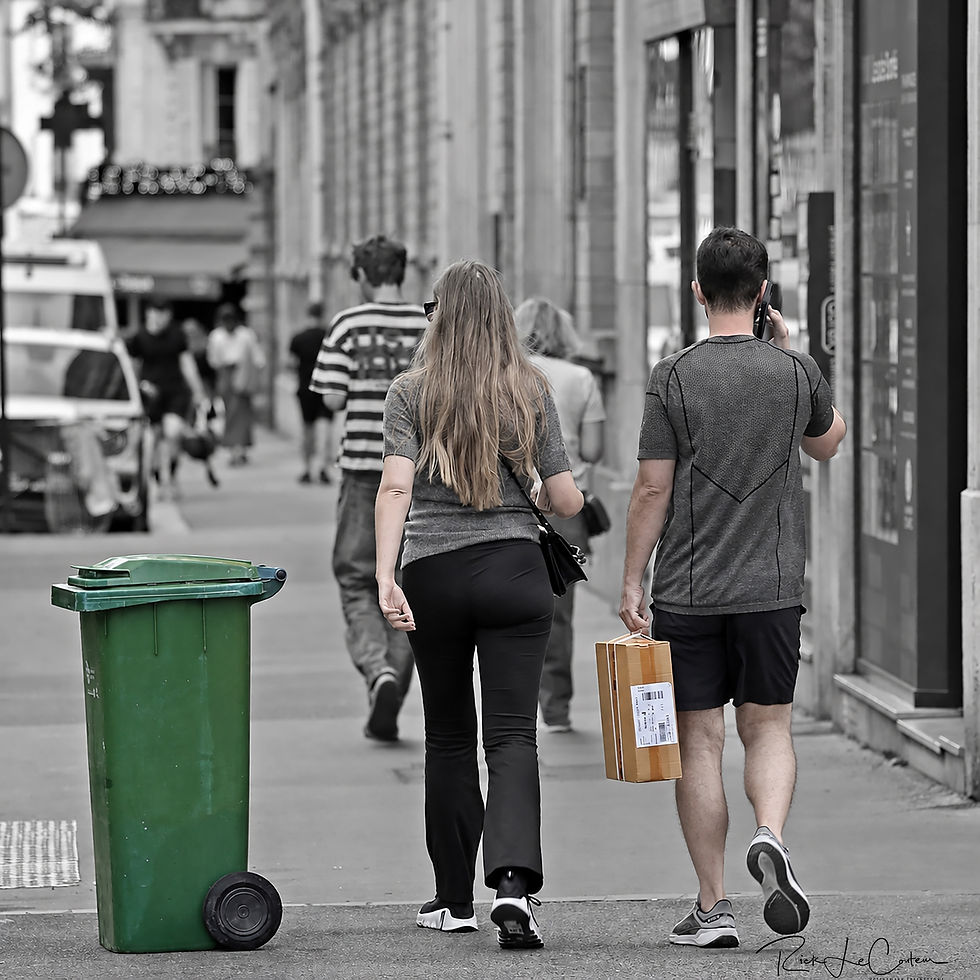
A person seen from behind.

A face disappearing into shadow.
Hands resting on a café table.
A silhouette beneath an umbrella.
A woman and her dog crossing a street.

Two people sitting on a bench, small within the architecture surrounding them.
A waiter framed through a restaurant window.
The photograph still contains a human being. It still contains a story. But the individual does not necessarily have to be identifiable.

Indeed, the City of Paris specifically notes that authorization is unnecessary when someone cannot be identified - for example because the person is photographed from behind or is blurred.
I have begun to think of this as anonymous street photography.
And perhaps something is gained rather than lost.
From Identity to Humanity
Look again at the great street photographs of the twentieth century.
We often don't know the names of the people in them anyway.
Who was the man jumping over the puddle behind the Gare Saint-Lazare in Cartier-Bresson's famous photograph?
For most viewers, it doesn't matter.
He became something larger than himself.
He became a man jumping over a puddle.
The unknown lovers, café patrons, workers, children, pedestrians and old people preserved by generations of photographers gradually ceased to be individuals and became representatives of something much larger:
Paris, France, childhood, old age, loneliness, affection, work, pleasure, hurry, boredom.
Life.

Perhaps the legal and ethical constraints of photographing France in 2026 force the street photographer to rediscover that distinction.
The objective is not necessarily to photograph someone.
It is to photograph something about being someone.
And sometimes the most universal human face is the one we never quite see.


Comments