Corporate Greed (Part 14): The wolf in sheep’s clothing (#481)
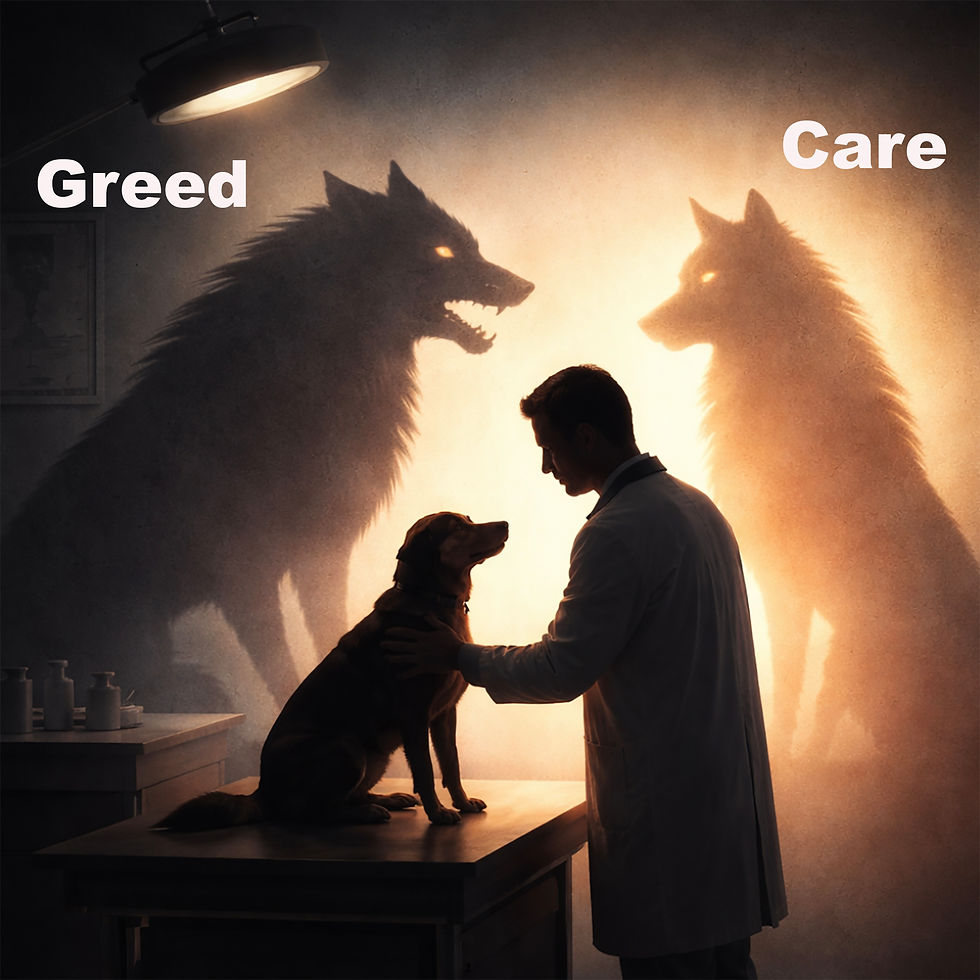
Picture two wolves in the veterinary profession.
One is Greed.
Not always snarling, often well-dressed. It speaks in polished phrases: efficiency, synergy, standardization, scale, shareholder value. It doesn’t announce itself as predation. It arrives as a spreadsheet.
The other is Care.
The old, stubborn animal in us. Compassion, craft, continuity. A vet who knows the patient, the client, the staff member’s kid’s name, the way a frightened dog leans into a particular tech’s knee. Care is slower. Messier. Harder to monetize. But it is the actual point.
The wolves fight. Every day. In clinics. In boardrooms. In universities. In continuing education. In the way we talk about production. In what we reward, what we tolerate, what we rationalize.
So which wolf wins?
Answer: The one we feed.
It doesn’t start with villainy. It starts with incentives.
Growth as the north star
When success becomes defined as endless expansion, everything else becomes adjustable - staffing ratios, appointment lengths, formularies, referral patterns, pricing opacity.
Opacity as strategy
When ownership structures are unclear, when clients can’t easily tell who is running the clinic, when branding masks consolidation, trust becomes a marketing asset instead of a moral duty.
Medicine bent around margins
Not better medicine, but billable medicine. Sometimes subtle: nudging diagnostics and add-ons. Sometimes blunt: quotas, targets, or the unspoken pressure to keep revenue curves climbing.
Clinicians as throughput units
Burnout becomes a rounding error. Turnover becomes “manageable.” The profession’s soul becomes collateral.
Greed doesn’t need to make vets bad people. It only needs to make good people operate inside a machine whose outputs are measured in dollars first and outcomes second.
Care, too, is fed by systems - not just intentions.
Transparent ownership and truthful labeling
If a practice is corporately owned, say so plainly. Trust requires daylight.
Metrics that honor outcomes
Patient welfare, client understanding, continuity of care, team stability - measured and rewarded, not treated as soft.
Clinical autonomy as a non-negotiable
Guidelines are fine. Scripts and quotas are not medicine.
Time as a clinical resource
You can’t do careful medicine at assembly-line speed. Longer appointments and protected case-review time aren’t luxuries; they’re safeguards.
Ethics in the open
Conflicts of interest disclosed. Sponsored education clearly labeled. Professional bodies resisting capture by corporate funding.
Care wins when the profession decides that some things are worth protecting even if they cost more.
The uncomfortable truth: both wolves get fed
Every vet has fed both. Every clinic has. Every one of us has made a choice that helped the machine because it was easier, because we were tired, because payroll was due, because the student debt was real, because the offer looked like stability.
This isn’t about purity. It’s about direction.
The profession won’t be saved by better slogans.
It will be saved by what we reward, what we disclose, and what we refuse.
Because in veterinary medicine, the wolves are already in the room.
And they are hungry.



Comments