Narbonne: The Woman in the Archbishop’s Courtyard (#702)
Updated: 4 days ago

You walk through Narbonne surrounded by history.
Roman history beneath your feet.
Medieval history above your head.
The enormous Gothic choir of the Cathedral of Saint-Just-et-Saint-Pasteur rises toward the sky. Beside it stands the Palace of the Archbishops, part residence and part fortress, its towers and walls reminding you that medieval churchmen exercised temporal as well as spiritual power.
And then you walk into the courtyard. And there she is. A woman. Naked. Crouching. Powerful. Tattooed. Completely unexpected.
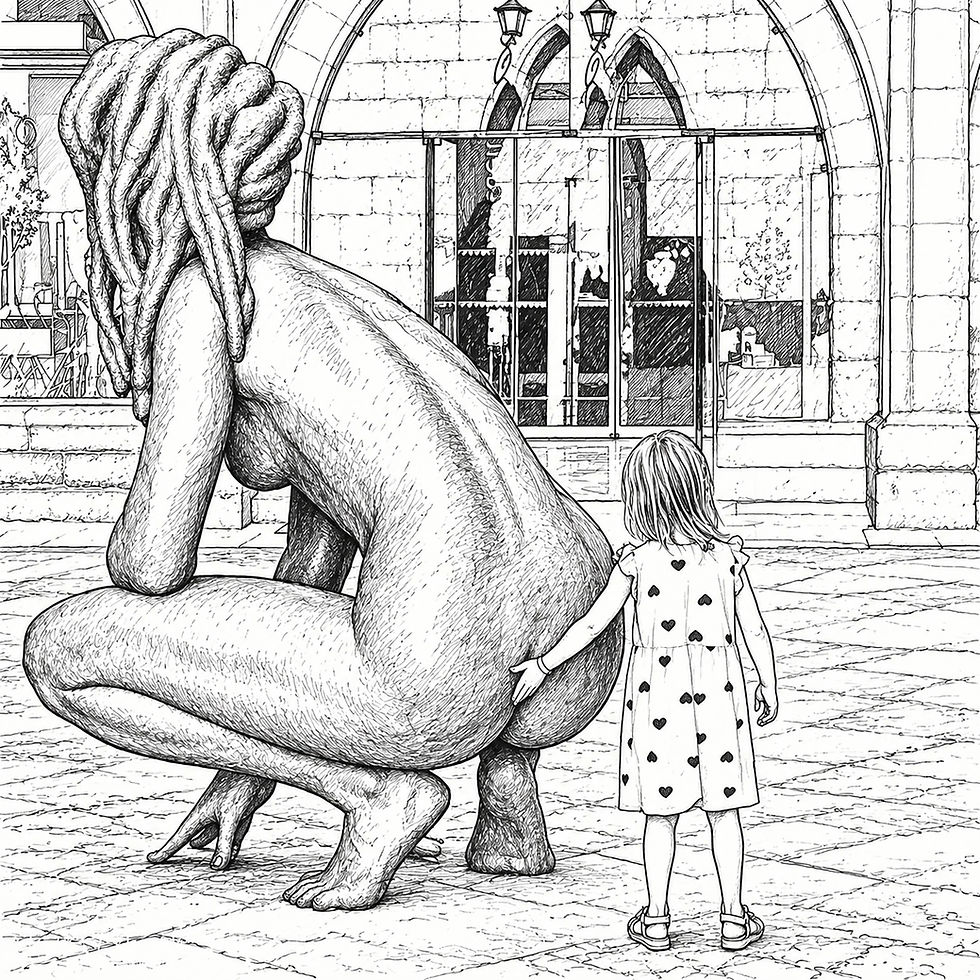
Her name is Walking in Beauty.
She is a monumental bronze sculpture, more than two metres high, created by the Spanish sculptors Joan Coderch and Javier Malavia, who work together under the name Coderch & Malavia.
And perhaps it is the setting that makes her so arresting. If she were standing in the courtyard of a contemporary art museum, we might glance at her, recognize her as modern sculpture, walk around her and move on.
But she isn't.
She is crouching in the courtyard of the Palace of the Archbishops of Narbonne.
And that changes everything.
The Artists Behind the Woman
Walking in Beauty was created in 2018 by Coderch & Malavia.
Joan Coderch, born in 1959, trained in Fine Arts in Barcelona. Javier Malavia, born in 1970, studied at the Faculty of Fine Arts in Valencia. After developing their skills separately and working alongside one another professionally, they established their joint artistic project in Valencia in 2015.
At the center of their work is the human figure.
Not the human body as something static or merely anatomically beautiful, but the body caught in a moment - moving, bending, balancing, struggling, thinking, dancing or preparing to act.
Their sculptures often seem to have been stopped for only a fraction of a second.
Walking in Beauty is a wonderful example.
The original work dates from 2018. The monumental version displayed in Narbonne rises to approximately 2.2 metres.
The title draws upon the Navajo/Diné concept commonly translated as Walking in Beauty - the idea of living in harmony with oneself, with other people, with nature and with the world around us.
Even the tattoos have meaning.
A phoenix on the woman's back evokes regeneration, resilience and rebirth.
A mandala on her shoulder represents unity, harmony and the cycles of life.
Nothing about her seems accidental.
She is crouched low, almost in the pose of a warrior. But she does not look submissive. Quite the opposite.
Her body seems compressed like a spring. There is tension in her limbs and confidence in her posture. She looks capable of standing at any moment. Or jumping. Or running. Or fighting.
There is strength in her stillness.
An Extraordinary Setting
The monumental sculpture came to Narbonne as part of Millenium, an exhibition of the work of Coderch & Malavia at the Palace of the Archbishops.
That matters.
She is not simply a modern statue that accidentally found herself surrounded by medieval buildings.
The juxtaposition was part of the experience.
Contemporary human bodies were placed against ancient stone.
And few settings could provide a more powerful contrast.
The Palace of the Archbishops has more than eight centuries of history. It was not merely the residence of Narbonne's archbishops. It was also a fortress and a physical expression of their enormous religious and political authority.
Its towers still dominate the center of Narbonne.
The palace stands immediately beside the Cathedral of Saint-Just-et-Saint-Pasteur, begun in 1272 - the same extraordinary cathedral whose Gothic choir was completed but whose intended transept and nave were never fully built.
Cathedral, palace, cloisters, towers and fortifications once formed an extraordinary concentration of ecclesiastical power.
Imagine the people who crossed this courtyard. Archbishops. Priests. Canons. Officials. Servants. Petitioners. Men in robes carrying documents and decisions. Men accustomed to authority.
Men inhabiting a world in which the Church determined much of the structure of public and private life.
And now, centuries later, a naked woman occupies their courtyard.
Not Venus. Not the Virgin Mary. Not a saint. Not an allegorical maiden demurely holding a book, a cross or a sheaf of wheat.
A modern woman.
Tattooed. Muscular. Independent.
And she does not appear remotely interested in asking anyone's permission to be there.
That was what I liked about her.
The Woman and the Palace
The more I looked at her, the more the relationship between sculpture and surroundings seemed to change.
At first, the palace dominates. How could it not?
Ancient stone surrounds her. Towers rise above her. The cathedral looms nearby. Everything represents permanence, authority and institutional power.
The woman is tiny by comparison. And yet your eye keeps returning to her.
Perhaps because she is the only thing that seems alive.
The palace represents the past. She represents the present.
The palace was built to project authority. She seems to possess authority without needing to project it.
The palace encloses her. But somehow she owns the courtyard.
And then there is the cathedral beside her.
I had been thinking about that cathedral as a magnificent medieval ambition that was never completed.
Its soaring choir was built. Its grand architectural dream was not.
The nave and transept that should have completed the enormous Gothic structure never materialized as originally intended.
And suddenly there seemed to be a conversation taking place between the cathedral and the woman.
The unfinished cathedral.
The complete woman.
One represents institutional ambition reaching upward. The other represents an individual grounded firmly on the earth.
One tried to conquer the sky. The other crouches close to the ground.
One required generations of builders, enormous resources and institutional power. The other requires nothing more.
She is already complete.
There is something wonderfully satisfying about that.
Walking in Beauty
Perhaps that is also why the title matters.
Walking in Beauty sounds, at first, as though it might refer simply to physical beauty.
It doesn't. The idea is much richer.
Beauty is not something you possess. It is a way of moving through the world. It suggests balance. Harmony. Respect. Resilience. Connection. Living comfortably within yourself and within the world surrounding you.
The phoenix on her back becomes particularly appropriate. Institutions rise and fall. Political power shifts. Religions change. Cities reinvent themselves. Buildings lose their original purpose. People disappear. Something new emerges.
Narbonne itself has done exactly that.
Roman Narbo Martius became a Visigothic city, a medieval ecclesiastical center and eventually the modern southern French city through which we walk today.
The Roman road remains beneath the Place de l'Hôtel de Ville.
The archbishops are gone. Their palace remains. Their cathedral remains unfinished.
And a tattooed woman now crouches in their courtyard.
There is something almost mischievous about that progression.
But there is something profound about it too.
What We Remember
Travel is supposedly about seeing famous things.
Cathedrals. Palaces. Roman roads. Museums. Monuments.
We photograph them because we know we are supposed to remember them.
But travel rarely works that way.
Sometimes what stays with you is something you had never heard of before you arrived. Something around a corner. A person at a café. A dog sleeping beneath a restaurant table. A musician in a square. A fragment of Roman road.
Or a naked woman crouching in the courtyard of an archbishop's palace with little girls climbing on it.

I knew I would remember Narbonne's cathedral.
I did not expect to remember the woman outside it. But I will.
Perhaps because she transformed the courtyard. Perhaps because she seemed so wonderfully out of place. Or perhaps because, after looking at her for a while, she didn't seem out of place at all. She belonged there.
The medieval archbishops built their palace to last. The cathedral builders attempted to build something that would reach toward eternity.
Neither could have imagined her. And yet there she is.
The archbishops are gone. Their palace remains. Their cathedral remains magnificently unfinished. And in their courtyard, seven centuries later, a woman crouches beneath the ancient stones.
Strong. Independent. Resilient. Unapologetic. Complete.
Walking in Beauty.


Comments