Paris: Finding a Wildebeest on My Napkin (#706)

A wet ring on a paper napkin holds a secret world.
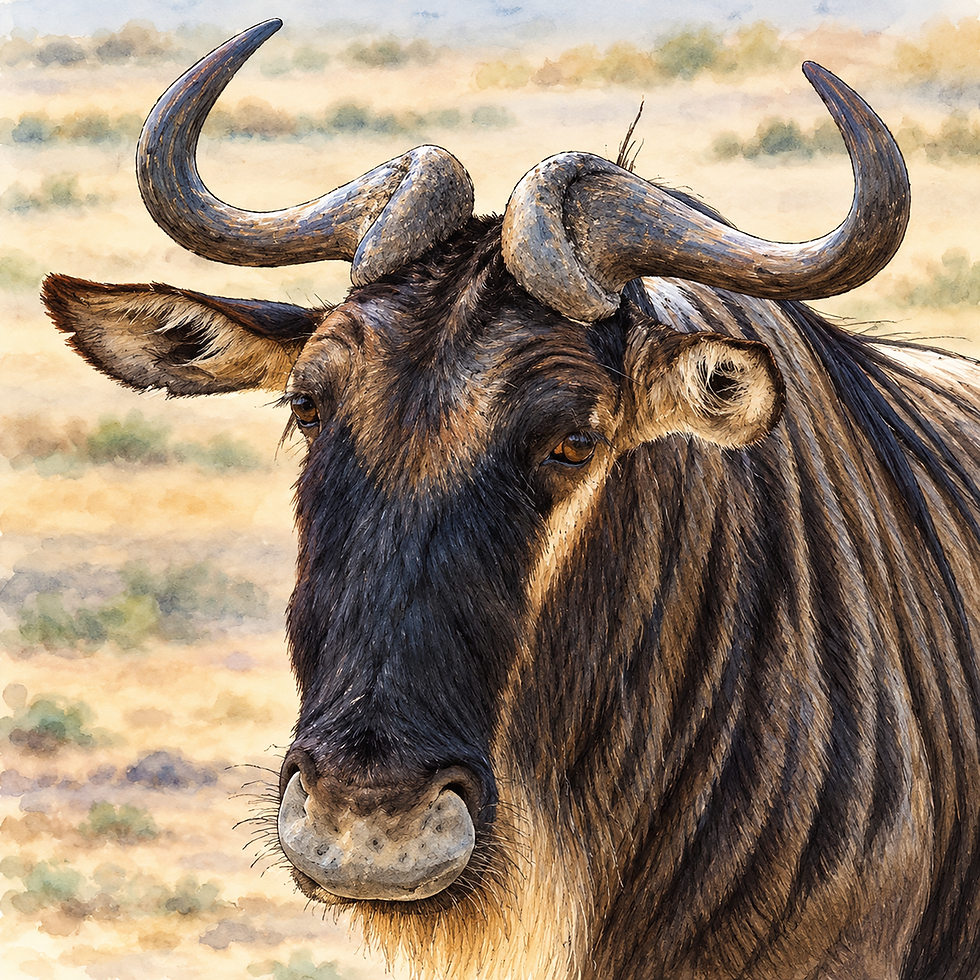
I looked down at my table today and saw a wildebeest.
Not an actual wildebeest, of course. There was no thundering of hooves, no dust rising over the Serengeti, no anxious glances toward a river filled with crocodiles.
Just a paper napkin.
My glass of cold water had been sitting on it for a while. Condensation had gathered on the outside of the glass, trickled downward, and soaked into the paper. When I lifted the glass, it left behind the usual irregular damp mark.
Except it wasn't usual.
There was a face.
Two eyes. A long muzzle. Heavy features. Even the suggestion of horns.
A wildebeest was staring back at me.
And once I had seen it, I couldn't unsee it.

The Animal That Wasn't There
There is a wonderful word for this:
Pareidolia.
It describes our tendency to perceive something familiar - particularly a face or recognizable shape - in something random.
We see a rabbit in a cloud, a face in the front of a car, a person in the bark of a tree, or a man in the moon.
And, apparently, a wildebeest in a wet napkin.
The remarkable thing is that the wildebeest isn't really there. The marks were produced by nothing more purposeful than water moving through paper fibers. There was no artist. No drawing. No intention.
My brain supplied the wildebeest.
But why a wildebeest?
That is the part I find intriguing.
Perhaps We See What We Carry With Us
I have spent a good deal of my life looking at animals.
As a veterinarian, I learned to look carefully at them - to notice posture, symmetry, movement, expression and tiny deviations from normal.
As a wildlife photographer, I learned another kind of looking: searching a landscape for the shape of an animal, finding an eye among leaves, recognizing a silhouette before consciously knowing what it is.
Years of looking train the eye. Perhaps they also train the imagination.
Someone else might have looked at my napkin and seen nothing more than spilled water. A child might have seen a monster. Someone fascinated by human faces might have seen an elderly man with a beard.
I saw Africa. I saw a wildebeest.
And perhaps that says as much about the observer as it does about the object being observed.
The Pleasure of Seeing
We spend much of our lives learning to identify things correctly.
This is a chair. That is a tree. That is a dog. That is a stain on a napkin.
There is obvious value in doing so. Much of science depends upon separating observation from imagination.
But occasionally it is rather nice to allow the opposite to happen.
To look at something ordinary and permit it to become extraordinary.
Children do this naturally. A cardboard box becomes a castle. A stick becomes a sword. Clouds become elephants, dragons and sailing ships. Somewhere along the way, adults become very good at seeing things only for what they are supposed to be.
A napkin is a napkin. A stain is a stain.
And perhaps we lose something in the process.
A Tiny Safari at the Table
There was something especially delightful about the absurdity of my discovery.
I have traveled considerable distances to see wildebeest. People fly halfway around the world to watch them gather on the plains of East Africa. Photographers carry enormous lenses. Safari vehicles bounce along dirt tracks. We wait, watch and hope that an animal will turn its head at precisely the right moment.
And here was one waiting quietly beneath my water glass.
Just condensation on a glass.
It reminded me that curiosity does not necessarily require exotic places. We sometimes imagine that discovery waits for us somewhere else - in Africa, Antarctica, the Galápagos, a museum, a cathedral, a laboratory.
But discovery is not really a place.
It is a way of looking.
Look Again
I could easily have picked up that napkin, wiped the table and thrown it away.
Most days, I probably would have.
Instead, for some reason, I looked twice.
That second look made all the difference.
Perhaps there is a small lesson hiding in my wildebeest.
We are surrounded by things we barely notice because we have already decided what they are. A gutter is a gutter. A doorway is a doorway. A shadow is a shadow. A stranger passing us on the street is simply part of the crowd.
But look again.
There may be a photograph there.
A story. A question. A moment of beauty.
Or occasionally, if you are very lucky, a wildebeest staring back at you from a wet paper napkin.


Comments