Red Fort of Agra: Power, beauty, & the weight of history (#515)
- Rick LeCouteur
- Feb 1
- 3 min read

The Red Fort of Agra does not announce itself gently.
It rises from the banks of the Yamuna like a statement. Massive red sandstone walls, crenellated and impenetrable, glowing warm in the Indian sun. You feel it before you understand it. This is not merely architecture. This is authority, ambition, and empire, built to endure.
I arrived in Agra early in the day, the heat already pressing in. The Taj Mahal may draw the crowds, but the Red Fort tells the deeper story.
If the Taj is poetry, the Red Fort is prose.
Layered, complex, political, and human.
A Fort Born of Empire
The Red Fort was commissioned in 1565 by Emperor Akbar, the third Mughal emperor and arguably the most visionary of them all. Akbar ruled not through fear alone but through strategy, tolerance, and administrative genius. He moved his capital from Delhi to Agra and built the fort not merely as a military stronghold, but as a city within walls.
A seat of government, a royal residence, and a symbol of Mughal dominance.

Construction took eight years. What emerged was a fortress stretching over 2.5 kilometers in circumference, protected by massive walls rising more than 20 meters high. Built primarily of red sandstone, the fort earned its name not from blood or conquest, but from the stone itself, Rich, warm, and glowing at sunset.
Yet this was never just a fort.
Inside those walls lived emperors, queens, courtiers, concubines, poets, soldiers, and servants. Politics, love, betrayal, art, and faith all coexisted in close quarters. It was a living organism, pulsing with power.

A City Within Walls
Passing through the Amar Singh Gate, you enter another world. The noise of modern Agra fades, replaced by open courtyards, arcaded halls, and a strange sense of calm. The scale is immense, but the details are intimate.

Akbar’s early structures are solid and muscular. Designed for authority and defense. But as the fort passed to his grandson Shah Jahan, the tone changed.
Shah Jahan, the builder of the Taj Mahal, brought elegance and refinement.

He replaced red sandstone with white marble. He introduced delicate inlay work, flowing water channels, and open pavilions designed for comfort as much as for grandeur.
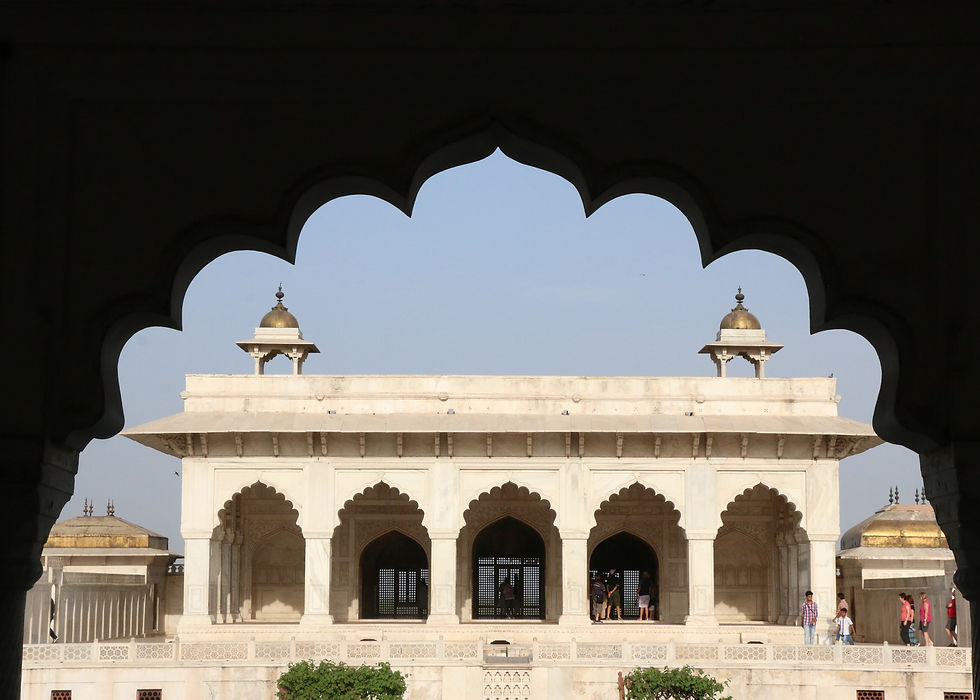
The Diwan-i-Am (Hall of Public Audience) still carries echoes of imperial ritual, where the emperor would hear petitions from his subjects.
Nearby, the Diwan-i-Khas (Hall of Private Audience) once hosted diplomats and dignitaries beneath carved marble and precious stone.
And then there is the Musamman Burj.
This octagonal tower, overlooking the Yamuna, is where Shah Jahan spent the final years of his life, imprisoned by his own son, Aurangzeb.
From its marble balcony, he could see the Taj Mahal in the distance.
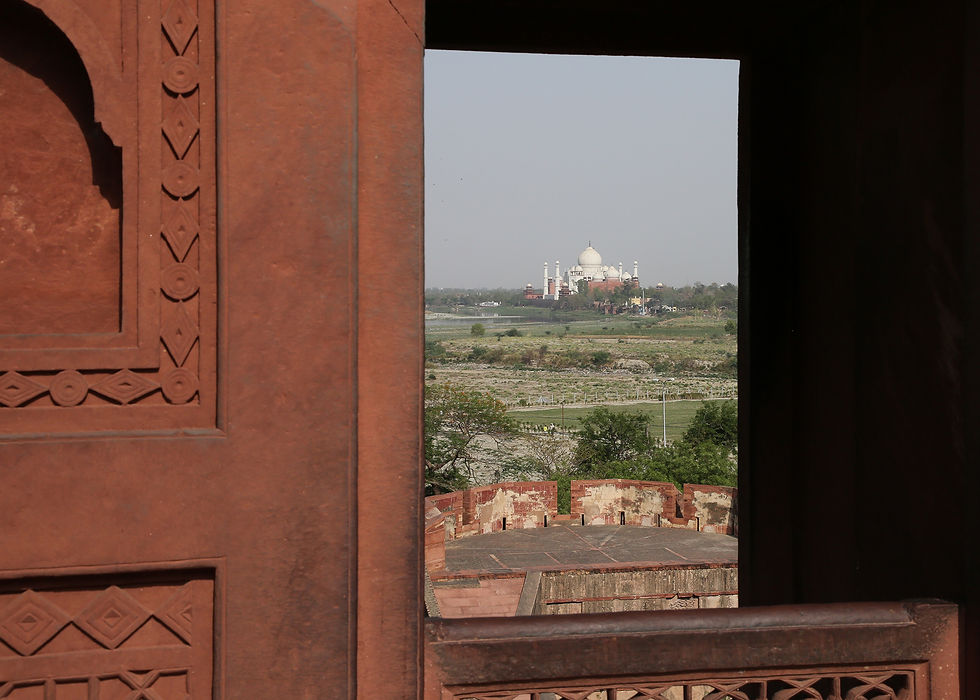
The Taj was the tomb he built for his beloved wife Mumtaz Mahal.
It is impossible to stand there and not feel the weight of that story. A ruler who commanded empires, reduced to watching the monument of his greatest love from afar.
Legend tells us that he spent his final days gazing at the Taj, its white dome glowing across the river, until death reunited them.
Whether entirely true or gently embellished, the story lingers in the air. The view alone is enough to make it believable.
More Than Mughal Glory
The Red Fort’s story does not end with the Mughals.
In 1803, it fell to the British East India Company.
Later, during the Indian Rebellion of 1857, it became a site of resistance and retribution. Portions were destroyed. Others repurposed. The fort became a military garrison, its elegance interrupted by colonial pragmatism.
Yet it survived.
In 1983, UNESCO designated the Red Fort a World Heritage Site, recognizing not just its architectural significance but its role in shaping the political and cultural history of India.
Walking Through Time
What struck me most was not the scale or the beauty but the layering of time.
You walk through Akbar’s courtyards, Shah Jahan’s palaces, British barracks, and modern restoration efforts all in one slow circuit. The stone carries centuries of footsteps. Empires rise and fall, but the walls remain.
And unlike the Taj Mahal, which inspires awe and reverence, the Red Fort invites contemplation.
It asks quieter questions:
What does power cost?
What remains after ambition fades?
How much of history is built on love, and how much on control?
Leaving the Fort
As I left in the late afternoon, the sun cast long shadows across the ramparts. The sandstone glowed again, as it must have five centuries ago. Tourists filtered out. Vendors packed up their wares. The Yamuna slipped quietly past, indifferent to empires.
The Red Fort does not seduce like the Taj Mahal.
It endures.
And in that endurance lies its power.



Comments