Rue Saint-Ferdinand: Who Owns the Street? (#705)

Rue Saint-Ferdinand is not one of the great streets of Paris.
It isn't the Champs-Élysées. It doesn't have the grandeur of Boulevard Saint-Germain or the fashionable mythology of Rue Saint-Honoré.
It is only about 435 metres long, running through the Ternes quarter of the 17th arrondissement from near the Église Saint-Ferdinand-des-Ternes toward the Avenue de la Grande-Armée.

And yet, after spending some time here, I began to think that this modest street tells you something rather important about Paris.
It is, in almost every sense, a community.
There are brasseries and cafés. Clothing shops. Beauty salons. A veterinarian. A pharmacy. A butcher. A fruit and vegetable shop. A small supermarket. There are places to buy a bottle of wine, have your hair cut, pick up dinner, meet a friend or sit outside over a coffee.
At one end stands the beautiful Église Saint-Ferdinand-des-Ternes, after which the street is named. The first church was constructed here in the 1840s, at about the same time that the surrounding neighborhood was being developed. Rue Saint-Ferdinand was created in 1847 as the principal axis of what was then called Ferdinanville. More than 175 years later, it still performs much the same function.

It is a thoroughfare, certainly. But it is also a meeting place. A place to shop. A place to eat. A place to stop and talk. And, most noticeably, a place to walk the dog.
There seem to be dogs everywhere.
Big dogs and little dogs. Old dogs shuffling behind their owners and young dogs straining at their leads. Dogs waiting patiently outside shops. Dogs sitting beneath café tables. Dogs greeting one another with the elaborate rituals that dogs have presumably practiced on Parisian streets for generations.
And dogs peeing. Lots of dogs peeing.
Watch for long enough and you begin to notice that they seem to have their favorite places.
The base of a lamppost. A particular corner of a building. A bollard. A doorway. A tree.
One dog leaves a message. Another comes along to read it and leaves a reply.
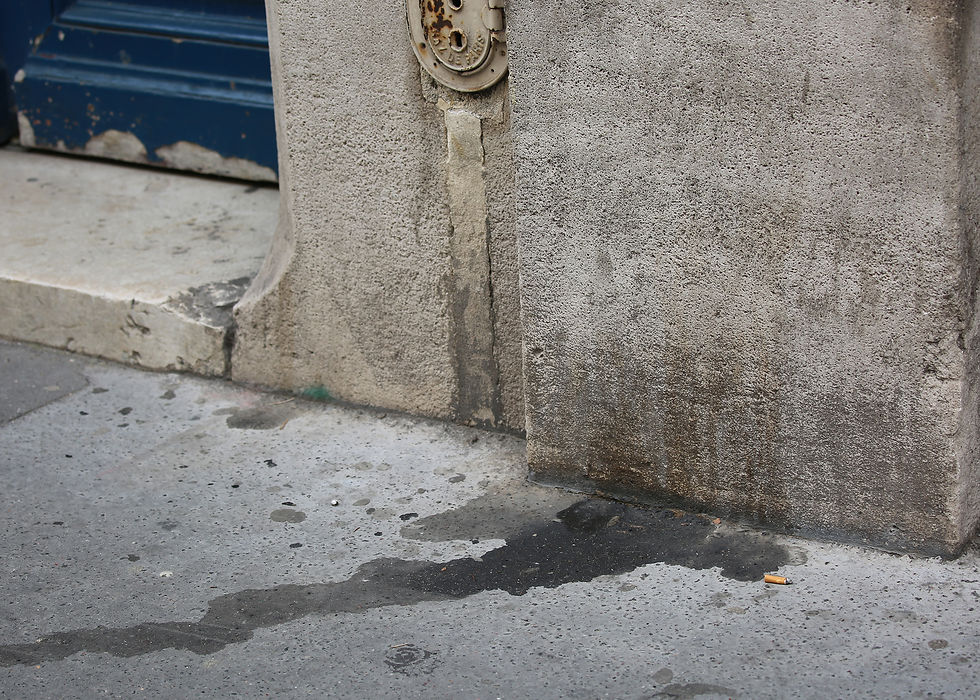
And gradually the pavement itself becomes a record of thousands upon thousands of lifted legs. Dark stains mark the sidewalk and the bases of buildings - the accumulated signatures of dogs that have walked this same little neighborhood over months and years.
Then there are the cigarette butts.
They collect in the gutters, particularly outside some of the shops where employees step outside periodically during the working day for a cigarette. One becomes ten. Ten become fifty. Eventually there is a small drift of filters against the curb.

And then there is the other rubbish. A crushed can. A plastic bottle. A scrap of paper. A food wrapper. A discarded receipt tumbling along the gutter.
None of it individually amounts to much. Collectively, it does.
And that is when Rue Saint-Ferdinand begins to puzzle me.
Because in the evening, I look up.
Above the shops are apartments. Their windows begin to glow as darkness settles over Paris.

Curtains are drawn. Lamps illuminate rooms. Somewhere behind those windows dinner is being prepared. Someone is reading. Children are getting ready for bed. A television flickers. Families talk around tables.
These are homes. And beneath them is their street.
Their butcher. Their pharmacist. Their café. Their veterinarian. Their church. Their neighborhood. Their community.
Yet the street beneath those softly illuminated windows can be dirty, stained, littered and, in places, decidedly smelly.
The contrast is extraordinary.
Perhaps it strikes me because I come from somewhere else. Perhaps Parisians simply see the boundary differently.
The apartment is mine. The pavement belongs to the city. Someone else sweeps it. Someone else empties the bins. Someone else washes the gutters.
Someone else is responsible.
But surely community begins precisely where the front door ends.
That raises a question much larger than Rue Saint-Ferdinand.
What does it mean to own a place?
Not legally. Emotionally.
Ownership does not have to mean possessing something. It can mean feeling responsible for it.
If a piece of paper were lying on the floor of my living room, I would pick it up. If someone dropped a cigarette butt onto my carpet, I would object. If my dog repeatedly urinated against the leg of my dining-room table, I would presumably do something about it.
But move the same behaviors a few meters beyond the front door and responsibility somehow becomes diluted.
It becomes public.
And public can easily come to mean someone else's problem.
That may be the paradox of Rue Saint-Ferdinand.
It possesses almost everything required to make a community. The shops are small enough that people recognize one another. The cafés spill onto the pavement. People stop to talk. Dogs introduce strangers. The church anchors one end of the street. Place Saint-Ferdinand provides the little village square in the middle.

There is intimacy here. There is familiarity. There is life. There is even beauty.
But is there ownership?
Not ownership measured in deeds and property values, but the quieter kind. The feeling that:
This is ours, and therefore we should look after it.
I found myself wondering what Rue Saint-Ferdinand would look like if every person who lived above it regarded the pavement below as an extension of their home.
Pick up one piece of rubbish. Put the cigarette butt in a container. Wash down the patch outside the shop. Take responsibility for what the dog leaves behind.
Nothing heroic. Nothing requiring another municipal program, another regulation or another government department.
Just ownership.
And perhaps that is why the street fascinates me.
Because despite everything I have described, I like Rue Saint-Ferdinand very much.
It is quintessentially Parisian - imperfect, crowded, intimate, slightly chaotic and wonderfully alive.
The brasseries fill. Shopkeepers stand in their doorways. Neighbors greet one another. Dogs investigate yesterday's news on the lampposts. And as evening falls, the apartments above the street begin to glow.
I look upward and think how warm and beautiful it all seems.
Then I look down at the gutter.
Two views of the same community.
One makes me smile.
The other makes me wonder:
If we don't feel responsible for the few meters of the world immediately outside our own front door, where exactly does community begin?


Comments