The Future of Veterinary Education: Part 6. The AI Veterinarian (#661)
- Rick LeCouteur
- Jun 22
- 4 min read
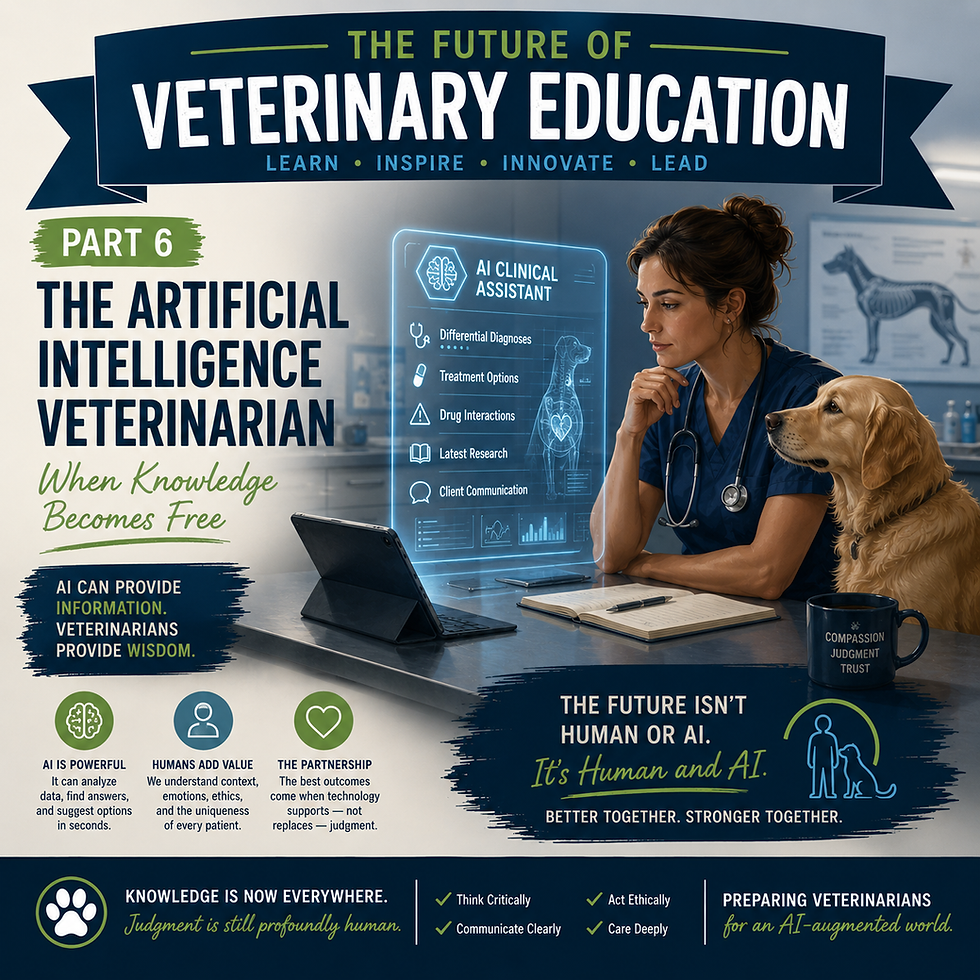
When Knowledge Becomes Free
Parts 1–5 have focused on how we teach, assess, mentor, and develop veterinarians.
Part 6 asks a question that would have seemed like science fiction when many of us entered veterinary school:
What happens when knowledge itself becomes free?
For most of veterinary history, knowledge was scarce.
Students spent countless hours memorizing anatomy, physiology, pharmacology, pathology, and hundreds of disease syndromes because they had little choice.
Information was difficult to access.
Textbooks were expensive.
Libraries had limited hours.
Journal articles could take weeks to obtain.
Knowledge itself was valuable because it was hard to find.
Today, that world no longer exists.
And the implications for veterinary education may be profound.
The End of Information Scarcity
A modern veterinary student can retrieve more information on a smartphone in thirty seconds than many veterinarians could access during an entire afternoon forty years ago.
Diagnostic algorithms. Drug dosages. Research papers. Differential diagnoses. Treatment recommendations. Continuing education lectures. Clinical images. Videos. Expert opinions.
And now, increasingly, artificial intelligence.
The defining challenge is no longer finding information.
The challenge is deciding what to do with it.
The New Reality
Like it or not, today's graduates will practice alongside artificial intelligence.
Not instead of it.
Alongside it.
AI systems already assist with medical record generation, radiographic interpretation, literature searches, drug interaction checks, client communication, differential diagnosis generation, and educational support.
These capabilities will expand rapidly.
The question is no longer whether artificial intelligence will influence veterinary medicine.
It already does.
The question is how veterinary education should respond.
The Memorization Problem
For generations, educational systems rewarded memorization.
Students memorized pathways, lists, drug dosages, classifications, and anatomical structures.
And understandably so.
If information was difficult to access, memorization had enormous value.
But what happens when every student carries instant access to a vast medical knowledge base?
Should veterinary education continue emphasizing memorization to the same degree?
Or should it shift toward something else?
This question makes many educators uncomfortable.
And it should.
Because it challenges assumptions that have existed for decades.
What AI Does Well
Artificial intelligence excels at certain tasks.
AI can rapidly retrieve information. AI can recognize patterns. AI can summarize enormous amounts of data. AI can generate lists of differential diagnoses. AI can compare treatment options. AI can identify relevant literature.
In many circumstances, AI can perform these tasks faster than experienced clinicians.
That reality is not a threat.
It is simply reality.
The calculator did not eliminate mathematics.
MRI did not eliminate neurologists.
Artificial intelligence will not eliminate veterinarians.
But it may change what veterinarians need to know.
What AI Cannot Do
At least for now, artificial intelligence struggles with something veterinarians encounter every day.
Context.
A dog is not merely a collection of symptoms, it exists within a family, a financial situation, an emotional situation, and a social situation.
A unique set of circumstances.
Veterinarians rarely solve medical problems alone.
They help people make decisions.
And decision-making often depends upon factors that cannot easily be captured by algorithms.
The Human Conversation
Consider a client facing a difficult decision.
An elderly dog. A serious diagnosis. Several possible treatment options. No perfect answer.
The client asks:
What would you do if this were your dog?
That question is not seeking information.
It is seeking judgment, experience, perspective, compassion, and trust.
No database can fully answer it.
No algorithm can completely replace it.
The value of the veterinarian often lies not in possessing information but in helping people navigate uncertainty.
A Lesson from Chess
When computers first defeated world chess champions, many predicted the end of competitive chess.
The opposite occurred.
Chess flourished. Players learned to use computers as tools. Human-computer partnerships emerged. The strongest competitors combined computational power with human judgment.
The future of veterinary medicine may look similar.
The most effective veterinarians may not be those who compete with artificial intelligence.
The most effective veterinarians may be those who learn how to work alongside it.
What Should Students Learn?
This raises a fascinating educational question.
If information becomes increasingly accessible, what should veterinary students spend their time learning?
Perhaps less emphasis on memorization, and more emphasis on interpretation.
Less emphasis on recall, and more emphasis on reasoning.
Less emphasis on finding information.
More emphasis on evaluating information.
Students may need to become skilled consumers of knowledge rather than repositories of knowledge.
The distinction is important.
The New Core Competencies
The veterinarian of the future may require a somewhat different set of strengths:
Critical thinking.
Clinical reasoning.
Communication.
Ethical decision-making.
Adaptability.
Leadership.
Judgment.
Curiosity.
These are precisely the qualities that artificial intelligence struggles to replicate.
Ironically, as technology becomes more sophisticated, the most valuable human skills may become even more important.
The Danger
There is, however, a danger.
Some may conclude that because AI can retrieve information, foundational knowledge no longer matters.
That would be a mistake.
Clinical judgment requires knowledge.
You cannot critically evaluate information you do not understand.
You cannot recognize errors if you lack foundational expertise.
Artificial intelligence is a powerful assistant.
It is not a substitute for education.
A veterinarian who blindly follows AI recommendations is no more effective than one who blindly follows a textbook.
Both have surrendered judgment.
The Real Opportunity
Perhaps the greatest opportunity lies not in replacing traditional education but in reimagining it.
If AI can assist with information retrieval, educators may have more time to focus on what matters most.
Clinical reasoning. Communication. Ethics. Mentorship. Professional identity. Judgment.
In other words, the very themes explored throughout this series.
Looking Ahead
Artificial intelligence is often discussed as a technological challenge.
It may actually be an educational opportunity.
For the first time in history, veterinary educators can seriously ask:
What knowledge must students memorize?
What knowledge must they understand?
What knowledge can they access when needed?
The answers may reshape veterinary education for generations.
But one thing seems certain.
As artificial intelligence becomes more capable, the qualities that define exceptional veterinarians will become increasingly human.
Compassion. Wisdom. Trust. Judgment. Empathy.
The future veterinarian may practice with artificial intelligence at their side.
But the future of veterinary medicine will still depend upon the uniquely human ability to care.
Coming Next
Part 7. Teaching Judgment: The Skill No One Can Fully Define
Part 7 serves as a pivot point in the series.
The earlier essays focus largely on educational structures.
Beginning with Part 6, the discussion shifted toward the qualities that distinguish excellent veterinarians from merely competent ones.
That sets up Part 7, which may ultimately become the centerpiece of the entire series.


Comments