Under the South Atlantic: The growing hole in Earth’s magnetic shield (#415)
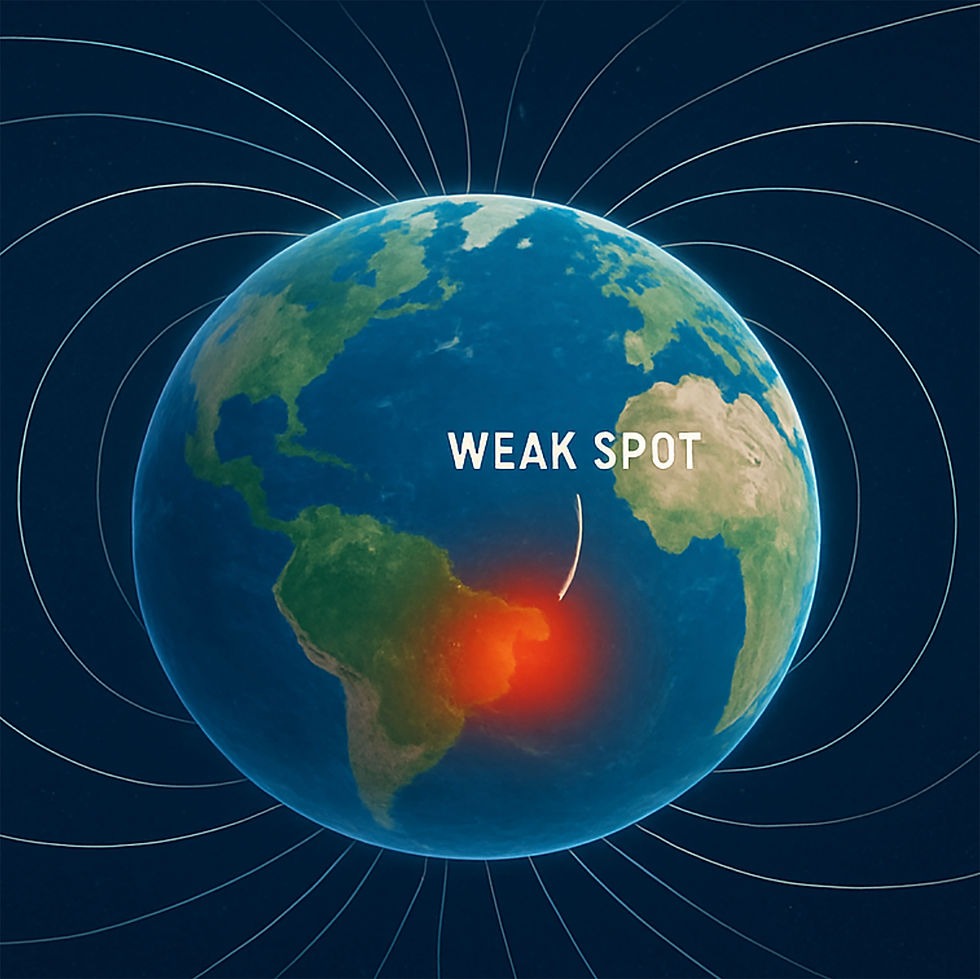
The weak spot in Earth’s magnetic field, known as the South Atlantic Anomaly (SAA), is highly significant because it offers insights into the behavior of Earth’s core dynamics, space-weather vulnerability, and satellite safety.
What is the weak spot?
The SAA is a vast region over the South Atlantic Ocean where Earth’s magnetic field is significantly weaker than elsewhere.
This anomaly was first detected in the late 1950s when satellites noticed unusually high radiation levels there. Evidence that the magnetic shield was less effective at deflecting cosmic rays and solar particles.
Why it matters scientifically
Window into Earth’s Core Dynamics
The SAA’s expansion, now covering an area nearly the size of Europe, suggests complex processes deep within the Earth, particularly at the boundary between the liquid outer core and the solid inner core.
Data from the Ecological Society of America’s (ESA’s) swarm satellite constellation shows magnetic field lines behaving unexpectedly. in this region, some field lines re-enter the core instead of emerging from it, indicating irregular movements of the molten iron that generate the field.
These findings help scientists understand how and why Earth’s magnetic poles shift and whether the planet might be heading toward a future magnetic reversal.
Why it matters practically
Hazards for Satellites and Spacecraft
Because the field is weaker, radiation belts dip closer to Earth here. Satellites passing through the SAA encounter higher doses of radiation, which can damage electronics, corrupt data, and shorten mission lifespans.
Space agencies use this information to design more resilient spacecraft and plan orbits that minimize exposure to the anomaly.
Why it matters for life and the atmosphere
Earth’s Shield and Habitability
The magnetic field protects Earth from solar wind and cosmic radiation, preventing the erosion of the atmosphere and maintaining conditions for liquid water and life.
If such weak spots continue to expand or multiply, they could increase atmospheric vulnerability over geological timescales. Though this remains unlikely in the short term.
Key discoveries from ESA’s swarm mission
The SAA is not one uniform region, but a dynamic, shifting field that’s moving westward over Africa.
While the Canadian “strong spot” of magnetic intensity has weakened, the Siberian “strong spot” has strengthened slightly, showing the magnetic field’s asymmetrical evolution across hemispheres.
These findings underscore that Earth’s magnetic field is not a static dipole but a complex, evolving system influenced by processes deep within the core.
Rick’s Commentary
The weak spot’s significance lies in its dual role:
A diagnostic tool for studying Earth’s interior and magnetic evolution.
A real-world concern for technology and atmospheric protection.
In essence, the South Atlantic Anomaly is a living laboratory.
An active clue to the restless, dynamic heart of our planet.
What is the use of a house if you haven’t got a tolerable planet to put it on?
- Henry David Thoreau
I do have reasons for hope: Our clever brains, the resilience of nature, the indomitable human spirit, and above all, the commitment of young people when they’re empowered to take action.
- Jane Goodall
Sources
Core field changes from eleven years of Swarm satellite observations. https://www.sciencedirect.com/science/article/pii/S0031920125001414
Swarm reveals growing weak spot in Earth’s magnetic field. https://www.esa.int/Applications/Observing_the_Earth/FutureEO/Swarm/Swarm_reveals_growing_weak_spot_in_Earth_s_magnetic_field
Swarm probes weakening of Earth’s magnetic field. https://www.esa.int/Applications/Observing_the_Earth/FutureEO/Swarm/Swarm_probes_weakening_of_Earth_s_magnetic_field


Comments