Champs-Élysées: Anonymous Street Photography (#708)
There may be no more famous street in the world.
The Avenue des Champs-Élysées runs in a grand, almost theatrical line from the Place de la Concorde toward the Arc de Triomphe.
It is monumental Paris: broad pavements, plane trees, cafés, luxury stores, traffic, tourists, monuments and history. The Arc dominates the western end of the avenue, reminding everyone who looks up that this is a place intended to impress.
But when I walked the Champs-Élysées with a camera, I found myself increasingly looking down.
Not at the architecture. At the people. And none of them had names.
The Anonymous City
Street photography is peculiar in that way. We photograph people about whom we know virtually nothing.

A man sits against a stone wall playing an accordion. His instrument rests heavily against his chest, his equipment gathered beside him, a makeshift container on the pavement waiting for coins. I don't know his name. I don't know where he lives. I don't know whether he has played that same spot for ten years or arrived in Paris yesterday.
But for a fraction of a second, our lives intersected.

Elsewhere, another musician plays a saxophone beneath the trees. The gold of the instrument catches the light while the city around him seems almost deliberately monochromatic. A telephone mounted in front of him suggests a thoroughly modern form of busking: the ancient business of playing music on the street meeting the age of social media.
And then there is the bearded man on the bench.

Black clothes. Black cap. Tattoos covering his arms. White beard. Earbuds in his ears. One leg crossed comfortably over the other as he studies his phone. Around him, Paris continues at full speed.
Who is he?
The question is irresistible.
And unanswerable.
Perhaps that is the point.
People Rather Than Portraits
Traditional portrait photography begins with identity.
This is Marie.
This is Jean.
This is Pierre, who has worked here for thirty years.
Anonymous street photography reverses the process. Identity disappears, and observation takes its place.
The photograph becomes less about who someone is and more about what it is to be human in a particular place at a particular moment.

A woman in an extraordinary orange dress stands beside someone almost entirely concealed beneath white clothing and a white umbrella. They might be performers. They might be preparing for a photograph. They might simply be two wonderfully eccentric people who happened to meet beneath the Arc de Triomphe.
I don't need to know.
The mystery makes the photograph stronger.

Nearby, two women walk through the crowd, one wearing leopard print, the other in a long white crocheted dress with a brilliant patterned scarf wrapped around her head. Behind them bicycles, tourists and commuters collide visually in that wonderfully disordered way that cities produce without assistance.
Nobody arranged the scene.
Paris did.
A Study in Color
As I worked through these photographs, I became fascinated by something else:
Color.
Not the color of Paris itself, but the color carried through Paris by people.

A yellow polka-dot dress moves down the avenue like a small patch of sunshine.
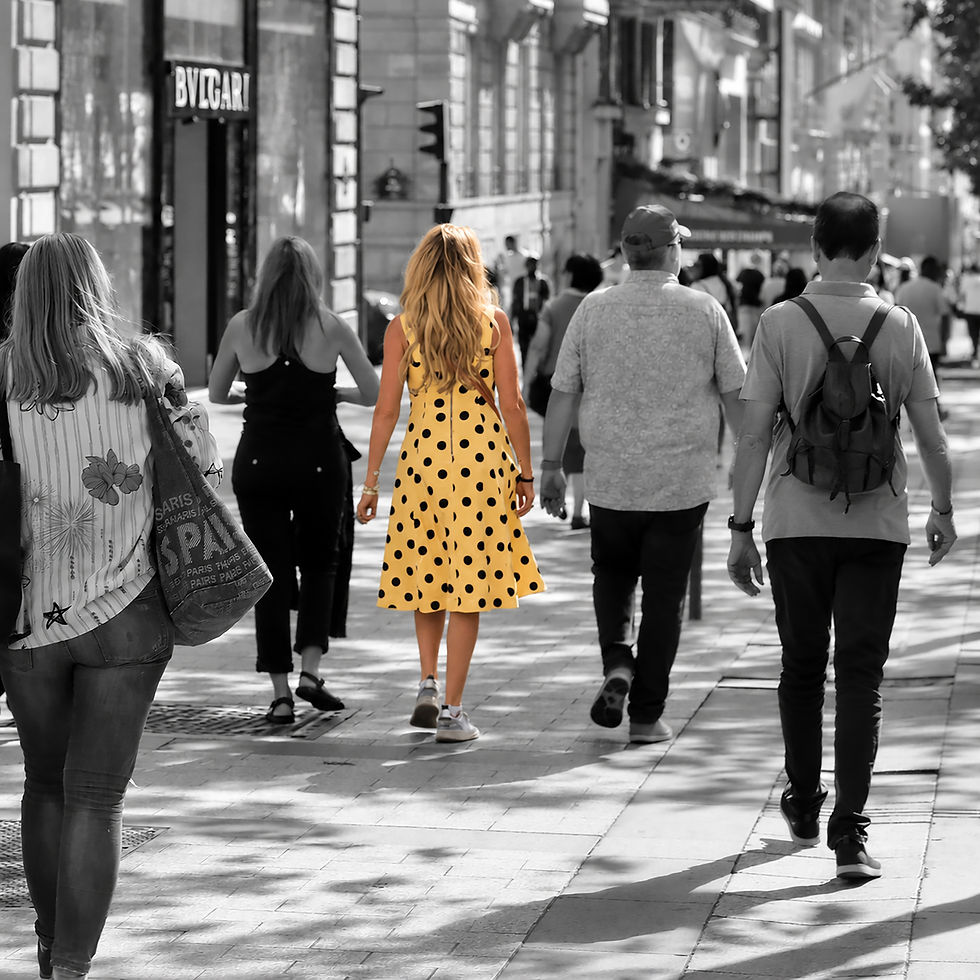
Another yellow dress, also covered in black dots, appears farther along the street. The woman wearing it walks away from me, anonymous and unaware, while Cartier hovers almost ghostlike in the background.

A young woman dressed almost entirely in pink crosses an open space beneath the trees - pink top, pink shorts, pink socks, pink ribbon. Against the gray architecture and pavement, she becomes almost luminous.

Two young women appear in elaborate dresses, one deep red and black, the other a confection of pink ribbons and flowing fabric. They look as though they have wandered out of another world and into twenty-first-century Paris.

Then there is the young woman pushing a bicycle: blonde braid, polka-dot top, blue jeans, and the tiniest flash of red appearing above the waistband.
It is an insignificant detail.
Which is precisely why I like it.
Street photography teaches us to notice things that ordinarily do not deserve noticing.
Hair

Three women lean together, absorbed in something none of us can see.
Their faces are largely hidden.
What remains?
Hair.
Black. Auburn. Blonde.
Three heads bent toward a common point. Perhaps a telephone. Perhaps a map.
It doesn't matter.
Remove the faces and the photograph becomes almost abstract - three textures, three colors, three people connected by posture.

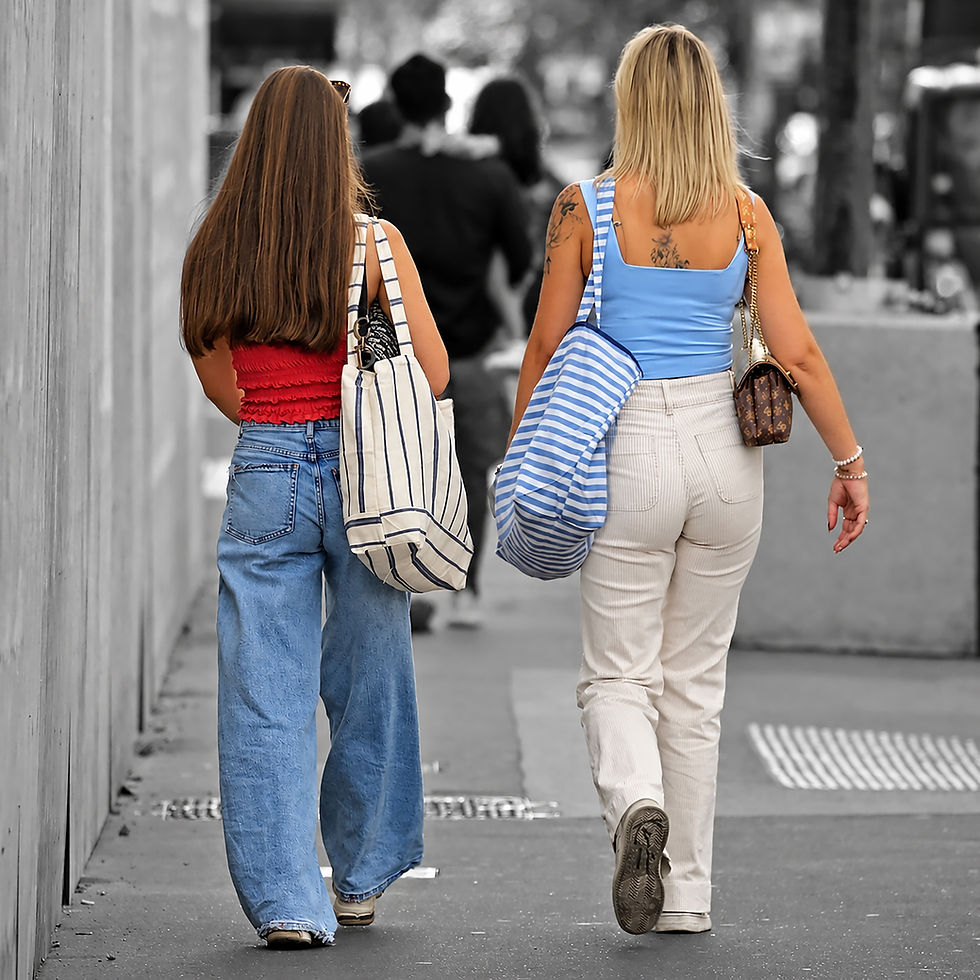
In another photograph, two young women walk away carrying enormous striped bags. One bag has horizontal stripes - the other vertical. One has long brown hair, the other blonde. Their clothes, bags, tattoos, posture and stride tell us something about them.
Or perhaps we merely imagine they do.
That distinction matters.
A photograph gives us evidence. We supply the story.
Mothers, Daughters, Friends and Strangers

A woman and a younger girl stand together in the open space near the Arc. The child reaches behind her head, gathering her hair. The older girl or woman stands beside her with a backpack over one shoulder.
Are they mother and daughter? Sisters? Cousins?
I don't know.
And I deliberately resist deciding.
That is one of the disciplines of anonymous street photography:
Observe without pretending to know.

The same applies to two women walking together across a broad pedestrian space, one in white trousers and the other in a spectacular patterned skirt and boots.

Or the traveler pulling a suitcase while a tiny white dog trots behind her.
Every photograph invites a narrative.
Every photograph also warns us that the narrative may be wrong.
The Decisive Fraction of a Second
Henri Cartier-Bresson (see bio below) famously built much of his photographic philosophy around the decisive moment - that fleeting instant when geometry, movement and meaning come together.
Street photography still depends upon it.
The accordionist looks up. The saxophonist leans into a note. A woman takes one more step. A skirt moves. A foot leaves the pavement. A hand rises toward a face. Two people momentarily separate from a crowd.
Hair catches the sunlight. Then it is gone.
A second later, the photograph no longer exists.
That is what I love about this kind of photography. I am not creating the scene. I am recognizing it.
There is a difference.
Why Remove the Color?
In these photographs I have deliberately allowed much of Paris to recede into black and white while retaining color in selected people or details.
It is obviously not documentary photography in the strictest sense. The camera recorded more color than I ultimately chose to show.
The manipulation is deliberate. The monochrome city becomes a stage. The person becomes the actor.
The yellow dress no longer competes with shop signs, cars, advertisements and hundreds of incidental colors. The pink ribbon becomes important. The saxophone glows. Tattoos emerge. Brown hair catches the light. Blue jeans suddenly matter.
It is a way of saying:
Look here.
Not because this person is famous.
Not because something extraordinary is happening.
But because, among several hundred people passing before me, this individual caught my eye.
The Arc Without the Arc
Perhaps the strangest thing about this collection is that it was made around one of the most recognizable monuments on Earth, and yet the Arc de Triomphe is almost irrelevant.
That enormous monument is there, even when it is outside the frame.
It determines the crowds, the traffic, the light, the open spaces and the constant movement of people. But I did not need another photograph of the Arc de Triomphe. Millions already exist.
What interested me was the temporary city assembled beneath it.
The musicians. The tourists. The shoppers. The women in beautiful dresses. The girl in pink. The woman with her dog and suitcase. The cyclist. The tattooed man looking at his phone. The three women leaning together. The people entering the frame and leaving it again.
None of them knew they were contributing to my portrait of Paris.
Anonymous, But Not Insignificant
And perhaps that is the word I keep returning to:
Anonymous.
There is a temptation to think that anonymity means insignificance.
Street photography suggests exactly the opposite.
Every person in these photographs was living a life every bit as complicated as mine. Each had somewhere to go, someone to meet, something to worry about, something to anticipate. Some were working. Some were traveling. Some were performing. Some were simply walking through Paris on a warm day.
I knew none of their stories.
For perhaps 1/500th of a second, however, they became part of mine.
Then I lowered the camera.
The accordion continued. The saxophone played another note. The man on the bench returned to his telephone. The women walked on. The little dog followed its owner. The yellow dress disappeared into the crowd.
And beneath the Arc de Triomphe, Paris quietly rearranged itself for the next photograph.
More About Henri Cartier-Bresson

Henri Cartier-Bresson has intuitively chronicled decisive moments of human life around the world with poetic documentary style. His photographs impart spontaneous instances with meaning, mystery, and humor in terms of precise visual organization, and his work, although tremendously difficult to imitate, has influenced many other photographers.
His photographs may be summed up through a phrase of his own:
The decisive moment.
The magical instant when the world falls into apparent order and meaning, and may be apprehended by a gifted photographer.
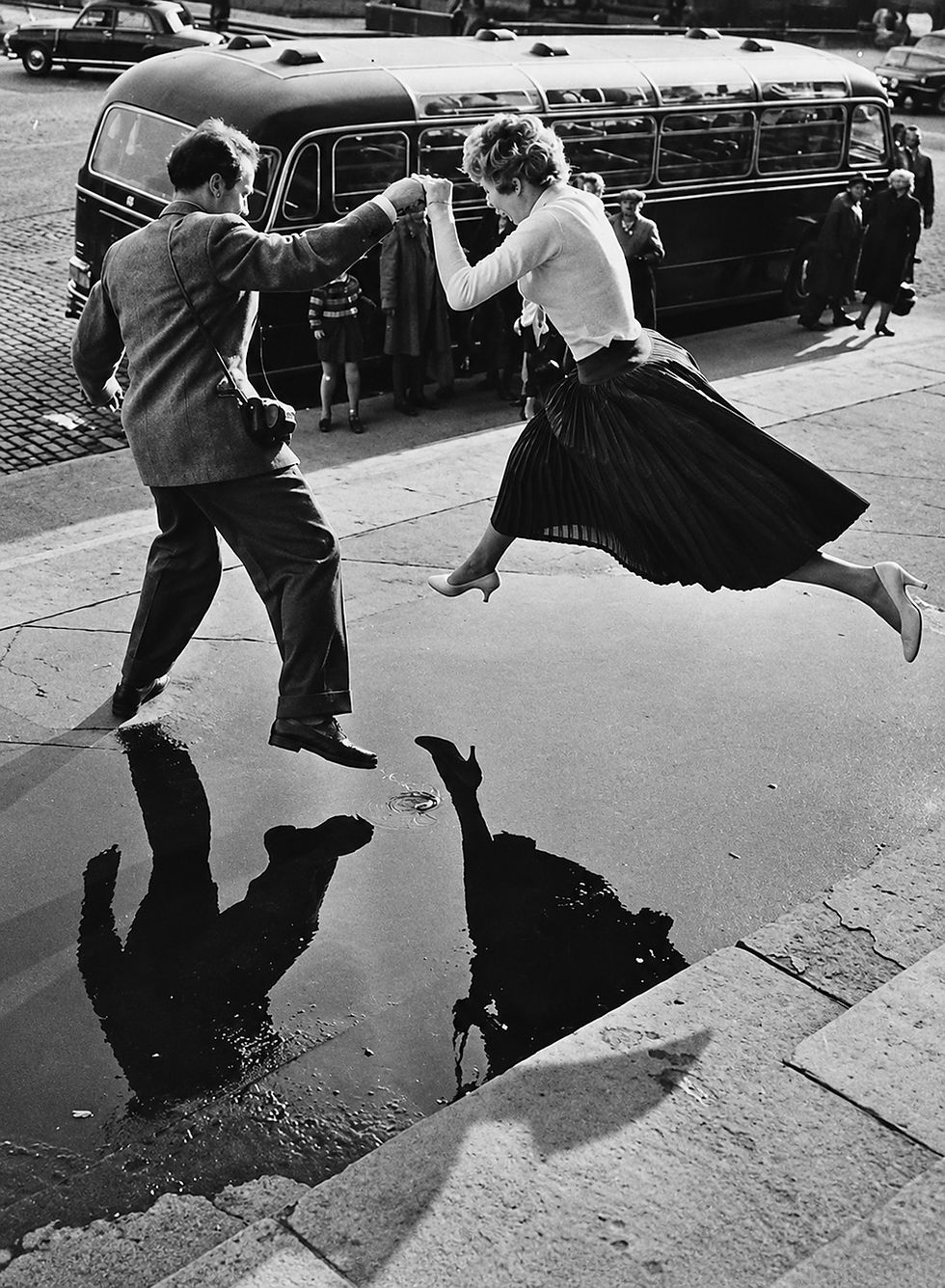
Cartier-Bresson was born in Chanteloup, and studied literature at Cambridge University in 1928-29. He began photographing in 1931 and purchased a Leica in 1933. He joined an ethnographic expedition to Mexico the next year, and in 1935 studied cinematography with Paul Strand. He assisted Jean Renoir in 1936 and 1939, and made his own documentary, Return to Life, in 1937. He was drafted into the film and photo unit of the French army in 1940 and was taken prisoner by the Germans that same year. After three years of imprisonment he escaped and began working for the French underground.
In 1943 he made series of portraits of artists, including Matisse, Bonnard, and Braque.
Through 1944 and 1945, Cartier-Bresson photographed the occupation of France and its liberation. In 1947 he co-founded the Magnum agency with Robert Capa, Chim (David Seymour), and George Rodger and he spent the next twenty years traveling around the world.
He received the Overseas Press Club Award four times; the American Society of Magazine Photographers award in 1953; and the Prix de la Société Française de Photographie in 1959, among other honors.
In 1966 he left Magnum, which remained his agent, and devoted himself to drawing.
Cartier-Bresson's extensive publications include From One China to Another (1954), The Europeans and People of Moscow (1955), The Face of Asia (1972), and The Decisive Moment (1973).


Comments