Les Halles de Narbonne: When Lunch Becomes a Rugby Match (#741)

In the south of France, a visit to the local market is about much more than buying food.
Sometimes, it involves a former international rugby player, a megaphone, and packages of meat flying through the air.
A Market with a History
There is something wonderfully French about a traditional covered market. It is simultaneously a place to shop, eat, socialize, argue, gossip, drink wine, and observe humanity.
Narbonne's famous covered market, Les Halles, is an excellent example.

Situated near the Canal de la Robine, the market occupies a magnificent building constructed from iron, steel, and glass. Designed by architect Léopold Carlier and built by André Gabelle, it opened on January 1, 1901. Its architecture reflects the influence of Victor Baltard, whose great iron-and-glass market buildings transformed Paris during the nineteenth century.
More than 120 years later, Les Halles remains an essential part of everyday life in Narbonne.
Inside, the atmosphere is intoxicating.

There are butchers displaying enormous cuts of meat, fishmongers arranging their morning catches, mountains of fresh vegetables, cheeses in every conceivable shape, charcuterie, olives, bread, pastries, and bottles of regional wine.


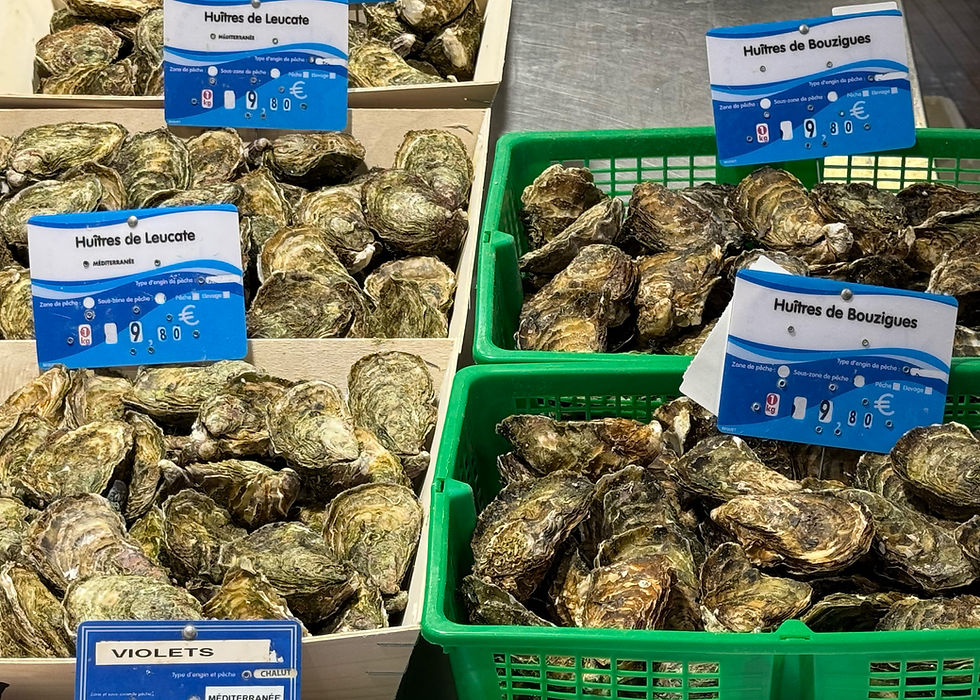
The sounds are equally impressive.
Vendors call to customers. Friends greet one another. Conversations overlap. Glasses clink. Somewhere, someone is laughing.


This is not a supermarket.
It is a community.
And tucked among the market stalls are small restaurants and bars where shoppers can enjoy a glass of wine, a plate of oysters, or a substantial lunch.


We had come for lunch.
What we hadn't anticipated was a rugby match.
Chez Bebelle: From Rugby to Restaurant
Our lunchtime destination was Chez Bebelle, an extraordinary little restaurant in the middle of Les Halles.

Its proprietor, Gilles Belzons, is a former professional rugby player who captained Narbonne's famous orange-and-black rugby team and played internationally during the 1990s.
Rugby runs in the family.
His father, André Belzons, was also an accomplished rugby player who represented Narbonne and helped the club reach the French championship final.
André acquired the nickname Bebelle from his teammates. The nickname subsequently passed to his son.
Today, Gilles has transferred his sporting talents to the restaurant business.
But he hasn't entirely abandoned rugby.
Indeed, watching him work, one might reasonably conclude that he has simply exchanged the rugby field for a restaurant.
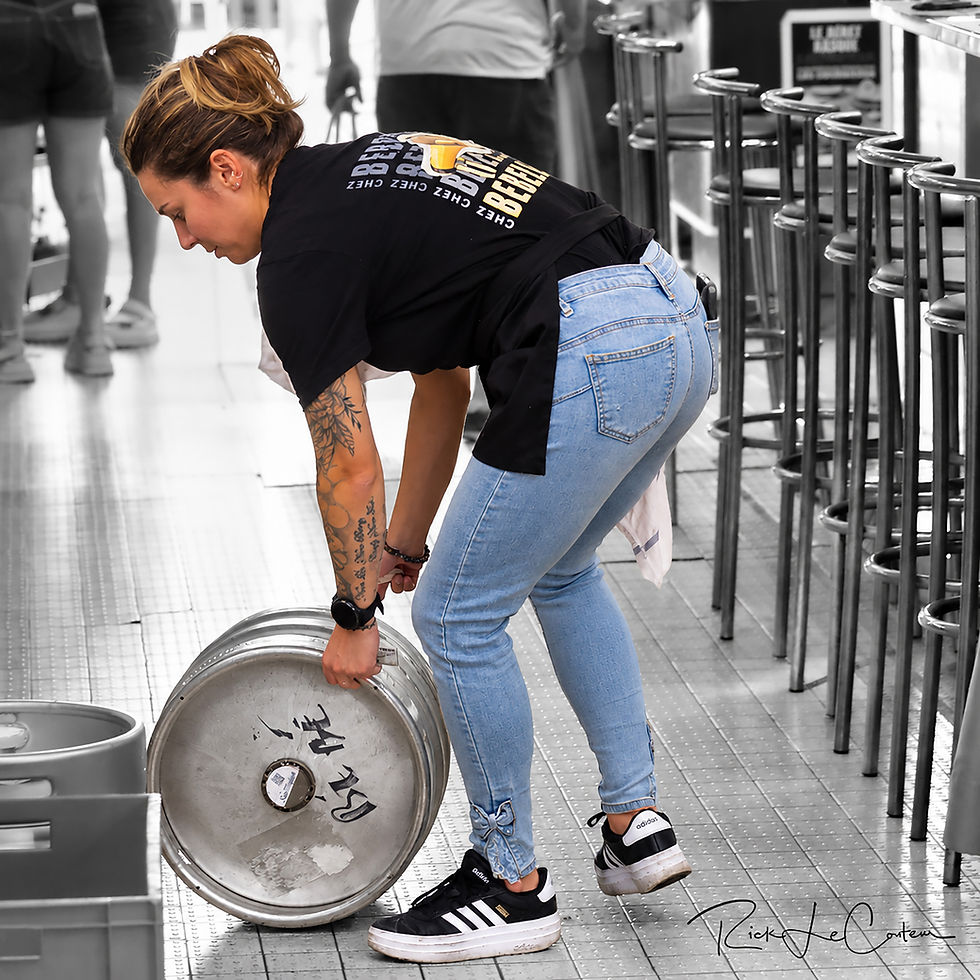

The establishment is very much a family affair. His sister Johanna works behind the grill, while other family members help maintain the extraordinary pace of service.
Above the counter are rugby photographs, memorabilia, and signed jerseys.
The restaurant celebrates its sporting heritage without apology.
But it is the method of ordering lunch that makes Chez Bebelle so remarkable.
Flying Meat
Imagine sitting at a restaurant surrounded by the hustle and bustle of a traditional French market.
You order a steak.
Instead of disappearing into a kitchen to retrieve it from a refrigerator, the proprietor picks up a megaphone.
He calls your order across the market aisle to one of the neighboring butchers.
The butcher selects the appropriate cut of meat, wraps it securely in butcher's paper, and prepares to deliver it.
But there is no delivery boy.
Instead, the butcher throws the package through the air.
Across the aisle.
Over the heads of unsuspecting shoppers.
And directly toward Gilles.
The former rugby player watches the approaching package, positions himself, and catches it.
Perfectly.
A pass worthy of a professional rugby match.

The meat is immediately delivered to the grill, where it is cooked and served with homemade fries and salad.
Then the megaphone sounds again.
Another order.
Another catch.
It is a remarkable performance.
And the customers love it.
There is something particularly delightful about watching a former international rugby player use his sporting skills to retrieve your lunch.
One wonders whether he has ever dropped a particularly expensive steak.
From Market Stall to Plate
Behind all this entertainment lies a relatively simple culinary philosophy.
Chez Bebelle sources its ingredients directly from the surrounding market.
The meat is selected and cut to order by the market's specialist butchers. It is then cooked on a plancha, a flat metal cooking surface commonly used throughout Spain and southern France.
The menu is unapologetically carnivorous.
Beef steaks, duck breast, grilled sausages, liver, tripe, and various skewers feature prominently.
There is even horse meat, reflecting a culinary tradition that remains part of French food culture, although it is increasingly controversial.
The accompaniments are straightforward.
French fries. Salad. Wine.
There are no elaborate presentations or unnecessary decorations.
The emphasis is on the ingredients, the cooking, and the atmosphere.
It is an interesting contrast to contemporary fine dining, where considerable attention is frequently devoted to presentation and the increasingly elaborate descriptions accompanying each dish.
At Chez Bebelle, the ingredients are the principal attraction.
Although, admittedly, watching those ingredients fly through the air provides considerable additional entertainment.
A Different Kind of Restaurant
What particularly interested me was the relationship between the restaurant and the surrounding market.
In most modern restaurants, the supply chain is invisible.
Ingredients arrive in delivery trucks, disappear into refrigerators, and eventually emerge from the kitchen as finished meals.
The customer rarely knows where the ingredients originated, who supplied them, or how they were selected.
At Chez Bebelle, the relationship between supplier, restaurant, and customer is quite literally on public display.
The butcher is only a few meters away.
You can see the meat being selected.
You can watch it being delivered.
And you can observe it being cooked.
The distance between producer and consumer has been reduced to the width of a market aisle.
Admittedly, the final stage of that journey is somewhat unconventional.
But the underlying principle is appealing.
There is transparency, familiarity, and a genuine relationship between the people supplying the food and those preparing it.
The butcher is not simply an anonymous supplier.
He is part of the performance.
And part of the community.
More Than a Market
Our visit to Les Halles reinforced something I have come to appreciate about traditional markets during our travels.
They are not simply places where people purchase food.
They are social institutions.
They connect farmers, producers, merchants, cooks, and customers. They preserve culinary traditions and provide opportunities for conversations and relationships that are increasingly absent from modern retail environments.
At Les Halles, shopping is not necessarily an activity to be completed as quickly as possible.
It can be an experience to be enjoyed.
People linger. They talk. They drink. They eat.
And occasionally, they duck as their lunch flies overhead.
There is an important distinction between efficiency and enjoyment.
Modern supermarkets are extraordinarily efficient. Their sophisticated supply chains allow consumers to purchase almost anything at almost any time of the year.
But something is inevitably lost when food becomes just another commodity and shopping becomes an exercise in convenience.
The traditional French market offers an alternative.
It reminds us that food is connected to people, places, traditions, and communities.
The Final Whistle
We visited Narbonne to explore its extraordinary history, magnificent cathedral, and medieval architecture.
But one of my most enduring memories will be lunch in its market.
A former international rugby player shouting through a megaphone.
A butcher launching packages of meat across a crowded aisle.
An enthusiastic catch.
And another perfectly ordinary French lunch transformed into something quite extraordinary.
There are many ways to experience the culture of a country.
You can visit its museums, explore its churches, admire its architecture, and study its history.
Or you can sit down in a crowded market and watch a retired rugby player catch your lunch.
Sometimes, the latter tells you just as much about a place as the former.
At Chez Bebelle, the food is local, the atmosphere is infectious, and the service is quite literally a team sport.


Comments