Narbonne: A City Built Upon Its Past (#742)

Two thousand years of history beneath your feet.
There are cities that preserve their history in museums, and there are cities where history remains part of everyday life.
Narbonne, in southern France, belongs firmly in the second category.
During our visit to Narbonne, two remarkable structures caught my attention. One was an ancient Roman road, uncovered beneath the city's central square. The other was a bridge that had evolved into a street, complete with shops and houses.
Separated by only a short walk, these two structures tell an extraordinary story of how a city can reinvent itself without entirely abandoning its past.
The Via Domitia: A Roman Road Beneath the Square

Imagine walking across a bustling French square, surrounded by cafés, shops and centuries-old buildings, only to discover that beneath your feet lies a Roman road more than two thousand years old.
That is precisely what awaits visitors to Narbonne's Place de l'Hôtel de Ville.
In 1997, during renovation work in the square, workers uncovered a section of the ancient Via Domitia.
Rather than covering it over again, the city decided to leave the road exposed, creating an extraordinary archaeological window into its Roman past.
The Via Domitia was constructed beginning in 118 BC, the same year that the Romans founded Narbo Martius, the settlement that would eventually become Narbonne.
The road was an engineering achievement of enormous strategic importance. It connected Roman Italy with the Iberian Peninsula, allowing armies, merchants, officials and travelers to move across southern Gaul.
Narbonne prospered because of its location along this important route. It became one of the principal cities of Roman Gaul and a major commercial center.
Today, the excavated roadway lies approximately two meters below the surrounding square, directly in front of the imposing Archbishop's Palace.
Standing beside the excavation, you can examine the ancient paving stones and imagine the countless people who traveled along this route.
Roman soldiers marching towards Spain. Merchants transporting wine, olive oil and pottery. Officials carrying imperial instructions. Ordinary travelers moving between distant communities.
All passing through precisely the same place where modern tourists now stand taking photographs.
What particularly struck me was the contrast between the two levels of the city.
Above, contemporary Narbonne continues its daily business.
Below, the Roman road remains remarkably tangible.
Two thousand years of history, separated by just a few steps.
The Pont des Marchands: A Bridge That Became a Street


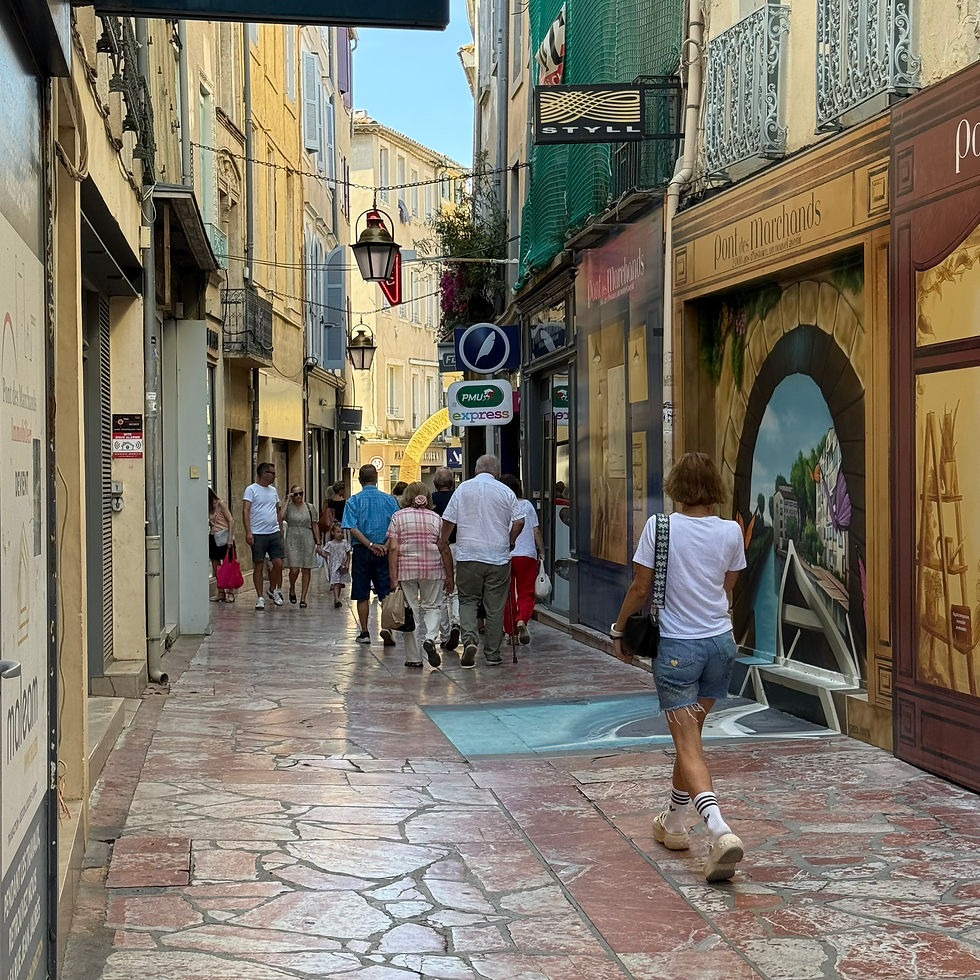
A short walk from the Roman road brings us to another remarkable structure: the Pont des Marchands, or Merchants' Bridge.
At first glance, it is difficult to recognize it as a bridge at all.
Instead of an open roadway with parapets overlooking the water, buildings occupy the structure. For centuries, shops and residences lined the bridge, making it resemble an ordinary commercial street.
Yet beneath these buildings lies an ancient crossing whose origins reach back to Roman Narbonne.
The original bridge carried the Via Domitia across the River Aude. It was a substantial structure, with several arches spanning the river.
Over subsequent centuries, the river changed course, and the urban landscape evolved around the surviving bridge.

Today, the Canal de la Robine flows beneath its remaining visible arch.
During the Middle Ages, merchants began constructing shops and houses on the bridge.
Eventually, it became so thoroughly incorporated into the surrounding streets that its original function was almost concealed.
The result was one of France's relatively rare inhabited bridges.
Unlike a conventional bridge, which simply connects two places, the Pont des Marchands became a destination in its own right.
People lived there. Merchants traded there. Generations crossed it without necessarily thinking about the ancient structure supporting their daily activities.
Unfortunately, the passage of time has also taken its toll. Structural concerns led to the evacuation of buildings on the bridge in 2023, raising difficult questions about its conservation and future.

The bridge is a reminder that preserving historic architecture is not simply a matter of admiring the past. It requires investment, engineering expertise and a willingness to protect structures that remain part of a living city.
Two Structures, One Extraordinary Story
What makes these two monuments particularly fascinating is their historical relationship.
The Via Domitia and the Pont des Marchands were originally components of the same Roman transportation network.
One provided the road through Narbonne. The other enabled travelers to cross the river.
Together, they helped establish the city as a major commercial and administrative center.
Yet their subsequent histories could hardly have been more different.
The Roman road disappeared beneath successive layers of urban development. It remained hidden until modern excavation brought it back into public view.
The bridge, meanwhile, remained in use. Rather than disappearing beneath the city, it became part of the city itself, gradually acquiring buildings and commercial functions that its Roman engineers could scarcely have imagined.
One structure was buried and rediscovered.
The other was continuously adapted until its original identity was almost forgotten.
Both survived.
And both demonstrate that cities are not static collections of buildings. They are living organisms, continually adapting to changing circumstances while retaining elements of their earlier existence.
Narbonne: The City That Never Stopped Building
Narbonne offers an extraordinary concentration of architectural history.
The unfinished Gothic cathedral, the Archbishop's Palace, the medieval streets, the covered market and the Canal de la Robine each represent different chapters in the city's development.
But for me, the exposed Via Domitia and the Pont des Marchands provide something particularly memorable.
They illustrate two contrasting approaches to the passage of time.
One preserves history by revealing it.
The other preserves history by incorporating it into everyday life.
And perhaps that is the real fascination of Narbonne.
Its past is neither completely buried nor entirely preserved behind museum walls. It remains interwoven with the present, sometimes visible, sometimes concealed, but always there.
As we walked between the ancient Roman road and the inhabited bridge, I found myself reflecting on the countless generations who had occupied these same streets.
Their buildings have changed. Their language has changed. Their methods of transportation have changed.
But the essential human activities of traveling, trading, building and creating communities have continued for more than two thousand years.
Narbonne is not simply a city with a history.
It is a city built upon its history.



Comments