Narbonne Cathedral: The Virgin, the Archbishop, and the Headless Saints (#740)

Three monuments, three stories, and several centuries of history.
Narbonne Cathedral is an extraordinary building. Begun in 1272, it was intended to become one of the great Gothic cathedrals of France. Yet it was never completed. Its enormous choir, soaring vaults and magnificent stained-glass windows survive, but the nave was never constructed.
Perhaps that is why I found the cathedral so fascinating. It is a building that tells stories not only through what was accomplished but also through what was left unfinished, damaged, destroyed or subsequently restored.
During my visit, three monuments particularly attracted my attention:
The remarkable sculptural ensemble in the Chapel of Our Lady of Bethlehem,
The statue of Notre-Dame du Pont, and
The elaborate tomb of Cardinal Pierre de La Jugie.
Together, they illustrate three very different aspects of medieval and early modern Christianity:
The promise of salvation.
The comfort of faith, and
The commemoration of ecclesiastical power.
They also raise an interesting question. What happens when religious art, created to endure for centuries, becomes a target of religious or political violence?

1. The Chapel of Our Lady of Bethlehem: Heaven, Hell and the Afterlife
At the eastern end of Narbonne Cathedral lies the Chapel of Our Lady of Bethlehem.

The remarkable 14th-century sculptural altarpiece is among the cathedral's most important artistic treasures.
The elaborate composition occupies approximately 26 square meters and is arranged in three registers. Its subjects include:
Hell, Purgatory, Limbo, episodes from the life of Christ, angels, saints and prophets.
It is an extraordinary example of medieval religious storytelling in stone.

For medieval Christians, the Last Judgment was not simply a biblical story. It represented a profoundly important question:
What would happen to their souls after death?
The sculptures provided a visual answer beneath the feet of Our Lady of Bethlehem.
Heaven offered the promise of salvation. Hell presented the consequences of sin. Purgatory represented purification before admission to Heaven.
In an age when many people could not read, such elaborate religious imagery communicated theological ideas through sculpture rather than written text.
The cathedral's great altarpiece was, in effect, a medieval picture book.


But it has another story to tell.
Parts of the sculptural ensemble were concealed for centuries, and the surviving work has undergone extensive restoration. Following approximately twenty years of conservation, the restored altarpiece was reinstalled in the chapel on 8 April 2000.
The City of Narbonne describes it as a masterpiece of European Gothic art.
Its survival is remarkable.
However, the damage sustained by some of the cathedral's medieval sculptures reminds us that religious art has not always been treated with reverence.
That becomes particularly apparent when examining another monument nearby.

2. Notre-Dame du Pont: A Virgin Who Crossed a Bridge
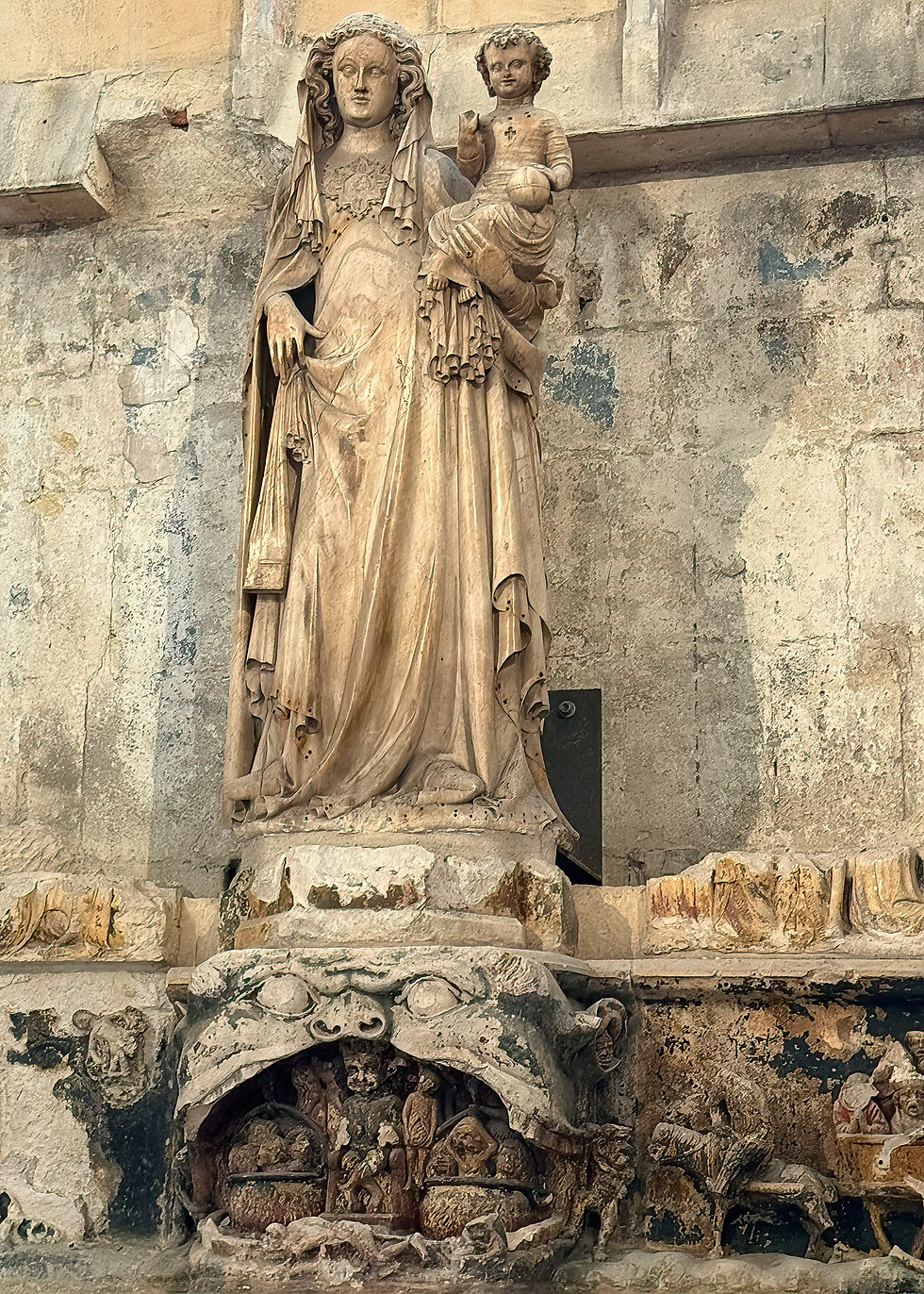
As I entered the cathedral, I encountered a statue of the Virgin Mary holding the infant Jesus.
It stood in a small alcove, enclosed by an elaborate wrought-iron grille. Two candles illuminated the figures.

Unlike the imposing architecture surrounding it, the sculpture was intimate and approachable.
Mary supports the infant Jesus on her arm. Her expression is composed, almost contemplative. The child looks outward, seemingly interested in something beyond his mother's embrace.
This is Notre-Dame du Pont - Our Lady of the Bridge.
And it has a particularly interesting history.
For more than three centuries, from 1525 until 1855, the statue occupied a position on a bridge crossing Narbonne's canal. The bridge was variously known as the Pont Notre-Dame, Pont de la Cadène and Pont Sainte-Catherine.
The statue stood within a protective niche of white marble. A lantern was reportedly kept burning beside it, day and night.
Its position was significant. It stood between two historic sections of Narbonne, providing a shared religious symbol for the city's inhabitants.
The statue itself is believed to have been venerated previously in the Church of Lamourguié.
In 1855, the municipal authorities ordered the demolition of the bridge to improve traffic circulation. Despite objections from residents, demolition began on 22 July.
The statue survived.
In 1889, its architectural setting was reconstructed inside Narbonne Cathedral, where the Virgin continues to be venerated.
What particularly interested me was the transformation in the statue's function.
Originally, it occupied a public space. People passed beneath or beside it as they crossed the bridge, conducting their everyday business.
It was a religious presence embedded in ordinary urban life.
Today, it occupies a quiet alcove within the cathedral.
The surrounding wrought iron creates a sense of separation, but the candles suggest continuing devotion.
For approximately five centuries, generations of people have looked upon this representation of mother and child.
The bridge has disappeared. The city has changed. The statue remains.
Its history provides a striking contrast with the next monument.

3. The Tomb of Cardinal Pierre de La Jugie: Power, Death and Destruction
Among the most impressive monuments in Narbonne Cathedral is the Tomb of Cardinal Pierre de La Jugie.
La Jugie served as Archbishop of Narbonne from 1347 until 1375, when he was transferred to the Archbishopric of Rouen. He became a cardinal in 1375 and died the following year.
He was an important figure in the ecclesiastical establishment of medieval France.
His position was not simply religious. Medieval archbishops frequently exercised considerable political and economic authority, and La Jugie belonged to a family closely associated with the Avignon papacy.
He commissioned an elaborate funerary monument in Narbonne Cathedral.

It was intended to commemorate his position, religious authority and expectation of salvation.
The surviving monument is an impressive example of Gothic funerary sculpture.
Its elaborate architectural framework includes pointed arches, decorative tracery, sculpted figures and heraldic shields.
Traces of medieval painting survive, including a representation of the cardinal's soul being carried toward Heaven by angels.
France's official heritage inventory dates the monument to the 14th century and records its protected status as a historic monument since 1840.
But the monument has suffered considerable damage.
The Mystery of the Headless Figures
What immediately caught my attention was a row of five sculpted figures standing beneath elaborate Gothic arches.

All five were missing their heads.
Their bodies remained remarkably well preserved. The folds of their robes, the positioning of their arms and much of the surrounding architectural decoration were still recognizable.
Yet their faces had disappeared.
It is a disturbing sight.
The missing heads raise an obvious question.
Who removed them?
The French Wars of Religion provide one possible historical context. During the 16th century, religious conflict between Catholics and Protestants resulted in widespread destruction of religious imagery.
However, I could find no documentary evidence establishing that Huguenots were responsible for the damage to these figures.
There is stronger historical evidence connecting the monument's destruction with the French Revolution.
A scholarly account of La Jugie's career specifically records that his tomb was vandalized during the Revolution. Another description dates damage to 1793.
The monument subsequently suffered further damage during a fire in the cathedral choir in 1909. A contemporary account published in 1910 identifies La Jugie's tomb and the cathedral's 14th-century stained glass as particularly badly affected.
Nevertheless, the precise circumstances in which the sculpted figures lost their heads remain uncertain.
It would be tempting to attribute their mutilation entirely to revolutionary iconoclasm. The historical evidence establishes that the monument suffered revolutionary vandalism, but it does not conclusively establish who removed each head or when.
That distinction matters.
History should not be reconstructed simply by selecting the most dramatic explanation.
There is another interesting detail.
Some sculptural elements from the monument have become separated from the original structure. The Musée des Augustins in Toulouse preserves six decorative panels and an architectural canopy associated with La Jugie's tomb.
These pieces were acquired during the 1830s, having been recovered in Narbonne.
The monument we see today is therefore not necessarily the complete monument originally commissioned by the archbishop.
It is a survivor.
And its missing heads have become part of its history.
Three Monuments, Three Different Stories
These three monuments illustrate how a cathedral can serve several purposes simultaneously.
The Chapel of Our Lady of Bethlehem presents medieval Christianity's understanding of salvation and the afterlife.
Notre-Dame du Pont represents something more personal: a continuing relationship between a religious image and the community that venerates it.
The tomb of Pierre de La Jugie reflects another dimension of medieval religion - the relationship between ecclesiastical authority, wealth, commemoration and the desire for immortality.
Yet there is a common thread.
All three monuments have survived substantial historical changes.
The bas refiefs of The Chapel of Our Lady of Bethlehem disappeared from public view for generations before being rediscovered and restored.
Notre-Dame du Pont lost its original architectural setting when the bridge on which it stood was demolished.
La Jugie's tomb survived revolutionary vandalism, fire and the dispersal of some of its sculptural elements.
Each monument has acquired a history beyond the intentions of its original creators.
And each raises questions about how societies choose to preserve, reinterpret or destroy their cultural heritage.
A Final Thought: The Faces We Have Lost
Of the three monuments, I found the headless figures on La Jugie's tomb particularly memorable.
Perhaps that is because they represent something that cannot easily be restored.
The Virgin and Child survives as an intact representation of maternal affection.
The Chapel of Our Lady of Bethlehem has benefited from painstaking conservation.
But the five figures on La Jugie's tomb have lost their identities.
Their robes and postures remain. Their architectural niches remain. Their heraldic surroundings remain.
Their faces do not.
There is something strangely compelling about these anonymous figures. They stand together, as they have for centuries, silently bearing witness to events that have largely disappeared from historical memory.
We may never know exactly who removed their heads.
Perhaps that uncertainty is itself an important part of their story.
A cathedral is not simply a monument to the people who built it. It is also a record of the people who worshipped in it, altered it, neglected it, damaged it and ultimately decided that it was worth preserving.
Narbonne Cathedral tells all these stories.
And it tells them in stone.


Comments