Pézenas: A Town That Remembers How to Be Old (#746)
Updated: Oct 2

There are towns that preserve their history behind glass, and there are towns where history simply carries on living.
Pézenas is one of the latter.
Set in the Hérault department of southern France, not far from the Mediterranean and the Canal du Midi, Pézenas is a town made for wandering.
Its narrow lanes twist between honey-colored stone buildings. Heavy wooden doors conceal courtyards. Wrought-iron balconies project over streets that seem scarcely wide enough for a horse and cart. Small workshops occupy spaces where craftsmen have worked for generations.
The temptation is to call it picturesque. It certainly is. But that word does not quite capture Pézenas.
The town feels used rather than preserved.

A Town of Princes and Merchants
Pézenas was once an important political and commercial center of Languedoc. Its great fairs attracted merchants and money, while its association with the governors of Languedoc brought political importance and wealthy residents.
That prosperity remains written into the architecture.
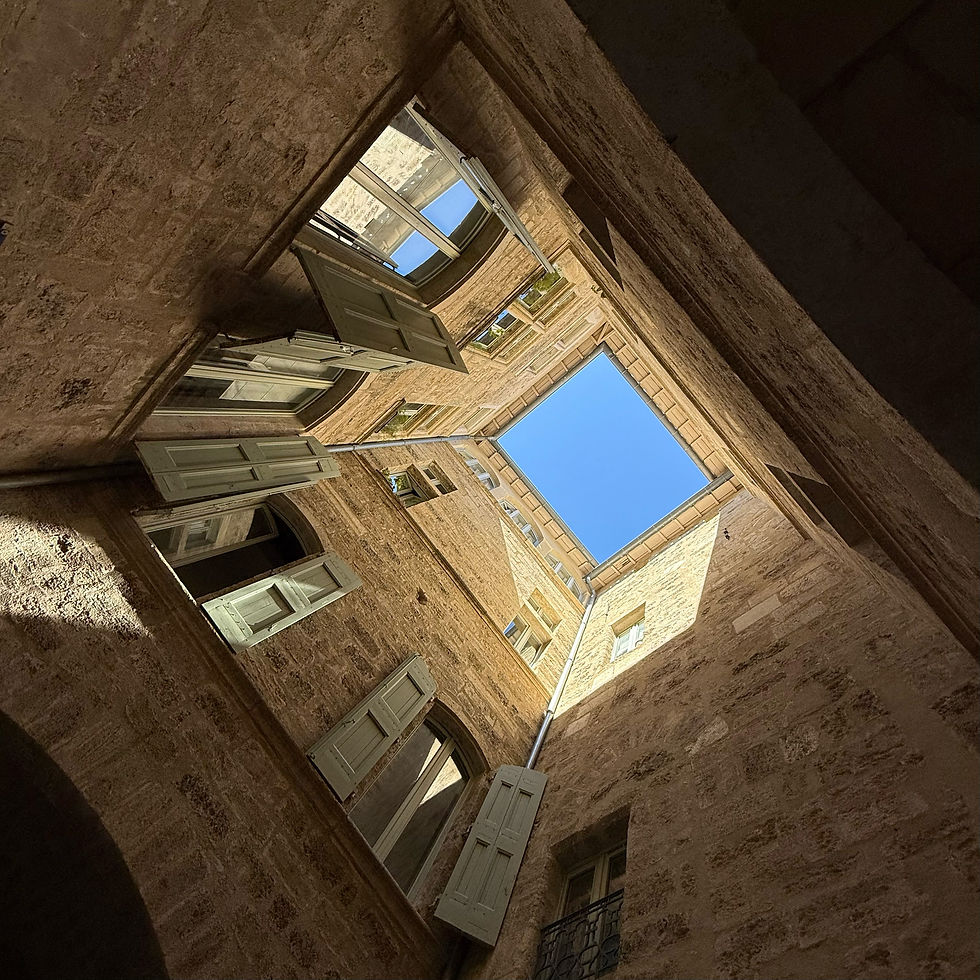
Behind relatively restrained façades are remarkable hôtels particuliers - private mansions built for prosperous merchants and officials - with vaulted entrances, elegant courtyards and imposing stone staircases.
Walking through Pézenas can therefore be deceptive.
A plain doorway may open into a magnificent courtyard. An unremarkable wall may conceal a Renaissance staircase.
The town constantly asks you to look twice.

Molière
One name follows you everywhere in Pézenas:
Molière.
The great French playwright spent time in the region during the 1650s while traveling with his theatrical company. Pézenas subsequently adopted him enthusiastically as part of its identity.
It seems appropriate.
Molière was an observer of people - their vanities, ambitions, pretensions and absurdities.
Pézenas remains an excellent town for doing exactly the same thing.
Sit at a café long enough and the theater begins.

Molière and the Barber of Pézenas
One of the most intriguing places associated with him is the Maison du Barbier Gély, at 1 Place Gambetta.


According to local tradition, Molière regularly visited the barber's shop, where he sat in a large wooden armchair, watching and listening to the customers.
And what a wonderful place for a playwright to gather material!
In the 17th century, a barber did considerably more than cut hair and trim beards. Barbers might also extract teeth, perform bloodletting and undertake minor surgical procedures.
The barber's shop was therefore a place where medicine, personal grooming, conversation and gossip came together.
One can imagine Molière sitting quietly in his chair, observing the procession of merchants, aristocrats, tradesmen and ordinary townspeople. Their conversations, complaints, eccentricities and pretensions would have provided abundant material for a writer fascinated by human behavior.
It is tempting to imagine that some of the characters who subsequently appeared in his comedies were inspired by people he encountered here.
The historical details of Molière's visits are difficult to verify, but the association between the playwright and the barber's shop has been part of Pézenas's local tradition for generations.
And there is a remarkable surviving object connected with that tradition: Molière's chair.
The large wooden armchair was preserved by successive owners before eventually returning to Pézenas in 2007. Today, it is displayed in the Musée de Vulliod Saint-Germain, where visitors can see the chair traditionally associated with the playwright.
Whether Molière really sat in that particular chair, and how much of his writing was inspired by conversations in the barber's shop, remains uncertain.
But I rather like the story.
A great playwright, sitting in a barber's chair, watching the world go by.
After all, isn't that what writers do?

Hôtel de Lacoste
Not far from the streets associated with Molière stands another reminder of the prosperity that once flowed through Pézenas: the Hôtel de Lacoste.
The word hôtel can be misleading to an English speaker. This was not a hotel for travelers, but an hôtel particulier - a substantial private urban residence built for a wealthy or aristocratic family.
The house belonged to the Montégut family, lords of Lacoste, and was substantially remodeled between 1509 and 1518. Its vestibule, courtyard and gallery date from this period.
What makes the building particularly interesting is that its architecture records successive generations of alteration.
In 1638, the staircase was covered with a ribbed vault - the date is still recorded on one of its keystones. The entrance façade was subsequently altered during the 16th and 18th centuries.


The surviving architectural details provide a small vocabulary of the changing building: pointed Gothic arches, a balustraded gallery, mullioned windows and remnants of crenellation. Rather than belonging neatly to a single architectural period, the Hôtel de Lacoste accumulated its appearance over centuries.
That seems particularly appropriate in Pézenas.
The town itself developed in much the same way. One generation built. Another remodeled. Another changed the windows or staircase. Another replaced a door.
And centuries later, we walk through the same streets trying to read those changes in the stone.
The Hôtel de Lacoste is therefore more than simply another beautiful old building. It helps explain the Pézenas we see today - a town whose importance attracted merchants, officials and aristocratic families wealthy enough to construct impressive residences within its walls.

And, once again, there is that recurring Pézenas lesson:
Don't just look at the façade.
Look through the doorway.
Some of the town's greatest architectural surprises are hidden inside.

Sainte-Ursule and the Black Madonna
Then there is another Pézenas, one belonging not to theater or commerce but to faith.
Inside the Église Sainte-Ursule is one of the town's most intriguing religious treasures: a medieval wooden Virgin and Child known as Notre-Dame-la-Noire - the Black Madonna.

The statue dates from the 13th century, making it considerably older than the church that now contains it. Sainte-Ursule was built in 1686 as the chapel of an Ursuline convent and later became a parish church. Its interior includes an impressive gilded wooden altarpiece dating from the late 17th century.
But it is the Black Madonna that fascinates me.
She sits enthroned with the Christ Child on her knee and belongs to the wider and still somewhat mysterious European tradition of Black Madonnas.
Her precise origins are uncertain, and - as so often happens when history leaves gaps - legend has filled them.
One tradition holds that the statue was discovered on the Mediterranean shore after being cast up by the sea and was brought to Pézenas by a sailor. Another associates it with the Knights of Saint John and Rhodes.
Whether those stories are literally true matters less than what happened afterward.
For centuries, the people of Pézenas turned to Notre-Dame-la-Noire in times of famine, disease and uncertainty. She was carried through the streets in religious processions. In 1840, during a drought, she was carried through Pézenas while townspeople prayed for rain.
Imagine that scene.
The fields drying beyond the town. Farmers watching an empty sky. And this ancient wooden Madonna, already perhaps six centuries old, being carried through the streets while people prayed for something over which they had absolutely no control.
She wasn't merely a work of medieval art.
She was something people turned to.
And she is still there.
Saint Roch: The Patron Saint of Dogs and Plague Sufferers
Another interesting figure in Pézenas is Saint Roch , the 14th-century saint traditionally associated with Montpellier and revered as the patron saint of plague sufferers, dogs and their owners.

According to legend, Roch devoted himself to caring for victims of the plague during his travels through Italy. He eventually contracted the disease himself and withdrew into a forest, where a dog brought him bread each day and licked his wounds.
In statues and paintings, Roch is usually depicted as a pilgrim, often accompanied by a faithful dog carrying a loaf of bread in its mouth.

But why is he lifting his tunic?
He is revealing a plague sore, or bubo, on his upper thigh. The swollen lymph nodes characteristic of bubonic plague commonly occur in the groin, armpits and neck. The exposed thigh became one of the identifying features of Saint Roch in religious art.
It is a curious combination of suffering, compassion and canine loyalty.
And perhaps a reminder that, even in medieval Europe, dogs were recognized as something more than mere companions.
Sometimes, at least in legend, they were lifesavers.
The Jewish Quarter
A short distance away is another history - one that is much easier to overlook.

I came upon a red historical sign headed simply:
Le Ghetto.
The word needs some qualification. The Jewish neighborhood of medieval Pézenas was a juiverie. Describing it as a ghetto applies terminology more commonly associated with a later period of European Jewish history. Nevertheless, Le Ghetto is the name used on the interpretive sign in Pézenas today.
And the sign contains some remarkable information.
We do not know precisely when a Jewish community first became established in Pézenas.
The first surviving documentary reference dates from 1298.
According to the record, the Jews of Pézenas agreed to pay 25 sols each year in taxes - and another 25 sols for the right to have their own butcher.
It seems like a trivial administrative detail.
It isn't.
Suddenly these are no longer anonymous medieval Jews mentioned in a history book.
These were families who needed food prepared according to their religious traditions. They bought and sold goods. They worked. They raised children. They participated in the commercial life of a thriving market town.
And they worshipped here.

Somewhere within the quarter there may also have been a mikveh, the ritual bath important in traditional Jewish religious life. The Pézenas sign records that Chevalier Poncet, described as the town's first historian, reported having seen the old mikveh during the 18th century in the tower of the Sieur Messe at the end of the cul-de-sac.
Modern evidence does not establish its location with certainty, so the mikveh is best regarded as an intriguing piece of historical testimony rather than a confirmed archaeological site.
The sign tells us that the Jewish community probably disappeared in 1394, at the time of the final expulsion of Jews from the Kingdom of France.
The streets remained. The buildings remained.
But the community that had given the quarter its identity was gone.
Standing there, reading that sign, medieval Pézenas suddenly seemed much more complicated than the beautiful old French town through which we had been strolling.
The Hands on the Doors
And then I began noticing the hands.
On doors throughout Pézenas I saw an unusual door knocker: a beautifully modeled metal human hand, emerging from a decorative cuff and apparently grasping the striker.

Once I had noticed one, I began seeing them everywhere.
These hand-shaped knockers are often referred to as the Main de Fatma - the Hand of Fatima - and are associated with the much older hamsa or khamsa, a hand-shaped symbol found throughout the Mediterranean and North Africa.
The symbolism crosses religious boundaries.
In Islamic tradition, the protective hand became associated with Fatima, daughter of Muhammad.
In Jewish tradition, a similar symbol is sometimes known as the Hand of Miriam, after the sister of Moses. The hand has particularly been associated with protection from misfortune and the evil eye.
But there is an important distinction.
The realistic closed-hand door knockers found on French and Mediterranean doors should not automatically be interpreted as ancient Muslim or Jewish objects. The form became particularly fashionable much later, especially during the 19th century, when European decorative arts were strongly influenced by North African and so-called Oriental motifs.

So, the knockers I photographed in Pézenas cannot simply be declared a surviving symbol of the town's medieval Jewish community.
But the juxtaposition is irresistible.
Here was a town in which Jewish, Christian and wider Mediterranean cultures had intersected over centuries.
And on its doors was a symbol understood across cultures as a hand of protection.
More than that, the hand had been placed precisely where such a symbol belonged:
At the threshold between the outside world and home.
A hand guarding the door.
And Then There Were the Doors
That brings me to one of my favorite discoveries in Pézenas.
The town remains remarkably associated with craftsmen: woodworkers, cabinetmakers, metalworkers, potters, painters, sculptors, jewelers and restorers.
These aren't simply souvenir shops occupying picturesque buildings. At their best, they represent something increasingly unusual:
People who still make things with their hands.
And that led us to Serge Ivorra, a menuisier-ébéniste - a carpenter and cabinetmaker - with an extraordinary fascination for old doors.


His collection has become a kind of door museum.
A door, after all, is one of the most ordinary objects imaginable.
Until someone teaches you how to look at one.
Suddenly there are different woods to identify, joints to understand, ironwork to examine, proportions to appreciate and centuries of wear to interpret.
A door becomes evidence. Who made it? Who paid for it? What was behind it? How many thousands of hands have pushed against it? Who knocked upon it and waited to be admitted?
Once you have looked at doors with a cabinetmaker, Pézenas becomes a different town.
You start noticing them everywhere.
And suddenly my photograph of that strange metal hand seemed even more appropriate.

The Market
Pézenas also remains a market town.
On market day its streets fill with stalls selling cheeses, olives, charcuterie, vegetables, fruit, bread, spices and regional specialties alongside clothing, household goods and handicrafts.
Markets like this remind us why towns such as Pézenas developed in the first place.
Long before tourists arrived with cameras, people came here because they needed somewhere to meet, trade, argue, gossip, buy food and exchange news.
Perhaps the medieval Jewish butcher recorded in 1298 isn't quite so difficult to imagine after all.
The merchandise changes.
Human behavior changes rather less.

The Pleasure of Getting Lost
Perhaps the best way to experience Pézenas is to abandon the map.
Turn down the smaller street. Walk beneath the archway. Look into the courtyard. Enter the church. Read the historical sign. Stop at the workshop. Look upward at the balcony.
And, particularly, look at the doors.


Modern travel encourages us to move efficiently from one designated attraction to another.
Pézenas rewards exactly the opposite.
Its pleasures lie in the things encountered between the supposed destinations.
A carving above a doorway. A 13th-century Black Madonna in the half-light of a church. A narrow street where Jewish families lived more than 600 years ago. A stone staircase disappearing into shadow. A metal hand knocking upon a door. A craftsman preserving doors that other people might have thrown away. Someone drinking coffee beneath a centuries-old façade. A dog asleep in the sun.
None of these, by itself, explains Pézenas.
Together they begin to.
A Town of Layers

Perhaps that is what I liked most about Pézenas.
It isn't really one town.
There is the Pézenas of wealthy merchants and magnificent houses. The Pézenas of Molière and the theater. The Pézenas of medieval Jewish families participating in the commerce of a thriving market town. The Pézenas of Catholic faith and an ancient Black Madonna carried through the streets when the rains failed. The Pézenas of Mediterranean symbols carried across religions, countries and centuries. And there is the Pézenas of craftsmen like Serge Ivorra, preserving the skills - and even the doors – of generations before them.
All these histories occupy the same few streets.
You simply have to slow down enough to notice them.
We arrived as visitors looking at an old French town.
We left realizing that Pézenas isn’t really old at all.
Its past is still everywhere.


Comments