The Locks of the Canal du Midi: A Staircase Through History (#734)
Four centuries of engineering, one man's extraordinary vision, and the pleasure of traveling slowly.
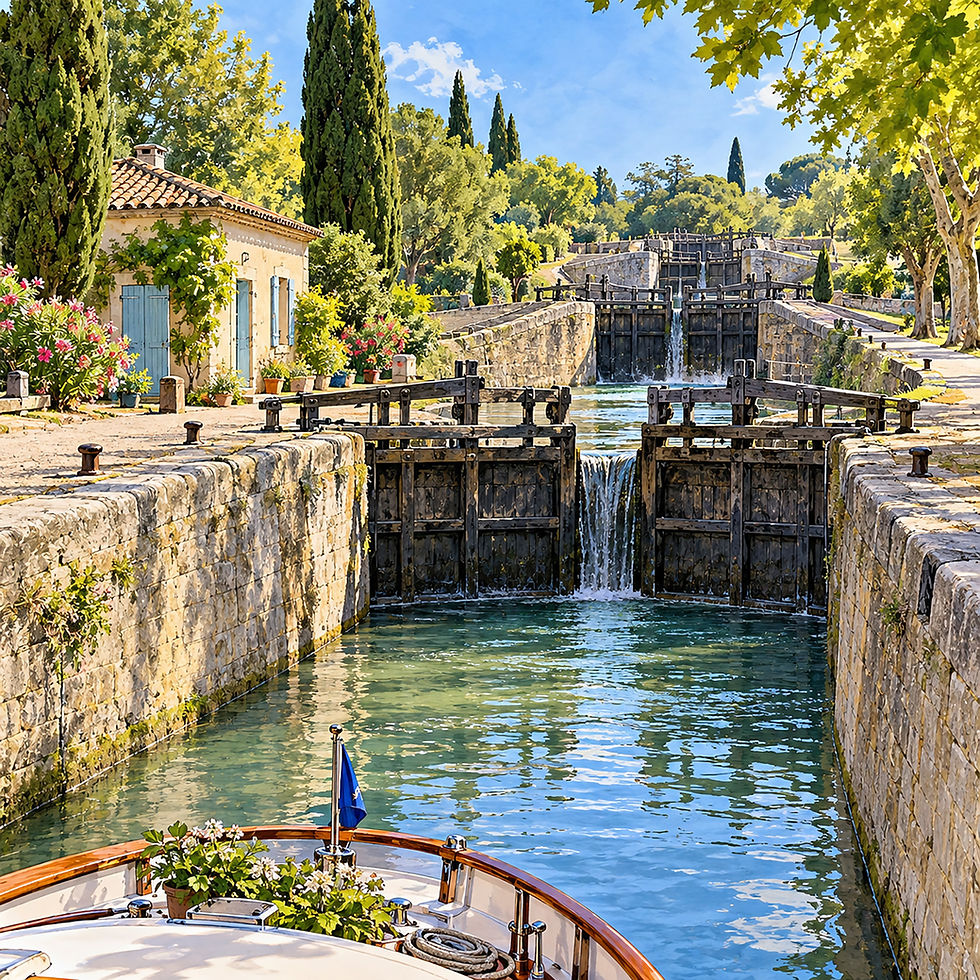
There is something wonderfully theatrical about traveling through a lock on the Canal du Midi.
Our barge, Saraphina, approaches a pair of enormous wooden gates set between centuries-old stone walls. The gates open, we glide inside, and the gates close behind us. Water begins to enter or leave the chamber. Almost imperceptibly, our barge rises or falls. The stone walls appear to move past us, although, of course, it is we who are moving.
Eventually, the water levels equalize, the gates ahead swing open, and we continue our journey.
It is a remarkably simple process. It is also an extraordinary piece of engineering.
What makes the experience particularly satisfying is the realization that we are traveling through a system conceived more than 350 years ago, when Louis XIV occupied the French throne and the idea of constructing a navigable waterway across southern France was considered almost impossibly ambitious.
The man who made it possible was Pierre-Paul Riquet.
The Dream of Connecting Two Seas
For centuries, European rulers had contemplated constructing a navigable waterway linking the Mediterranean Sea with the Atlantic Ocean.
Such a connection would eliminate the need for vessels to sail around the Iberian Peninsula, through the Strait of Gibraltar, and along a maritime route vulnerable to storms, piracy, and political conflict.
The potential economic and strategic benefits were enormous.
The problem was geography.
Between the Mediterranean and the Atlantic lay the hills and valleys of southern France. A canal would have to climb from one watershed to a summit and then descend toward the other.
Locks could overcome the differences in elevation, but every passage through a lock required water. Supplying sufficient water to the highest section of the proposed canal was the seemingly insurmountable obstacle.
Until Pierre-Paul Riquet came along.
Pierre-Paul Riquet: The Man Who Made It Happen
Pierre-Paul Riquet was born in Béziers, probably in 1609. He was not a formally trained civil engineer but a wealthy tax collector with an extraordinary interest in hydraulics.
He understood something that had defeated previous attempts to construct the canal.
The solution lay not simply in digging a channel across France but in finding a reliable source of water to supply it.
Riquet identified the streams and rivers of the Montagne Noire, the Black Mountains, north of the proposed canal. He developed an ingenious system of feeder channels to collect this water and deliver it to the canal's summit near Naurouze.
His scheme included the enormous Saint-Ferréol reservoir, constructed to store water and help maintain the canal's supply.
In 1662, Riquet presented his proposal to Jean-Baptiste Colbert, Louis XIV's powerful finance minister.
After extensive investigation, royal authorization was granted in 1666, and construction began the following year.
It was one of the largest engineering projects undertaken in seventeenth-century Europe.
Approximately 12,000 men and women participated in its construction. They excavated the canal, built bridges, aqueducts, tunnels, dams, and locks, and created an entirely new transportation system through the countryside of southern France.
Riquet was heavily involved in financing and managing the undertaking. The costs were enormous, and he committed much of his personal fortune to the project.
Tragically, he never saw his masterpiece completed.
Riquet died in October 1680, only months before the canal officially opened in May 1681.

His sons continued his work, although the family inherited substantial debts.
Today, Riquet's name is inseparable from the Canal du Midi. His achievement was not simply the construction of a waterway but the creation of an integrated hydraulic system that continues to function more than three centuries later.
Why So Many Locks?
The Canal du Midi stretches approximately 240 kilometers from Toulouse to the Étang de Thau, near the Mediterranean coast.
Its highest point, the Seuil de Naurouze, lies approximately 189 metres above sea level.
Boats traveling from Toulouse toward the Mediterranean must first climb toward this summit and then descend toward the sea.
A conventional canal cannot simply follow the contours of the land. Water flows downhill, and a continuously sloping canal would become a river.
Instead, the canal consists of a succession of essentially level sections, known as pounds, connected by locks.
A lock is effectively a water-filled elevator for boats.
A vessel enters a chamber enclosed by gates at either end. By allowing water to flow into or out of the chamber, the boat can be raised or lowered to the level of the next section of canal.
No mechanical lifting equipment is necessary. Gravity does the work.
The Canal du Midi and its associated branches contain 77 locks, including 63 on the principal canal itself.
Some are single locks. Others have two, three, or even four successive chambers.
And then there is Fonseranes.
But first, there is something particularly interesting about the shape of these locks.
Why Are the Locks Oval?
One of the most distinctive features of the Canal du Midi is the unusual oval shape of many of its original locks.
Most modern canal locks are rectangular. Their straight walls and parallel sides accommodate vessels efficiently.
Riquet initially constructed rectangular locks, too.
Unfortunately, he encountered a problem.
The enormous pressure exerted by the surrounding earth threatened the stability of the lock walls. In 1669, damage to one of the early locks prompted a reconsideration of the design.
Riquet's solution was elegant.
Instead of constructing straight walls, he designed outwardly curved walls, giving the lock chamber its characteristic oval appearance.
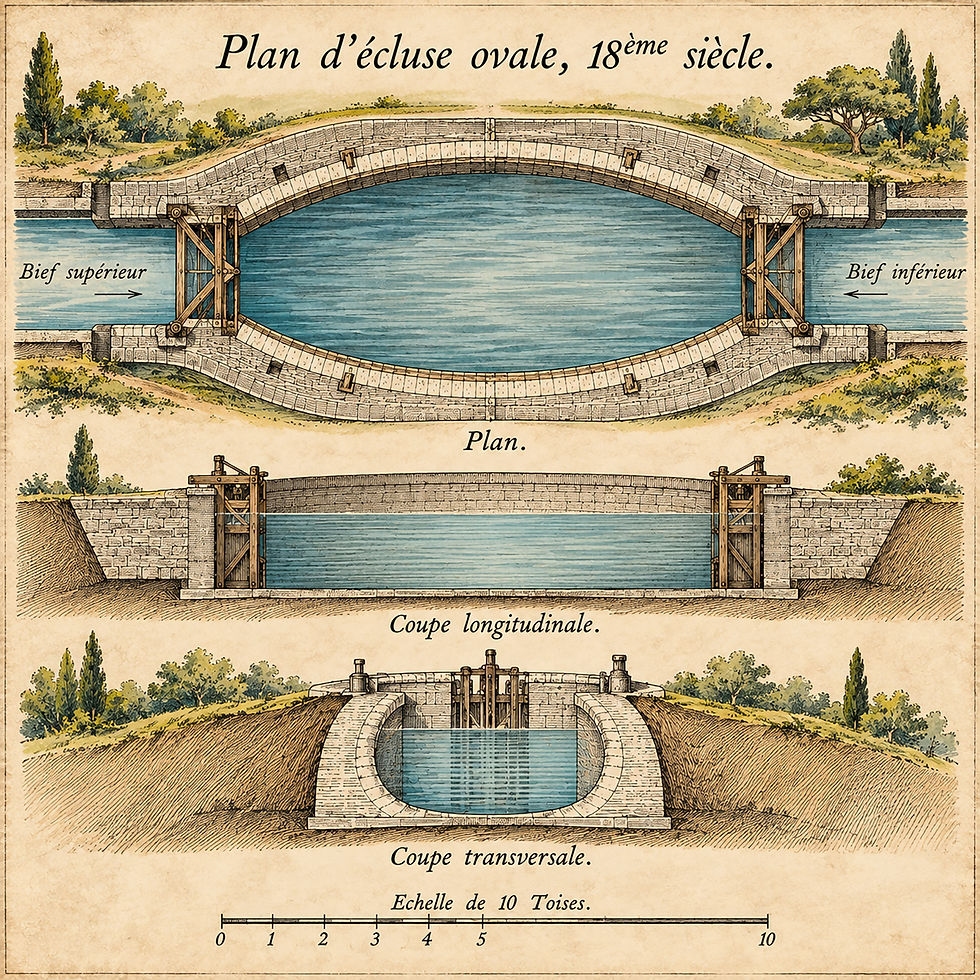
The curved masonry helped distribute the enormous lateral forces exerted by the surrounding ground, making the structure more resistant to collapse.
It also created a remarkably attractive architectural feature.
The oval locks are broader in the middle than at their gates. They resemble elongated stone basins, their curved walls rising gracefully above the water.

For passengers aboard a barge, they are among the most memorable features of the canal.
What began as a practical engineering solution became one of the defining aesthetic characteristics of the entire waterway.
There is something appealing about that transformation.
An engineering problem produced an architectural signature.
Fonseranes: The Staircase at Béziers
Of all the locks on the Canal du Midi, none is more spectacular than the staircase at Fonseranes, just outside Béziers.
Here, Riquet confronted a particularly difficult geographical problem.
The canal approached Béziers at an elevation considerably higher than the River Orb, which the original route needed to cross.
The solution was a remarkable series of interconnected locks.
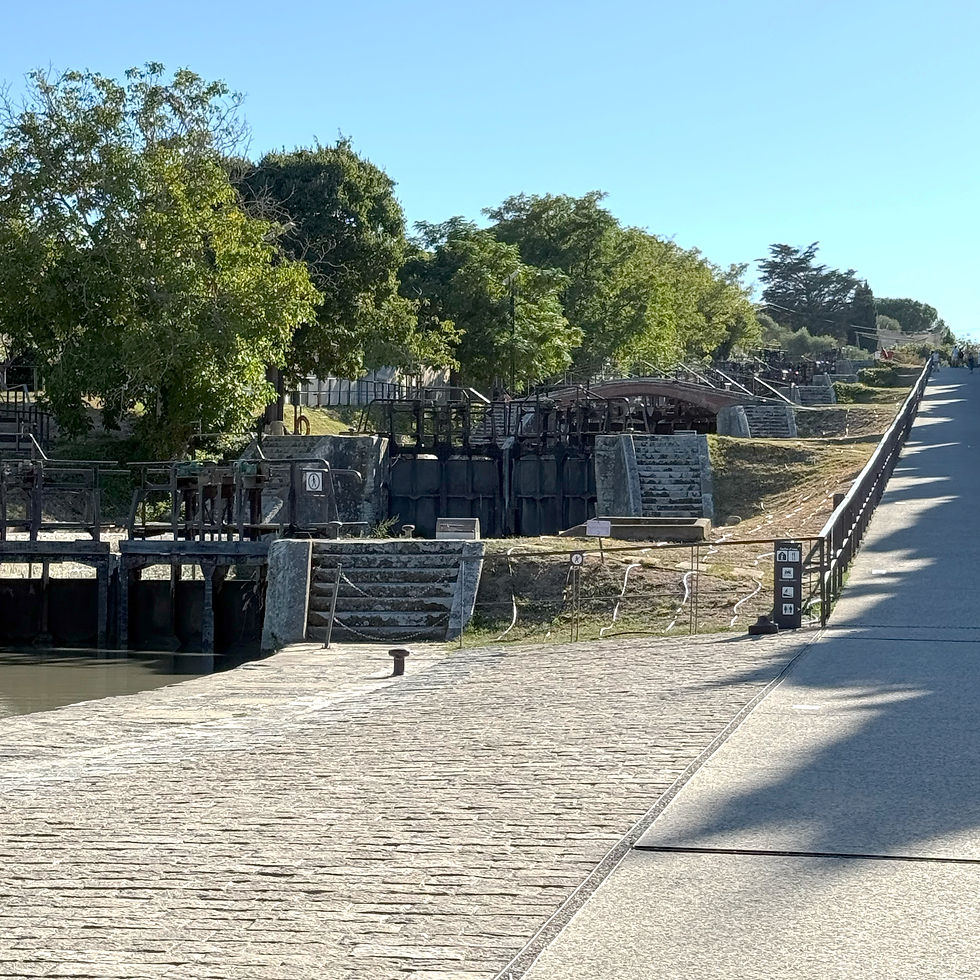
The original Fonseranes staircase consisted of eight consecutive oval chambers separated by nine sets of gates. Together, they enabled boats to overcome an elevation difference of approximately 21.5 metres.
The entire structure extends for roughly 300 metres.
Imagine constructing such a system in the seventeenth century, using little more than human labour, animal power, surveying instruments, and an understanding of hydraulics.
Even today, the scale of the undertaking is impressive.
The staircase is commonly known as Les Neuf Écluses de Fonseranes - the Nine Locks of Fonseranes.
Strictly speaking, the traditional name refers to its nine sets of gates rather than nine separate chambers.
The Orb Aqueduct
The construction of the Orb aqueduct in the nineteenth century altered the canal's route.
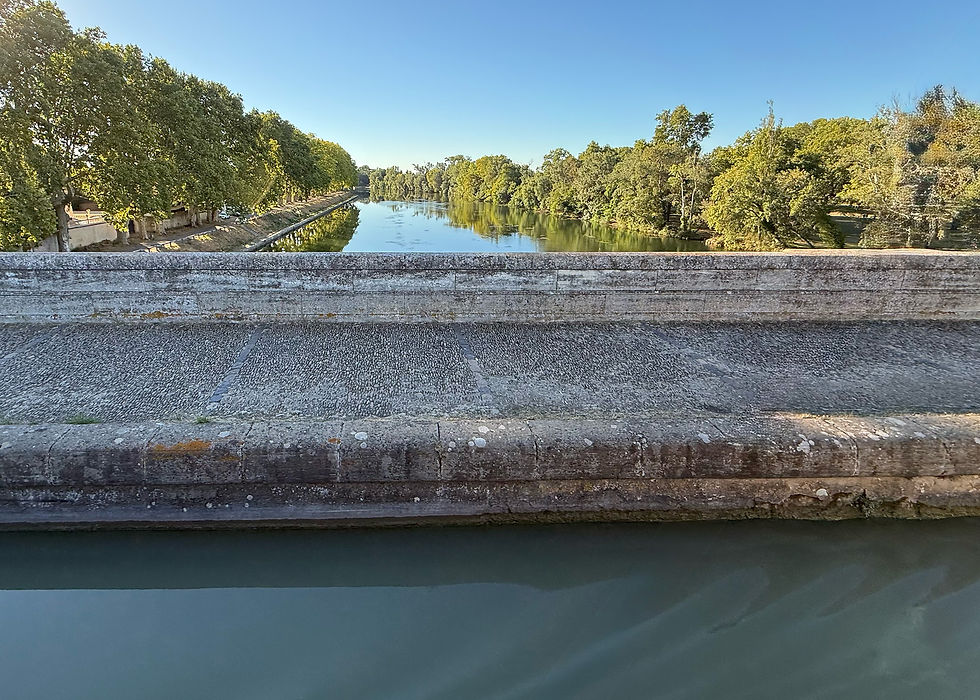

Boats could now cross above the River Orb rather than navigate through it.
Consequently, vessels traveling along the principal canal today normally use only six of the original eight chambers at Fonseranes.
Nevertheless, the staircase remains one of the most extraordinary surviving examples of seventeenth-century hydraulic engineering.
Watching boats negotiate these locks is fascinating. Each chamber must be filled or emptied in sequence, with the movement of water carefully coordinated to allow vessels to progress through the staircase.
It is an enormous stone machine powered by gravity.
And it still works.
The Lock Keeper
For much of the canal's history, every lock depended upon its lock keeper.
The éclusier was responsible for operating the gates, controlling the flow of water, assisting passing vessels, and maintaining the lock and its surroundings.
Lock keepers frequently lived in small houses beside their locks.

Many of these charming buildings survive, some converted into cafés, restaurants, or private residences.
Their locations are often idyllic, surrounded by plane trees, gardens, and the quiet waters of the canal.
However, the work was not always idyllic.
Operating enormous wooden gates demanded considerable physical effort. Managing water levels required experience and judgment, particularly when commercial barges were moving along the canal.
A lock keeper also had to accommodate competing demands from vessels traveling in opposite directions.
Today, many locks have been mechanized or automated, although human supervision remains important at some locations.
The traditional lock keeper represents an interesting connection between the canal's engineering heritage and the generations of people who have kept it functioning.
Travelling at the Speed of Water
One of the pleasures of traveling aboard Saraphina was discovering that locks impose their own rhythm upon a journey.
A lock cannot be hurried.
Approaching vessels must sometimes wait while another boat completes its passage. Gates must be opened and closed. Water must enter or leave the chamber.
There is nothing passengers can do to accelerate the process.
For people accustomed to traveling by aircraft, train, or automobile, this enforced patience is surprisingly refreshing.
The lock becomes a place to observe.
There are the massive wooden gates, their surfaces worn by water and weather. There is the centuries-old stonework, sometimes covered with moss and vegetation. There are the swirling currents as water enters the chamber.

Occasionally, another boat approaches, and its passengers exchange greetings with ours.
The surrounding countryside provides an ever-changing backdrop.
And then, with a final movement of the gates, we are released to continue our journey.

There is a certain satisfaction in traveling this way.
Rather than overcoming the landscape through speed, we negotiate it through patience.
A Remarkable Legacy
The Canal du Midi was originally constructed for commerce.
For generations, it carried grain, wine, timber, and other goods between the Mediterranean and the interior of France.
Its commercial importance declined with the development of railways and, eventually, modern road transportation.
Today, recreational boating and tourism have given the canal a different purpose.
In 1996, UNESCO designated the Canal du Midi a World Heritage Site, recognizing both its extraordinary engineering and the beauty of the landscape created around it.
The canal's original construction was followed by further improvements, notably those undertaken after the military engineer Vauban inspected the waterway in the 1680s.
Yet the essential principles established by Riquet remain intact.
Water collected in the Montagne Noire continues to supply the canal. Gravity continues to operate its locks. Boats continue to travel through chambers whose design originated more than three centuries ago.
Few engineering projects of this age remain so visibly connected to their original purpose.
A Staircase Through Time
As our barge passed through the locks of the Canal du Midi, I found myself thinking about Pierre-Paul Riquet.
He conceived a project of extraordinary ambition, devoted much of his life and fortune to its realization, and died without witnessing its completion.
He could hardly have imagined passengers aboard a luxury hotel barge enjoying leisurely meals and fine French wines while traveling along his waterway.
Nor could he have anticipated that the commercial canal he created would eventually become an internationally celebrated destination for recreational travelers.
Yet I suspect he would have appreciated the enduring success of his engineering.
The most remarkable aspect of the Canal du Midi is not simply that it was constructed in the seventeenth century.
It is that it continues to work.

Every time a lock gate opens, every time a chamber fills with water, and every time a boat rises or falls between two stretches of canal, Riquet's extraordinary vision comes alive again.
Traveling through these locks is more than an exercise in navigation.
It is an opportunity to experience history in motion.
And sometimes, the best way to appreciate history is to travel through it very, very slowly.
Historical References
The principal historical and engineering details are drawn from the following sources:
UNESCO World Heritage Centre: Canal du Midi. The canal's international heritage significance and engineering achievements. https://whc.unesco.org/en/list/770?utm_source=chatgpt.com
Canal du Midi: The History and Construction of the Canal. Riquet's project, construction chronology, and subsequent improvements. https://www.canal-du-midi.com/en/history-and-heritage/350-years-history/construction-between-1666-and-1694/?utm_source=chatgpt.com
The Canal du Midi Locks. Lock numbers, oval construction, operation, and historical modifications. https://www.canal-du-midi.com/en/history-and-heritage/350-years-history/construction-between-1666-and-1694/?utm_source=chatgpt.com
The Remarkable Fonseranes Locks. The history and operation of the famous staircase near Béziers. https://www.canal-du-midi.com/en/explore/along-the-waters/beziers-thau-lagoon/fonseranes-beziers/?utm_source=chatgpt.com
American Society of Civil Engineers: Canal du Midi. The engineering significance of Riquet's water-supply system. https://www.asce.org/about-civil-engineering/history-and-heritage/historic-landmarks/canal-du-midi?utm_source=chatgpt.com


Comments